

Everyday vs Every Day: What’s the Difference?

The difference between everyday and every day comes down to meaning and grammar. One form describes a noun. The other form shows how often something happens.
Learning everyday vs every day matters because the wrong choice changes meaning. This guide explains both forms with clear rules, examples, and tests.
Quick Answer: Everyday vs Every Day
Everyday is one word. It is an adjective that means ordinary, routine, or commonplace. It describes a noun.
Every day is two words. It means each day. It shows how often an action happens. It can also act as a noun phrase.
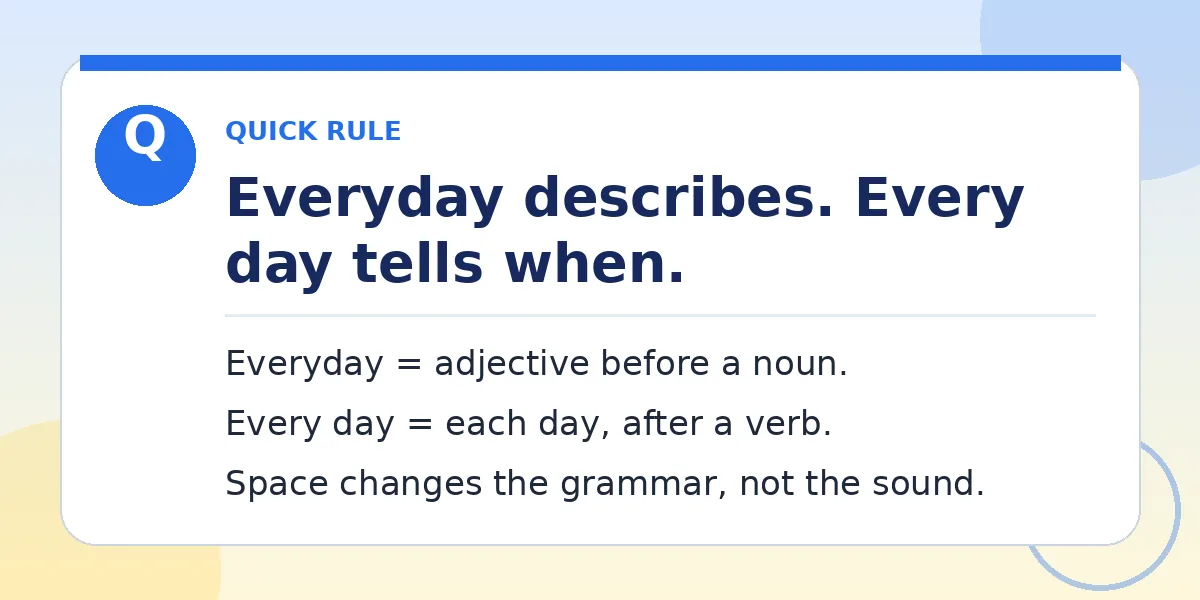
The rule is simple. Use everyday to describe a thing. Use every day to show time.
Examples:
- I wear my everyday shoes to work.
- I walk to work every day.
Table of Contents
- At a Glance
- What Does Everyday Mean?
- What Does Every Day Mean?
- Side-by-Side Comparison
- How to Choose Between Everyday and Every Day
- Where Do Everyday and Every Day Appear in a Sentence?
- How Do You Pronounce Them?
- Common Mistakes
- Is Everyday Hyphenated?
- Related Confused Word Pairs
- Easy Memory Trick
- Practice Questions: Everyday or Every Day?
- Frequently Asked Questions
- Final Takeaway
- Related Guides
At a Glance
| Feature | Everyday | Every day |
|---|---|---|
| Spelling | One word | Two words |
| Grammar | Adjective | Adverbial phrase or noun phrase |
| Meaning | Ordinary or routine | Each day |
| Main question | What kind? | When? Or how often? |
| Typical use | Describes a noun | Shows frequency or names a day |
| Example | Everyday clothes | Exercise every day |
Everyday problems are part of life. We deal with problems every day. Every day brings something new. This at a glance table sums up everyday vs every day in one view.
What Does Everyday Mean?
Everyday Is an Adjective Meaning Ordinary or Routine
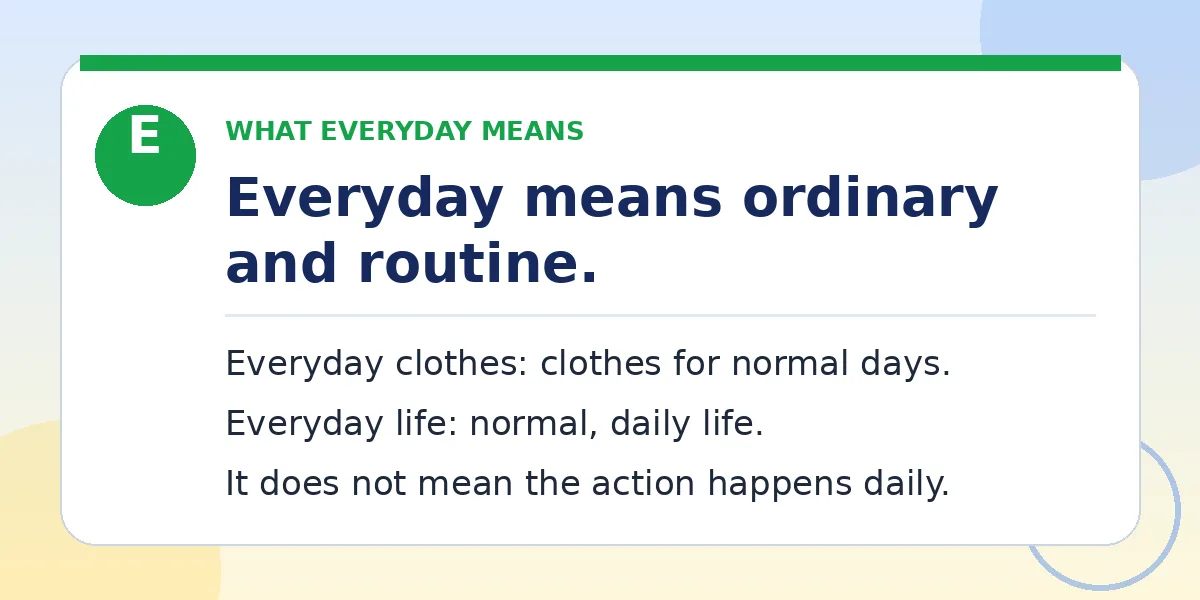
Everyday is a word that means common or regular. It describes a noun. The first half of everyday vs every day is this adjective. It answers the question, “What kind?”
Everyday does not always mean that something happens daily. It means that something is normal or usual.
Merriam-Webster defines everyday as “encountered or used routinely or typically: ordinary.” Its first known use dates to 1628. That history shows how long the word has described normal life.
Examples:
- These are my everyday clothes.
- Cooking is an everyday activity in our home.
- She uses everyday language instead of technical terms.
- The news covered an everyday problem.
Common Everyday Expressions
Many fixed phrases use everyday. These phrases describe normal life, work, and routines.
- Everyday life
- Everyday clothes
- Everyday shoes
- Everyday tasks
- Everyday problems
- Everyday language
- Everyday routine
- Everyday use
- Everyday occurrence
Examples:
- Technology has become part of everyday life.
- These shoes are comfortable enough for everyday use.
- Washing dishes is one of my everyday tasks.
Does Everyday Mean Daily?
No, not always. Everyday can describe something normal even if it does not happen daily. Daily can describe frequency. It can also describe something routine. That overlap makes daily a weak test.
Use the meaning of the sentence. If the word describes a thing, everyday is correct.
What Does Every Day Mean?
Every Day Means Each Day
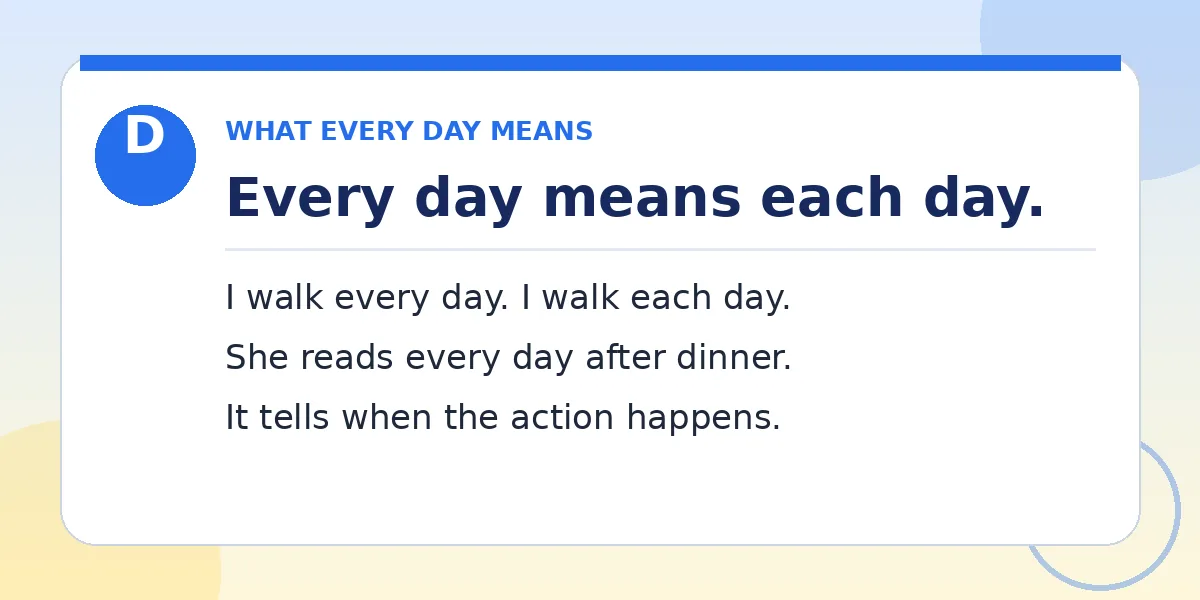
Every day is a phrase with two separate words. It means each day. The second half of everyday vs every day is this time phrase. It often modifies a verb. It answers the question, “When?” or “How often?”
Every day tells us that an action repeats daily. It does not describe a noun.
Examples:
- I read every day.
- She calls her mother every day.
- We practice English every day.
- They walk their dog every day.
Every Day Can Also Be a Noun Phrase
Every day can name a day. In that case, it can act as the subject of a sentence. It still stays as two words.
Examples:
- Every day is different.
- Every day brings a new challenge.
- Every day is a chance to learn something.
Both Forms in Meaning
Everyday describes a thing. Every day describes time. The same topic can use both forms in one sentence.
Example: My everyday routine includes reading, and I follow it every day.
Side-by-Side Comparison
| Everyday | Every day |
|---|---|
| My everyday bag is black. | I carry my bag every day. |
| These are everyday shoes. | I wear these shoes every day. |
| She uses everyday vocabulary. | She studies vocabulary every day. |
| Cooking is an everyday activity. | We cook every day. |
| It is an everyday problem. | This problem occurs every day. |
Pronunciation alone cannot tell you the correct spelling. The two forms sound the same. Meaning and grammar decide the form.
How to Choose Between Everyday and Every Day
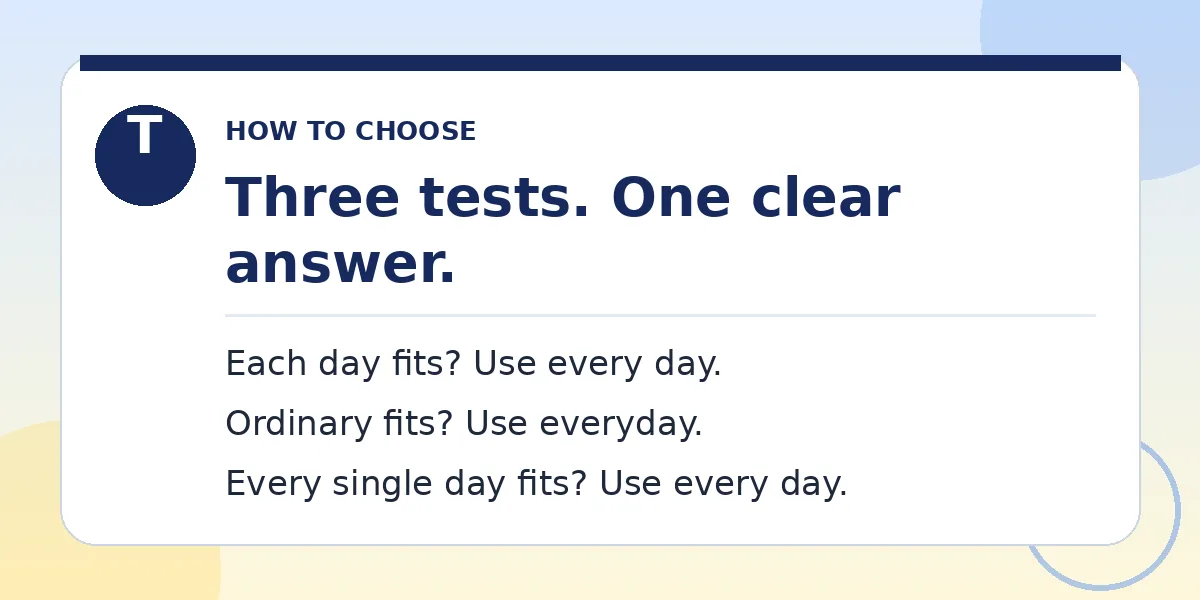
Use three simple tests in order. Each test checks the meaning of the sentence. Use these tests to settle everyday vs every day every time.
Test 1: Try Replacing It With Each Day
Replace the phrase with each day. If the sentence still makes sense, use every day.
Examples:
- I exercise every day. I exercise each day. (Correct)
- I bought everyday shoes. I bought each day shoes. (Incorrect)
This test works well for frequency. It is the first test to try.
Test 2: Insert the Word Single
Insert single after every. If every single day fits, use the two-word form.
Examples:
- We talked every day. We talked every single day. (Correct)
- My everyday habits are simple. My every single day habits are simple. (Incorrect)
This test helps you spot the time phrase. It fails when the meaning is ordinary.
Test 3: Replace Everyday With Ordinary
Replace everyday with ordinary. If the sentence still makes sense, use everyday.
Examples:
- She wears everyday clothes. She wears ordinary clothes. (Correct)
- I practice ordinary. (Incorrect)
This test checks for an adjective. It works when the word describes a noun.
Use the What Kind or When Question
Ask what the sentence needs. What kind? Use everyday. When or how often? Use every day.
This shortcut helps in most cases. Still check the sentence function. Every day can be a subject, not just a time phrase.
Where Do Everyday and Every Day Appear in a Sentence?
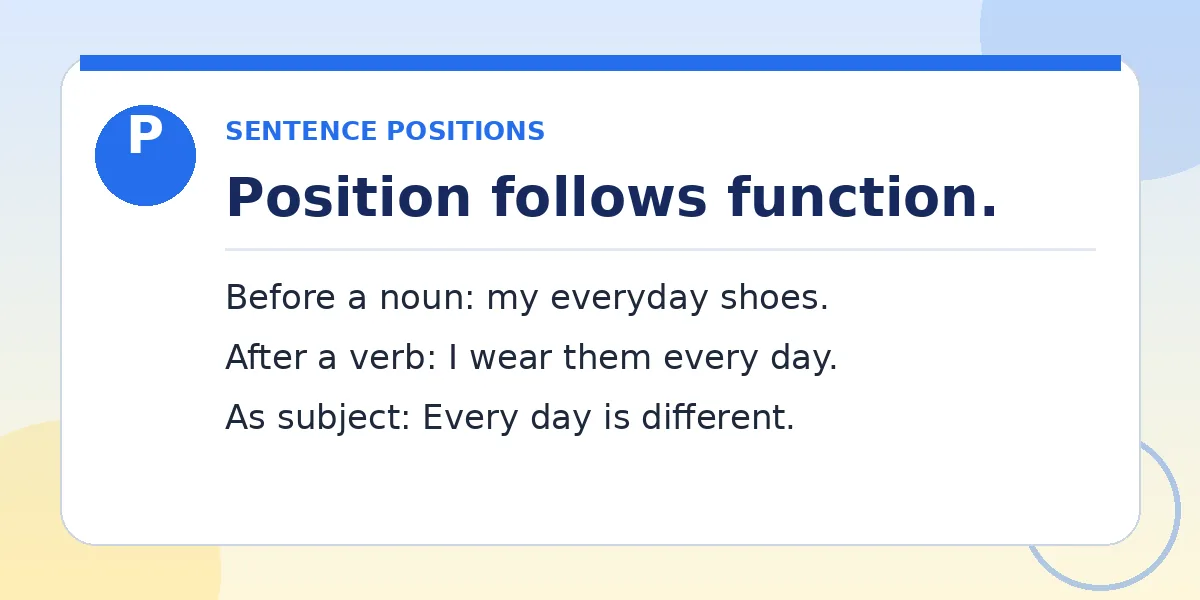
Sentence position gives a strong clue. Each form has a normal place. Some cases break the simple pattern.
Everyday Usually Comes Before the Noun It Describes
Everyday comes before a noun. It may have another adjective after it.
Examples:
- I bought an everyday jacket.
- These are everyday problems.
- She prefers everyday English.
- She wears everyday black shoes.
In the last example, both everyday and black describe shoes. The order does not change the rule.
Every Day Usually Appears After the Verb
Every day often comes after a verb. It shows how often the action happens.
Examples:
- I study every day.
- He exercises every day.
- They communicate every day.
This position is common. It is not the only position.
Every Day Can Appear at the Beginning of a Sentence
Every day can start a sentence. It sets the time for the action.
Examples:
- Every day, I learn something new.
- Every day, she walks to school.
Every Day Can Be the Subject of a Sentence
Every day can be the subject. It still stays as two words.
Examples:
- Every day is a new opportunity.
- Every day brings a different experience.
- Every day matters.
Some guides say every day always modifies a verb. That claim is incomplete. The subject use proves it wrong.
How Do You Pronounce Them?
Both forms sound the same in normal speech. You cannot hear the space. Pronunciation will not settle everyday vs every day. Pronunciation cannot tell you the spelling.
Stress can help as a learning aid. Everyday has stress on the first syllable: EVeryday. Every day has stress on the first and last syllables: every DAY.
Do not rely on stress in real speech. Speakers do not stress the words in a clear way each time. Use meaning and grammar instead.
Common Mistakes
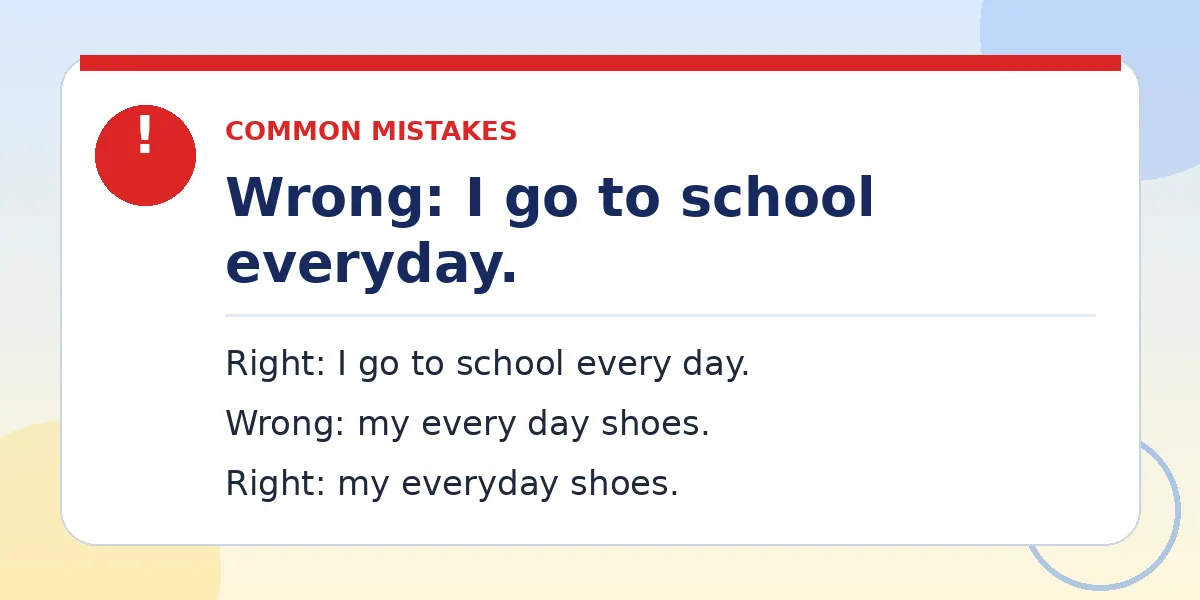
Most everyday vs every day mistakes come from swapping the two forms.
Using Everyday When You Mean Each Day
Incorrect: I brush my teeth everyday.
Correct: I brush my teeth every day.
Using Every Day When You Mean Ordinary
Incorrect: I need my every day shoes.
Correct: I need my everyday shoes.
Assuming Every Day Cannot Be a Subject
Incorrect: Everyday is different.
Correct: Every day is different.
Thinking Both Forms Are Interchangeable
The forms are not interchangeable. Each form has a different job. Changing the form changes the meaning.
Example:
- I wear everyday clothes. (The clothes are ordinary.)
- I wear clothes every day. (I wear clothes each day.)
Choosing Based Only on the Word Daily
Daily is not a clean test. It can fit both meanings in some sentences. Check the intended meaning instead. Ask if the word describes a thing or shows time.
Is Everyday Hyphenated?
No. Modern standard spelling uses everyday as one word. The time phrase stays as every day. Every-day is not the normal modern spelling.
The adjective began as a hyphenated form in the 1600s. Dickens still used the hyphenated form in 1841. The Oxford English Dictionary gives a single-word example from 1868. Modern use has settled on the closed form.
Do not use every-day in normal writing. Use everyday for the adjective. Use every day for the time phrase.
Related Confused Word Pairs
English has other pairs where a space changes meaning. The same space test helps with anytime vs any time, a pair already covered on ClarifyWords. The Related Guides below link only to live ClarifyWords guides.
Easy Memory Trick
If something is ordinary, it is everyday. If something happens each day, it happens every day.
Use this sentence to remember both forms: If you do something every day, it can become an everyday habit.
Practice Questions: Everyday or Every Day?
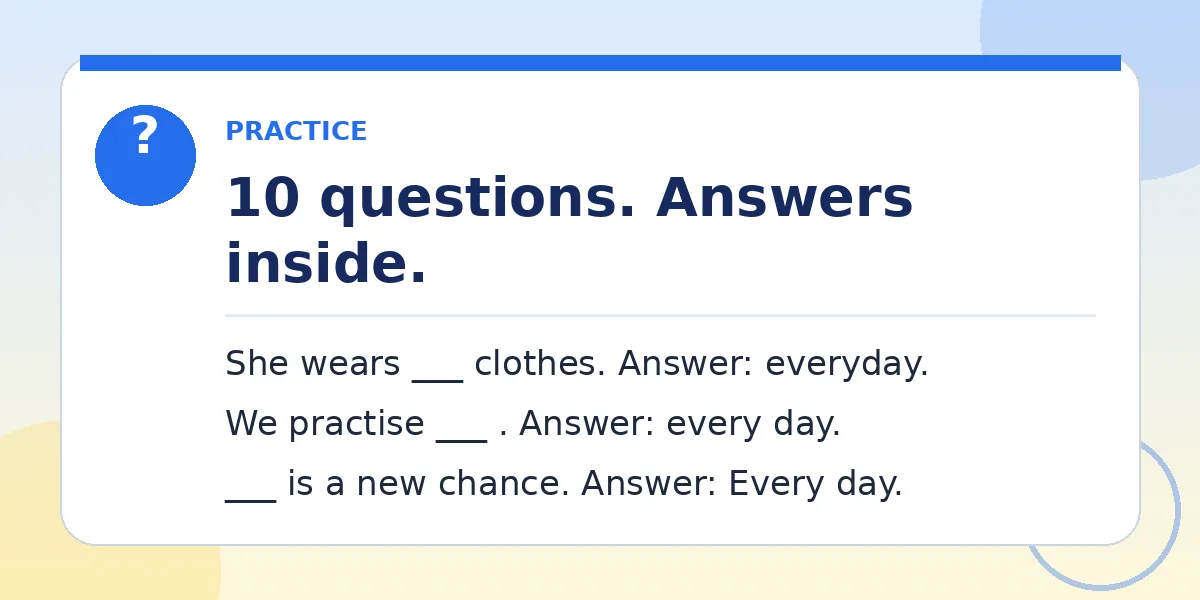
- I drink water ______ to stay healthy.
- These are my ______ shoes.
- She reads for twenty minutes ______.
- Technology is part of ______ life.
- ______ brings a new opportunity.
- We practice English ______.
- He prefers ______ language.
- They discuss their problems ______.
- This is an ______ occurrence.
- ______ is another chance to improve.
Answer Key
- Every day. The sentence shows frequency, so each day fits.
- Everyday. The word describes shoes, so it means ordinary.
- Every day. The sentence shows how often she reads.
- Everyday. The phrase describes life as normal.
- Every day. The phrase acts as the subject.
- Every day. The sentence shows frequency.
- Everyday. The word describes language as simple.
- Every day. The sentence shows how often they discuss problems.
- Everyday. The word describes the occurrence as common.
- Every day. The phrase acts as the subject.
Frequently Asked Questions
1. What Is the Difference Between Everyday and Every Day?
Everyday is an adjective that means ordinary or routine. It describes a noun and usually comes before it. Every day means each day. It often shows how often something happens.
2. How Can I Quickly Tell Whether to Use Everyday or Every Day?
Try each day in place of the phrase. If the sentence still makes sense, use every day. Try ordinary in place of the word. If that fits, use everyday. Start with that test every time.
3. Why Is Everyday One Word and Every Day Two Words?
Everyday is a closed compound adjective. It describes a noun as one unit. Every day is a phrase made of two words. It expresses time, not a single descriptive word.
4. Can Everyday and Every Day Be Used Interchangeably?
No. They have different meanings and different grammar jobs. Everyday describes a noun. Every day shows frequency or names a day. Swapping them changes the meaning. That change can confuse your reader. Keep the grammar job in mind.
5. Is Every-Day With a Hyphen Correct?
No, not in modern standard spelling. Use everyday for the adjective. Use every day for the time phrase. The hyphenated form is historical, not current standard use. Old books may show the hyphenated form.
6. Can Every Day Be the Subject of a Sentence?
Yes. Every day can act as a noun phrase subject. Examples include “Every day is different” and “Every day brings a new opportunity.” It stays as two words. The subject job does not change the spelling.
7. Does the Difference Between Everyday and Every Day Matter in Formal Writing?
Yes. Correct spelling shows care and improves clarity. In school, work, or published writing, the wrong form can confuse readers. Check the meaning before you submit. Readers trust writing that gets small details right.
Final Takeaway
Everyday describes something ordinary. Every day means each day.
Use the everyday vs every day tests before you write. Ask what kind or when. That check will help you choose the right form.