Good or Bad: Meaning, Difference, Examples, and How to Choose
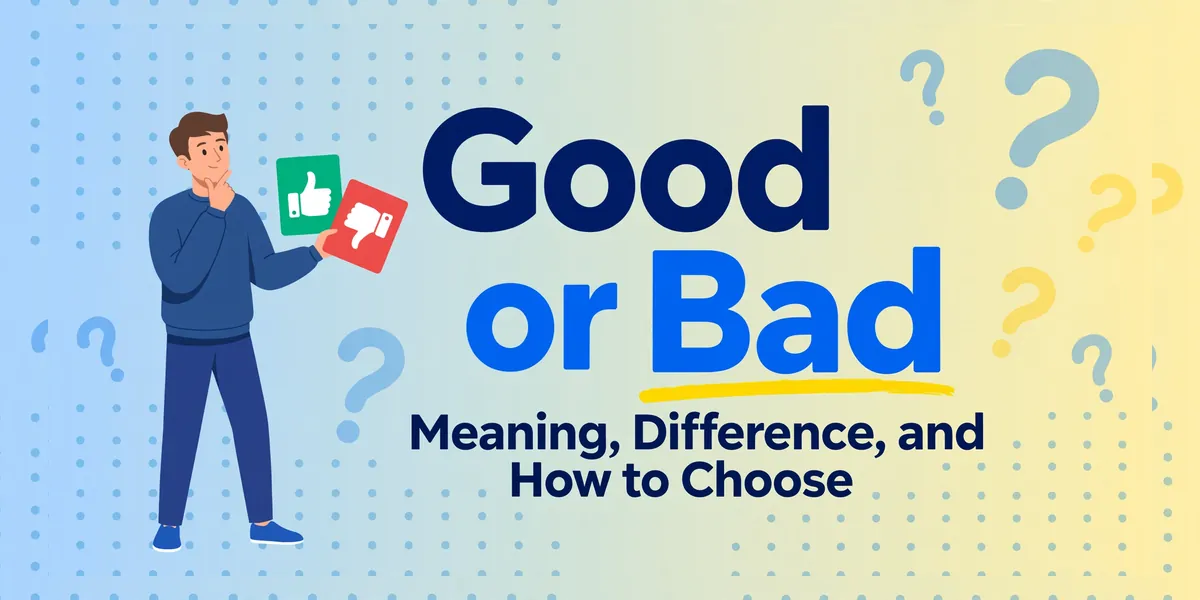
Is something good or bad? The answer is a judgment. Good points to something positive, useful, or of high quality. Bad points to something negative, harmful, or of poor quality. Context decides which sense fits. A good meal can mean tasty food. A good person can mean a kind person. A good plan can mean a plan that works. The same word changes with the thing it describes.
Quick Answer: What Does Good or Bad Mean?
| Word | Basic meaning | Common uses | Example |
|---|---|---|---|
| Good | Positive, suitable, or desirable | Quality, behavior, health, benefit, skill | She made a good choice. |
| Bad | Negative, harmful, or unsuitable | Poor quality, behavior, health, problems | That was a bad choice. |
Use good when something meets a positive standard. Use bad when something falls below that standard. Neither word explains the reason on its own. Add the reason when the reader needs it. That simple habit makes your writing clear. This short guide answers good or bad in full.
Table of Contents
- Good or Bad at a Glance
- What Does Good Mean?
- What Does Bad Mean?
- Good or Bad: Side by Side
- How to Use Good and Bad in Sentences
- The Grammar Trap: Good vs Well and Bad vs Badly
- When Bad Means Good
- Common Phrases With Good and Bad
- The Gray Area: When Something Is Both Good and Bad
- Stronger Words Than Good and Bad
- Common Mistakes With Good and Bad
- An Easy Memory Trick
- Practice Questions: Good or Bad?
- Frequently Asked Questions
- Final Takeaway
Good or Bad at a Glance
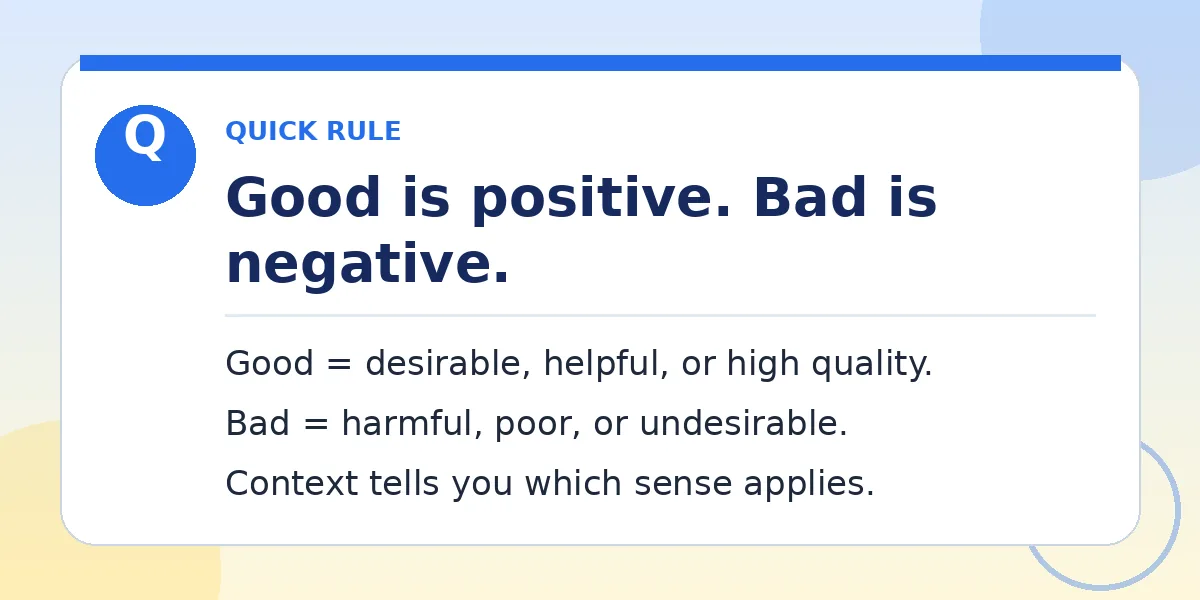
Good and bad are evaluation words. They judge a person, thing, action, or result. They do not describe one fixed quality. Good can praise quality, morals, health, skill, or benefit. Bad can warn about poor quality, harm, illness, or wrong behavior. Ask what is being judged before you choose. Ask what standard it must meet. That pair of questions prevents most confusion.
What Does Good Mean?
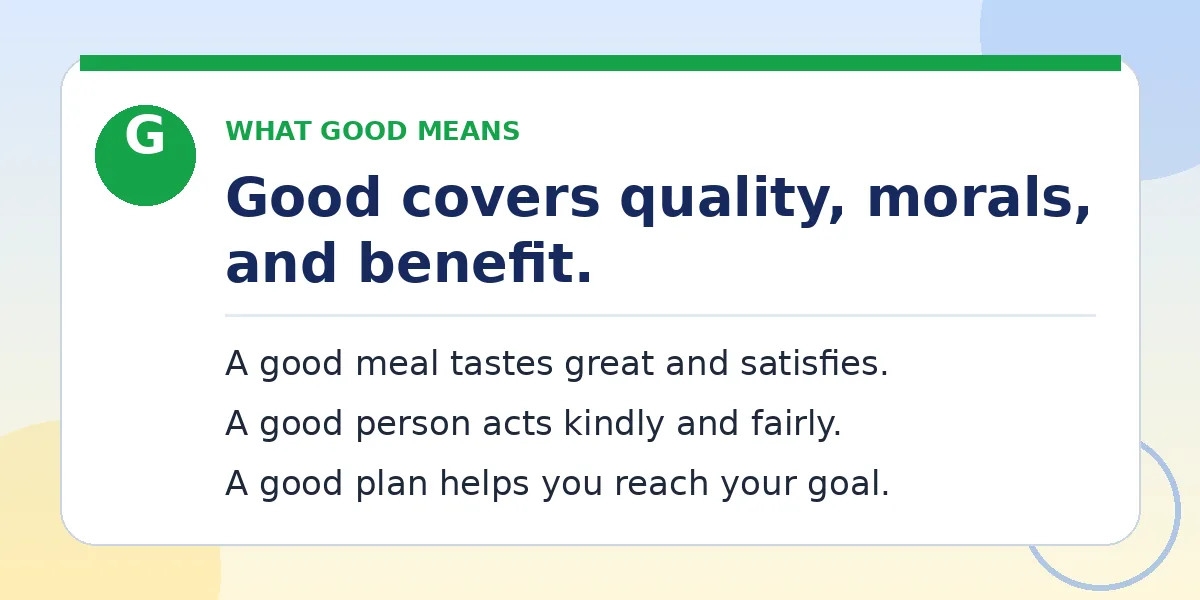
Good is an adjective. Merriam-Webster lists many senses for it. The senses include favorable quality, suitability, benefit, pleasantness, and moral character. The word comes from Old English god. Its basic idea is positive and desirable. The sections below break the senses into clear groups.
Good Means High Quality
Use good when something meets a high or acceptable standard. It can describe food, work, products, services, and experiences.
Examples:
- This is a good book.
- We had a good meal.
- She did a good job on the project.
- The hotel offers good service.
In each case, good shows that expectations were met. It can also show that something pleased the person who used it.
Good Means Morally Right or Kind
Good can describe honest, kind, or fair behavior. It can describe a person who helps others. It can describe an action that does good for a group.
Examples:
- He is a good person.
- She always tries to do good things.
- Helping neighbors is a good deed.
- The teacher was good to her students.
Here, good describes character. It does not describe size, price, or physical quality.
Good Means Beneficial or Healthy
Something can be good because it helps a person or a group. It may support health. It may improve learning. It may help a community.
Examples:
- Walking is good for your health.
- Fresh air is good for plants.
- This change could be good for the community.
- Reading is good for language growth.
The phrase good for you often means beneficial. Its exact sense still depends on context. Good for your health is not the same as good for your budget.
Good Means Skilled or Capable
Good can describe skill, knowledge, or ability. It often appears with at.
Examples:
- She is good at mathematics.
- My brother is good at cooking.
- He is a good doctor.
- They are good with children.
This sense focuses on what a person can do. It does not judge the person’s character.
Good Means Suitable, Correct, or Enough
Sometimes good means suitable for a purpose. It can mean that something still works. It can mean that an answer is acceptable.
Examples:
- Is this time good for you?
- These apples are good for baking.
- The old car is still good for another year.
- Your answer is good enough.
In these sentences, good means appropriate or useful. It does not always mean excellent.
What Does Bad Mean?
Bad is also an adjective. Merriam-Webster lists senses tied to poor quality, harmful effects, unpleasant experiences, immoral behavior, and faulty things. The word comes from Middle English badde. Its origin is obscure. Its basic idea is negative and undesirable. The groups below make the senses easy to tell apart.
Bad Means Poor Quality
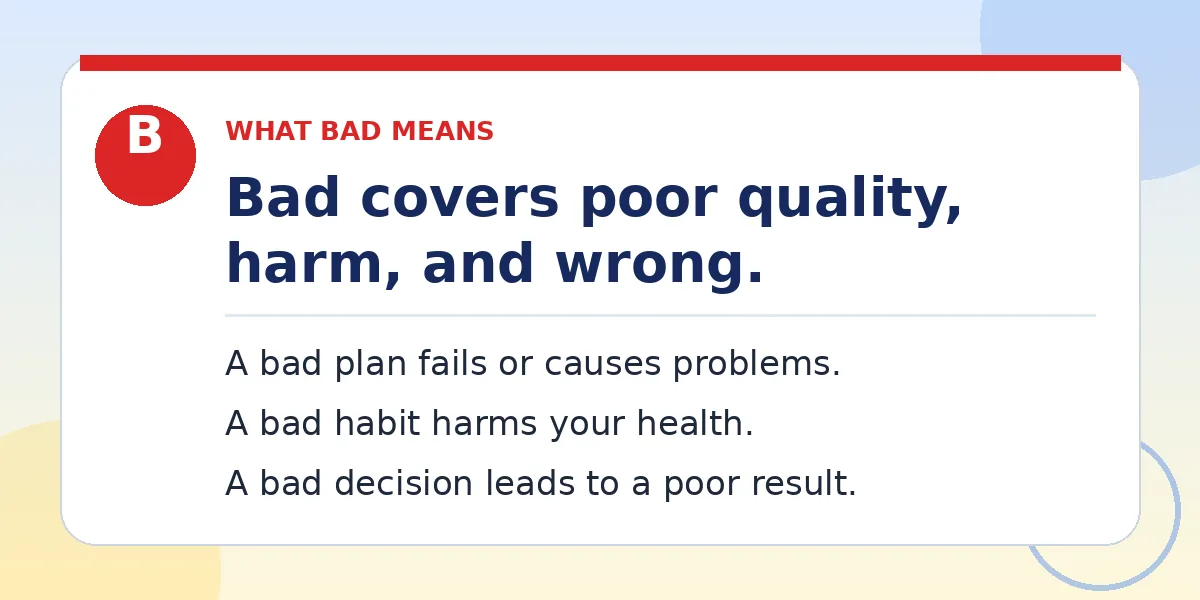
Use bad when something does not meet an expected standard. It can describe products, services, work, food, and experiences.
Examples:
- The restaurant served bad food.
- He received a bad grade.
- This phone has a bad battery.
- The repair job was bad.
In each case, bad means poor or below expectations. It does not always mean harmful. A bad meal can simply taste poor.
Bad Means Morally Wrong or Harmful
Bad can describe dishonest, cruel, or harmful behavior. It can describe actions that hurt others. It can describe actions that cause damage.
Examples:
- Stealing is bad behavior.
- He made a bad decision.
- Lying can have bad results.
- The plan caused bad harm to local shops.
This sense relates to ethics and effects. A bad decision is not always a crime. It can be a choice with poor results.
Bad Describes Health, Feelings, or Condition
Use bad when someone feels unwell. Use it for pain, sadness, or regret. Use it for a damaged or unhealthy condition.
Examples:
- I feel bad about missing the meeting.
- She had a bad headache.
- He has a bad cold.
- The car is in bad condition.
The word can cover body, mood, and state. A bad cold is physical. Feeling bad about a missed meeting is emotional.
Bad Means Spoiled, Unpleasant, or Unsuitable
Something can be bad when it is no longer fresh. It can be bad when it cannot serve its purpose. It can be bad when timing or results are unwanted.
Examples:
- The milk smells bad.
- We had bad weather during the trip.
- That was a bad time to call.
- The plan was bad for the business.
Here, bad describes an unwanted quality or result. Context tells you whether freshness, timing, or outcome is the issue.
Bad Means Incorrect or Faulty
Bad can describe mistakes, errors, and faulty work. It can describe information that does not follow accepted rules.
Examples:
- The student used bad grammar.
- This is a bad translation.
- The report contains bad information.
- He made a bad calculation.
In these cases, bad means incorrect or unsuitable. A bad translation may still be readable. It fails the standard for accuracy.
Good or Bad: Side by Side
The difference is clearest in paired sentences. The same frame can hold either word. The judgment changes, but the topic stays the same.
| Situation | Good | Bad |
|---|---|---|
| Quality | A good product | A bad product |
| Character | A good person | A bad person |
| Behavior | Good behavior | Bad behavior |
| Benefit | Good for your health | Bad for your health |
| Feelings | I feel good today. | I feel bad today. |
| Skill | She is good at writing. | She is bad at writing. |
| Condition | The house is in good condition. | The house is in bad condition. |
| Results | A good outcome | A bad outcome |
| Suitability | A good choice | A bad choice |
Good usually signals a positive result or quality. Bad usually signals a negative one. Neither word explains the reason by itself. A long commute may be bad for free time. It may be good for access to a better job. The reason matters more than the label.
How to Use Good and Bad in Sentences
Both words appear in daily talk, school work, and professional writing. The right choice depends on meaning and context. The examples below show common settings.
At School
Use good for positive performance. Use bad for poor performance.
- She received a good grade on her test.
- He made a bad mistake in his essay.
- The class had a good discussion.
- The student showed bad study habits.
At Work
These words can describe performance, decisions, results, and conditions.
- Our team completed a good project.
- The company made a bad investment.
- She has good communication skills.
- Poor planning led to a bad result.
Food and Health
Use good for something beneficial, fresh, or enjoyable. Use bad for something harmful, spoiled, or unpleasant.
- Vegetables are good for a balanced diet.
- The milk has gone bad.
- I ate a good breakfast.
- Too little sleep can be bad for your health.
Weather and Daily Life
The same weather or event can affect people in different ways.
- Sunny weather is good for a picnic.
- Heavy rain is bad for outdoor plans.
- A quiet morning is good for studying.
- Traffic was bad this morning.
Asking Whether Something Is Good or Bad
You can use the pair to ask for a judgment.
- Is this decision good or bad for students?
- Was it bad to leave early?
- Is this a good time to visit?
- Is the new rule good for safety?
Such a question often needs more context. Ask what standard matters before you judge. Ask who gains and who loses.
The Grammar Trap: Good vs Well and Bad vs Badly
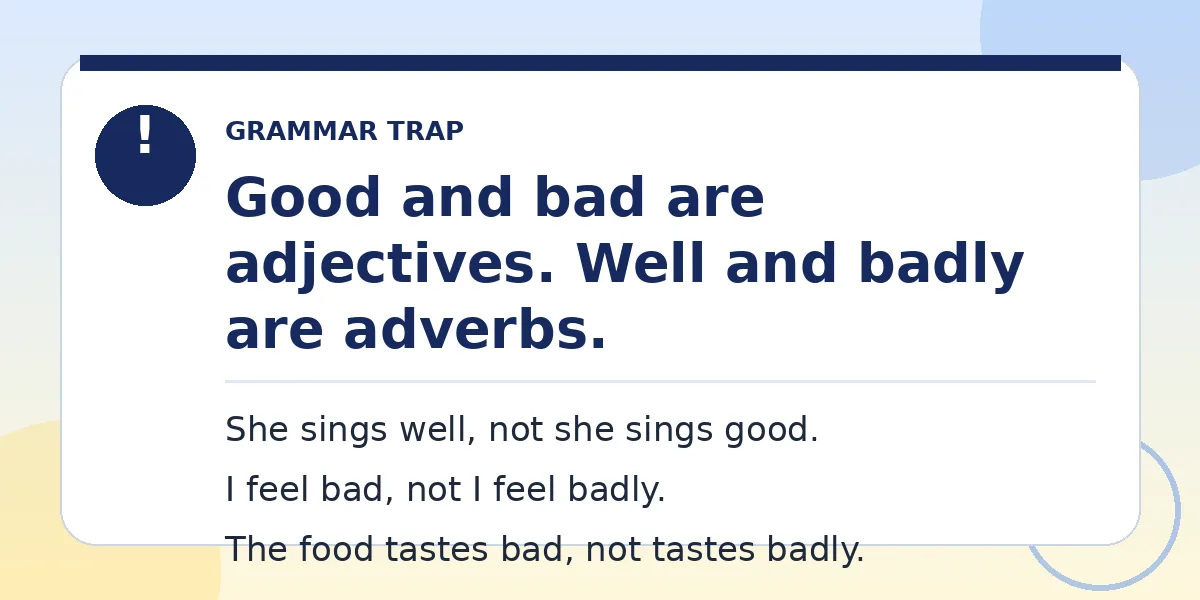
This trap causes many errors. Good and bad usually work as adjectives. Well and badly usually work as adverbs. Adjectives describe nouns and pronouns. Adverbs usually describe verbs, adjectives, and other adverbs. Purdue OWL gives this basic rule for adjectives and adverbs.
Good Is an Adjective, Well Is Usually an Adverb
Use good to describe a person, place, thing, or experience. Use well to describe how someone performs an action.
| Correct sentence | Why it works |
|---|---|
| She is a good singer. | Good describes the noun singer. |
| She sings well. | Well describes the action sings. |
| He writes good essays. | Good describes the noun essays. |
| He writes well. | Well describes the action writes. |
Cambridge Dictionary also notes that good is an adjective and well is generally an adverb. The rule is simple in most cases. Describe a thing with good. Describe an action with well.
Bad Is an Adjective, Badly Is Usually an Adverb
Use bad to describe a person, thing, or condition. Use badly to describe how an action happens.
| Correct sentence | Why it works |
|---|---|
| That was a bad performance. | Bad describes the noun performance. |
| He performed badly. | Badly describes the action performed. |
| The food smells bad. | Bad describes the smell of the food. |
| She played badly. | Badly describes how she played. |
Linking Verbs Take Adjectives
Linking verbs connect a subject to a word that describes it. Common linking verbs include be, feel, look, smell, taste, and seem. Use an adjective after these verbs when it describes the subject.
Examples:
- The soup tastes good.
- The room smells bad.
- She looks good today.
- He feels bad about the mistake.
The adjective describes the subject. It does not describe the action of tasting, smelling, or feeling.
Feel Good vs Feel Well
Both I feel good and I feel well are correct. They can carry slightly different meanings. I feel good can describe mood or general wellbeing. I feel well usually stresses physical health. In American English, people often say feel good for mood or general health. Merriam-Webster accepts both forms after the linking verb feel.
Feel Bad vs Feel Badly
Use feel bad for sadness, regret, or discomfort.
Examples:
- I feel bad about forgetting your birthday.
- She feels bad after hearing the news.
- He felt bad because he missed the appointment.
Feel badly can suggest trouble feeling through touch. That is not the usual meaning in daily speech. In formal writing, use feel bad for an emotional state.
Want It Bad vs Want It Badly
Both forms appear in English, but their style differs. I want this job badly is the standard choice in formal writing. I want this job bad is informal and conversational. For school work and professional writing, choose badly when you mean very much. Merriam-Webster usage notes treat bad as acceptable after want and need in speech. Other guides still prefer badly in formal writing. This guide follows the formal choice.
When Bad Means Good
Sometimes bad has a positive meaning in informal English. It can mean excellent, impressive, or very good. Merriam-Webster lists this slang sense as great.
Examples:
- That singer is bad, in the best way.
- He is the baddest player on the team, in slang only.
- That car looks bad, and I mean it as praise.
Use this sense with care. The listener must grasp the tone and context. It is unsuitable for formal essays, business reports, or academic writing. In formal writing, use excellent, impressive, or skilled instead.
What Does Not Bad Mean?
Not bad usually means fairly good or better than expected. It expresses mild approval, not strong excitement.
Examples:
- The movie was not bad.
- Your talk was not bad at all.
- The weather is not bad today.
Tone matters here too. Not bad can sound polite. It can also sound faint in praise. Add detail when you want clear praise.
Common Phrases With Good and Bad
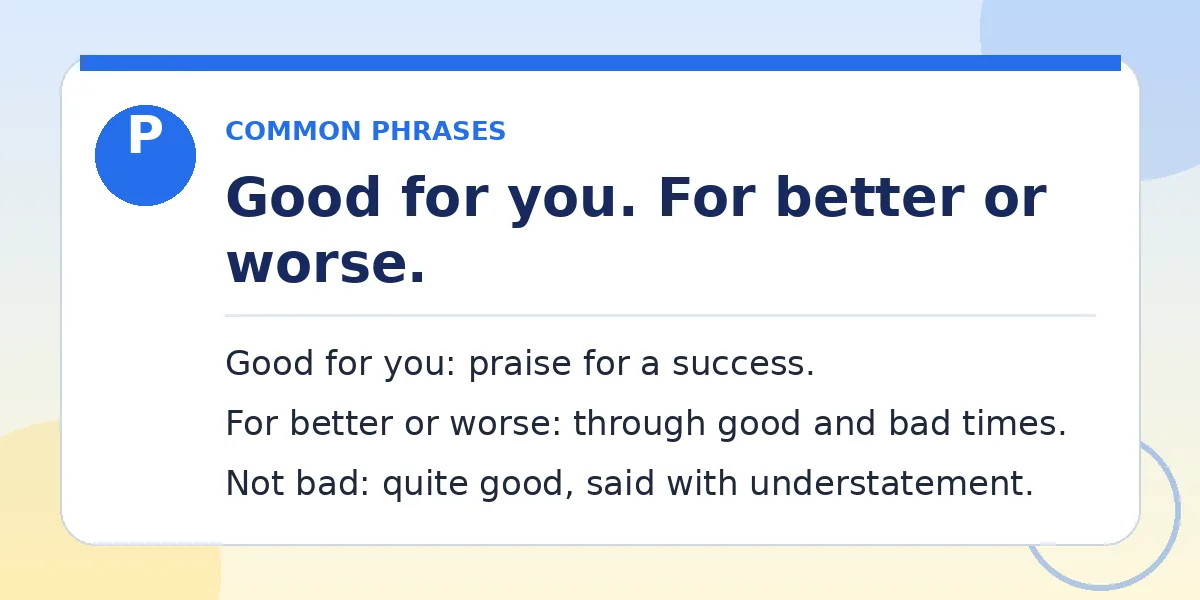
These phrases appear often in everyday American English. Their meanings can differ from the single words alone.
| Phrase | Meaning | Example |
|---|---|---|
| Good for you | Beneficial, or praise for success | Regular exercise is good for you. |
| For better or worse | Whatever results happen, positive or negative | We will support the choice for better or worse. |
| Make the best of a bad situation | Improve an unpleasant situation as much as possible | We made the best of a bad situation. |
| As good as new | Almost the same condition as before | The repaired bike is as good as new. |
| Good news | News that brings a positive result | I have good news about your application. |
| Bad news | News that brings an unwanted result | The delay was bad news for the team. |
| The good and the bad | The positive and negative parts of something | Every job has its good and bad sides. |
| Bring out the best in someone | Help someone show strong qualities | A kind teacher can bring out the best in students. |
Learn phrases as whole units. A word by word reading can mislead you. For better or worse is a promise to accept results. Good for you can praise a person or state a benefit.
The Gray Area: When Something Is Both Good and Bad
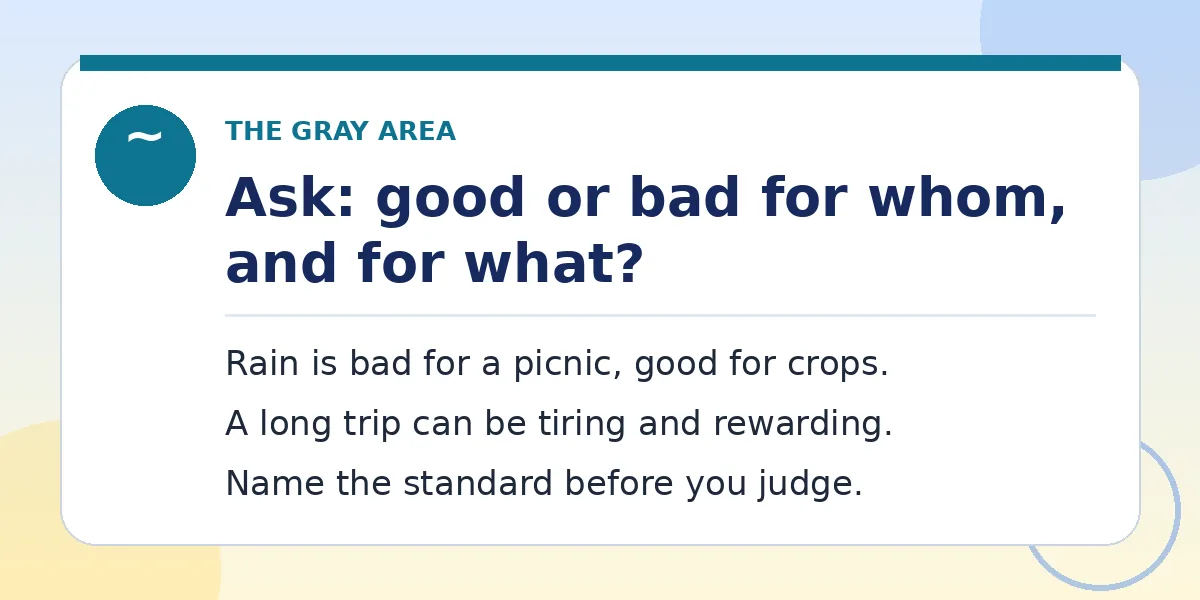
Not every case has a clear answer. Something can be good in one way and bad in another. The result often depends on purpose, person, or standard.
Rain is good for crops because plants need water. Rain is bad for a picnic because it may ruin outdoor plans. A long commute may be bad because it takes time. It may be good if the job offers better pay or valuable experience. Honest feedback can be good because it helps a person improve. It can feel bad because criticism may hurt. The case has not changed. The purpose or view has changed.
Three Questions to Help You Decide
When you are unsure, ask these questions:
- Good or bad for whom? One person may gain while another loses.
- Good or bad for what purpose? A choice may work for one goal but fail for another.
- Good or bad by which standard? Quality, fairness, usefulness, and taste can lead to different answers.
Also note that good and bad do not always mean right and wrong. A choice can be useful without being morally right. A person can make a mistake without being a bad person. Keep the moral sense separate from the practical sense when you judge.
Stronger Words Than Good and Bad
Good and bad are useful, but they can be too general. When good or bad feels too vague, pick a precise word. A precise word tells the reader exactly what you mean. Choose a synonym based on the quality you want to describe.
| Meaning | Alternatives for good | Alternatives for bad |
|---|---|---|
| Quality | Excellent, high quality, superior | Poor, inferior, defective |
| General approval | Great, wonderful, impressive | Awful, terrible, disappointing |
| Benefit | Helpful, useful, beneficial | Harmful, damaging, unhealthy |
| Morality | Honest, kind, ethical | Cruel, dishonest, immoral |
| Feelings | Pleasant, enjoyable, satisfying | Unpleasant, upsetting, miserable |
| Skill | Skilled, capable, talented | Unskilled, weak, incompetent |
| Suitability | Suitable, appropriate, fitting | Unsuitable, inappropriate, unfit |
How to Choose the Right Synonym
Think about the meaning before you replace the word. Use excellent for very high quality. Use beneficial for an advantage. Use ethical for behavior that follows moral rules. Use poor for a result below standard. Use harmful for damage. Use inappropriate for a poor fit. A precise word makes writing clear. It stops the reader from guessing your meaning.
Common Mistakes With Good and Bad
- Using good instead of well. Incorrect: She sings good. Correct: She sings well. Well describes how she performs the action.
- Using feel badly for sadness. Incorrect: I feel badly about the argument. Correct: I feel bad about the argument. Feel is a linking verb here.
- Using smells badly for an odor. Incorrect: The milk smells badly. Correct: The milk smells bad. Bad describes the smell of the milk.
- Using badder in formal writing. Incorrect: This is the badder option. Better: This is the worse option. The standard comparative is worse. The standard superlative is worst. Badder and baddest appear in slang only.
- Calling something good or bad with no reason. Unclear: The decision was bad. Clearer: The decision was bad because it raised costs and delayed the project. Add context when the reader needs the reason.
An Easy Memory Trick
Good means thumbs up. Bad means thumbs down. Then ask one more question: For what? Something can be good for one purpose and bad for another. A clear reason makes your judgment easy to grasp. For grammar, recall this set: Good describes a person or thing. Well usually describes an action. Bad describes a person, thing, or condition. Badly usually describes an action.
Practice Questions: Good or Bad?
Choose the correct answer. Check the key after you finish.
- The students received ______ grades on their final exams. A. good B. badly
- She plays the piano very ______. A. good B. well
- I feel ______ about missing the family dinner. A. bad B. badly
- The milk smells ______. Do not drink it. A. bad B. badly
- Walking often is ______ for your health. A. good B. bad
- He made a ______ decision because he ignored the warning. A. good B. bad
- The team performed ______ during the final match. A. good B. badly
- In informal slang, bad can sometimes mean ______. A. excellent B. harmful
- Rain can be ______ for crops but ______ for an outdoor picnic.
- Which sentence is correct? A. She is a good writer. B. She is a well writer.
Answer Key
- A. Good describes the noun grades.
- B. Well describes how she plays the piano.
- A. Bad describes an emotional state after feel.
- A. Bad describes the smell of the milk.
- A. Good. Walking can give health benefits.
- B. Bad. Ignoring a warning led to a poor choice.
- B. Badly describes how the team performed.
- A. Excellent. This is an informal slang sense.
- Good, then bad. Rain helps crops but may spoil picnic plans.
- A. Good describes the noun writer.
Frequently Asked Questions
What Is the Difference Between Good and Bad?
Good describes something positive, useful, suitable, or morally right in context. Bad describes something negative, harmful, unsuitable, or morally wrong. Context decides which sense fits each case. The sense always follows the thing judged.
Is Good Always the Opposite of Bad?
Usually, good and bad express opposite judgments, but the best opposite still depends on context and sense. For quality, the opposite of good may be poor. For health, it may be harmful.
Should I Say I Feel Good or I Feel Well?
Both forms are correct after the linking verb feel in standard English usage. I feel good often covers mood or general wellbeing, while I feel well usually stresses physical health more clearly.
Is It Feel Bad or Feel Badly?
Use feel bad when you describe sadness, regret, or physical discomfort in normal speech and writing. Feel is a linking verb here, so the adjective bad correctly describes the subject, not an action.
What Are Some Synonyms for Good and Bad?
Good can mean excellent, helpful, beneficial, pleasant, or suitable, depending on the sense you intend to express. Bad can mean poor, harmful, unpleasant, unsuitable, or immoral, depending on context and the standard you apply.
Can Bad Mean Good in Slang?
Yes, in informal English bad can describe someone or something impressive, talented, or excellent in tone and context. Do not use this slang sense in formal writing, where excellent or impressive will read clearly and safely.
What Does For Better or Worse Mean?
For better or worse means accepting a decision or situation whatever results follow, positive or negative alike. People use it to promise support through both easy times and hard times, without knowing the final outcome.
Final Takeaway
Good and bad are common adjectives with several meanings. Good usually describes something positive, useful, suitable, or morally right. Bad usually describes something negative, harmful, unsuitable, or morally wrong. The right word depends on what you describe and the standard you use. When unsure, name the purpose and explain your reason. For precise writing, choose a stronger and more specific word.