Choose or Chose: What’s the Difference?
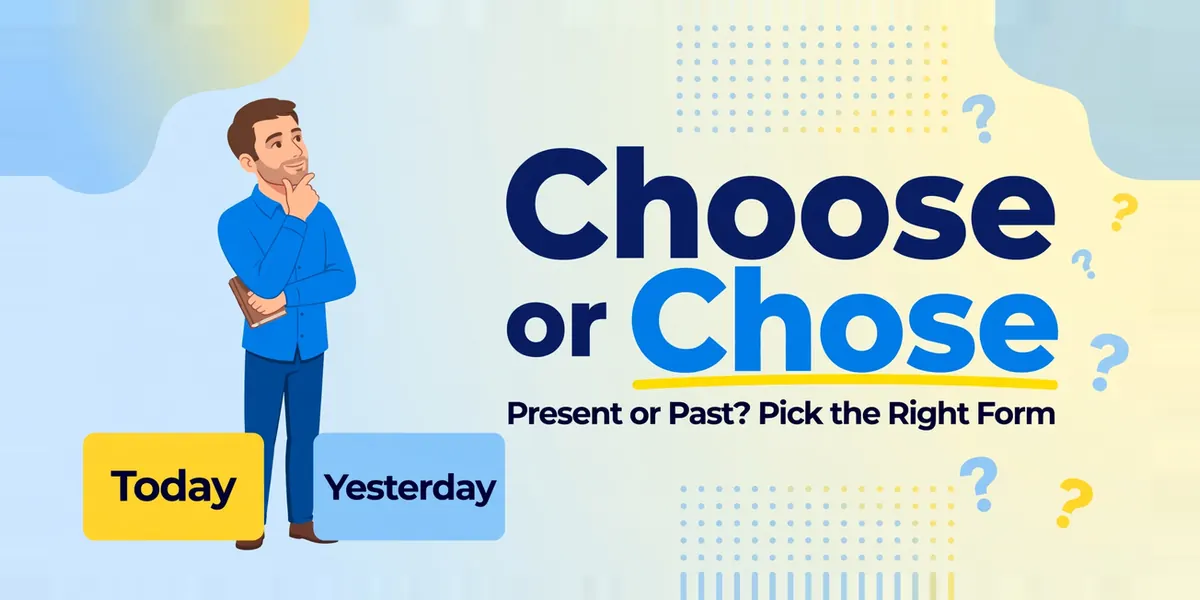
Choose is the present tense and base form of the verb. Chose is its simple past tense. Use chosen as the past participle. Use choosing for an action in progress or as a gerund.
- Choose: I usually choose the window seat.
- Chose: I chose the window seat yesterday.
- Chosen: I have chosen the window seat.
Many writers ask about choose or chose when they edit a sentence. The right form depends on the sentence’s tense and helping verb. This guide explains all five forms, the rules for did, made, and modal verbs, and the most common mistakes.
Table of Contents:
- Choose, Chooses, Chose, Chosen, and Choosing: Full Verb Forms.
- When to Use Choose.
- When to Use Chose.
- When to Use Chosen.
- The Did and Made Rule.
- The Modal Verb Rule.
- Chose vs. Have Chosen.
- Choose vs. Choice.
- Pronunciation and Memory Tricks.
- Common Mistakes.
- Similar Irregular Verbs.
- Practice Questions and Answer Key.
- Frequently Asked Questions.
- Final Takeaway.
Choose, Chooses, Chose, Chosen, and Choosing: Full Verb Forms
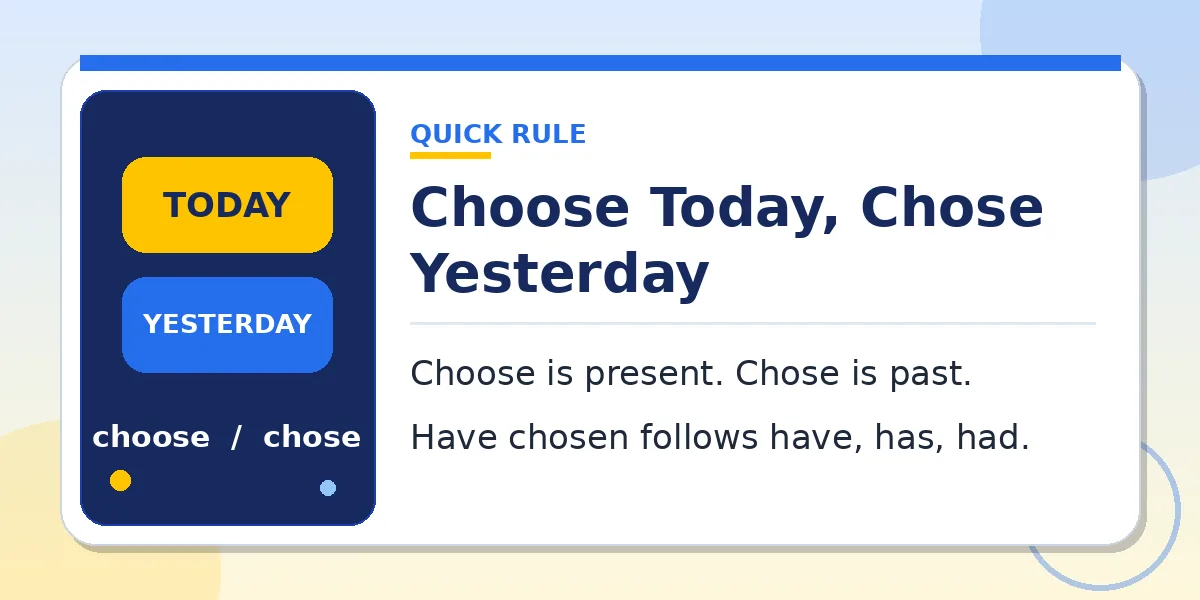
Choose is an irregular verb. It means to select something or decide what you want. Unlike regular verbs, it does not form its past tense by adding -ed. Its main forms are choose, chooses, chose, chosen, and choosing.
| Verb form | Grammatical use | Example |
|---|---|---|
| Choose | Base form and present tense | I choose the blue shirt. |
| Chooses | Third-person singular present | She chooses the blue shirt. |
| Chose | Simple past tense | She chose the blue shirt yesterday. |
| Chosen | Past participle | She has chosen the blue shirt. |
| Choosing | Present participle and gerund | She is choosing a shirt. |
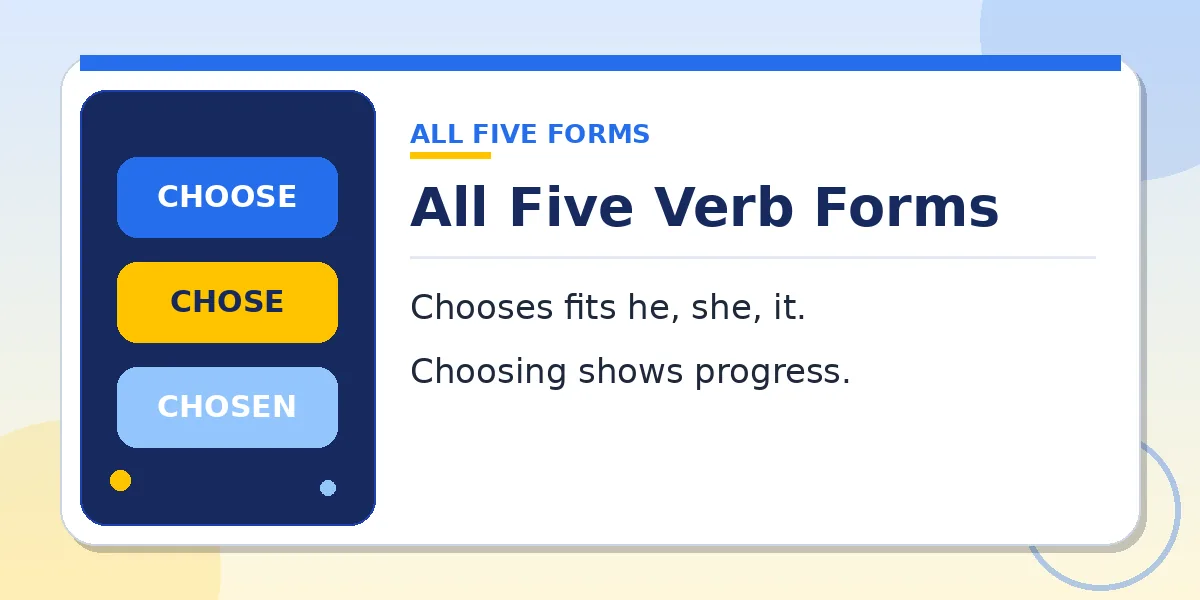
The key distinction is between chose and chosen. Chose is the simple past form. Chosen is the past participle. Chose does not need a helping verb. Chosen usually appears with have, has, had, or a form of be.
Choose
Use choose as the base form of the verb. It appears with I, you, we, and they in the simple present. Examples: I choose my clothes the night before. You can choose any available seat. We choose a different topic each week. They choose their own schedules. Please choose one answer. Use choose after to when forming an infinitive. I want to choose a new laptop. She needs to choose a college. They decided to choose another route.
Chooses
Use chooses with a singular third-person subject in the simple present. These subjects include he, she, it, and singular nouns. Examples: He chooses his words carefully. My sister chooses the restaurant. The manager chooses the final candidate. This store chooses its products carefully. The ending changes because of subject and verb agreement. Do not use chooses with I, you, we, or they.
Chose
Chose is the simple past tense of choose. Use it for a decision that happened in the past. Examples: I chose the smaller apartment last year. She chose a different career. We chose the earlier flight. They chose to stay home. He chose the red folder yesterday. The form stays the same with every subject. You write I chose, she chose, and they chose. You do not add an -s for a singular subject.
Chosen
Chosen is the past participle of choose. It usually appears with a helping verb, such as have, has, or had. Examples: I have chosen a new password. She has chosen her favorite design. They had chosen a date before the meeting. We have chosen the best available option. Use chosen in passive sentences, too. The winner was chosen by the judges. A new team leader will be chosen tomorrow. The location has been chosen. Chosen can also describe a noun. The chosen candidate accepted the offer. We reviewed the carefully chosen examples. Her chosen career requires years of training.
Choosing
Choosing is the present participle of choose. Use it in continuous verb forms. Examples: I am choosing a gift for my friend. She was choosing a dress when I called. They are choosing a new team captain. We will be choosing our seats soon. Choosing can also work as a gerund. A gerund acts as a noun in a sentence. Choosing a career takes time. I enjoy choosing gifts for others. Careful choosing can prevent mistakes.
When to Use Choose
If you are deciding between choose or chose for a present action, use choose. Use choose when the sentence needs the base form or present tense. The subject and helping verb determine the correct form.
For present decisions: Use choose for decisions made now or general preferences. I choose tea instead of coffee. You choose the movie tonight. We choose healthy meals most days. They choose their own learning methods.
For habits and repeated actions: Use choose when describing a regular action. I choose a different book every month. We choose a new restaurant each Friday. They choose their seats before class. For he, she, or a singular noun, use chooses instead. She chooses a new book every month. My brother chooses the same meal each time.
For future decisions: Use choose after future expressions such as will and going to. I will choose a color tomorrow. She will choose her college next week. We are going to choose a new supplier. They will choose the final design later. Do not write will chose. The word after will must use its base form.
After modal verbs: Modal verbs include can, could, should, would, must, may, and might. Use choose after these verbs. You should choose your words carefully. I can choose either option. They might choose another location. She could choose to leave early. We must choose a team leader.
After do and does: Use choose after do and does in questions and negative sentences. Do you choose your own schedule? Does he choose the music? I do not choose the final winner. She does not choose the menu. The helping verb carries the tense and subject agreement. The main verb stays in its base form.
When to Use Chose
For a past action, choose or chose is settled by chose. Use chose when someone made a decision in the past. It is the simple past form of choose.
For completed past decisions: I chose the blue jacket. She chose a new apartment. They chose the winning design. We chose to travel by train. These decisions happened before the present moment.
With past time expressions: Words that point to a finished past time often appear with chose. I chose that option yesterday. She chose her major last year. We chose the venue two weeks ago. They chose a different route in 2024. A past time expression alone does not determine the verb form. The helping verb still matters. Correct: Why did you choose that option yesterday? Incorrect: Why did you chose that option yesterday?
For past habits: Chose can describe repeated decisions in the past. Example: As a child, he chose the same toy every time. However, used to choose may sound more natural when describing a habit that has stopped. Example: As a child, he used to choose the same toy every time.
With choose to + verb: Use the base form of another verb after choose to or chose to. I choose to study every evening. She chose to wait outside. They chose to change their plans. He chose to leave early. Do not write chose to went. The correct form is chose to go.
When to Use Chosen
The choose or chose question often hides a third form, chosen. Use chosen as the past participle of choose. It appears in perfect tenses and passive constructions.
With have, has, and had: Use chosen after these helping verbs. Have: I have chosen a new course. Has: She has chosen her favorite song. Had: They had chosen a date before the meeting. These combinations are correct: I have chosen. He has chosen. We had chosen. These combinations are incorrect: I have chose. He has chose. We had chose.
In passive voice: Use chosen after a form of be when someone or something receives the action. The winner was chosen by the judges. She was chosen for the position. The final design has been chosen. A new director will be chosen soon.
As an adjective: Chosen can describe someone or something selected for a purpose. The chosen applicant received an email. We discussed the chosen topic. The carefully chosen words made the message clear.
The Did and Made Rule: Why It Is “Did Choose,” Not “Did Chose”
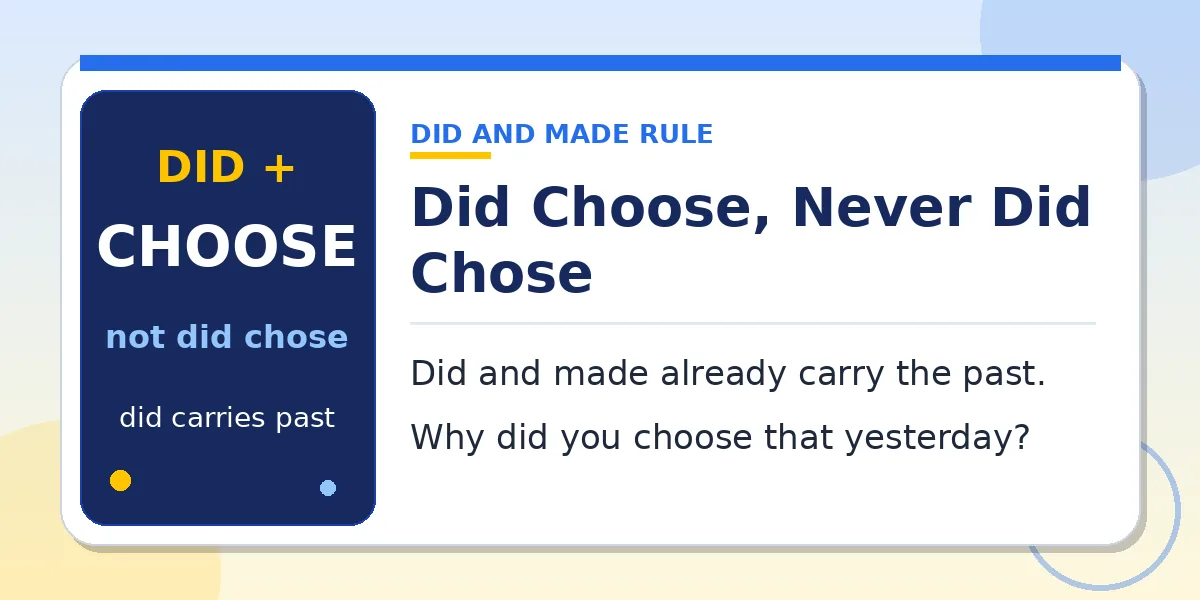
The did rule is a common trap in choose or chose. One common mistake is using chose after did or made. The correct form is choose. The reason is simple. The helping verb already carries the past tense.
Did + choose: Use choose after did in questions and negative sentences.
| Correct | Incorrect |
|---|---|
| Did you choose this one? | Did you chose this one? |
| Why did she choose that name? | Why did she chose that name? |
| I did not choose this option. | I did not chose this option. |
| They did not choose a winner. | They did not chose a winner. |
Even when a sentence includes yesterday or last week, the rule stays the same. Correct: Why did you choose this option yesterday? Incorrect: Why did you chose this option yesterday?
Made + choose: The same base form rule applies after made. What made you choose this career? The price made her choose another product. His advice made them choose a safer route. Compare: She chose a different career yesterday. What made her choose a different career yesterday? In the first sentence, chose carries the past tense. In the second, made carries it.
The Modal Verb Rule: Use Choose After Modals
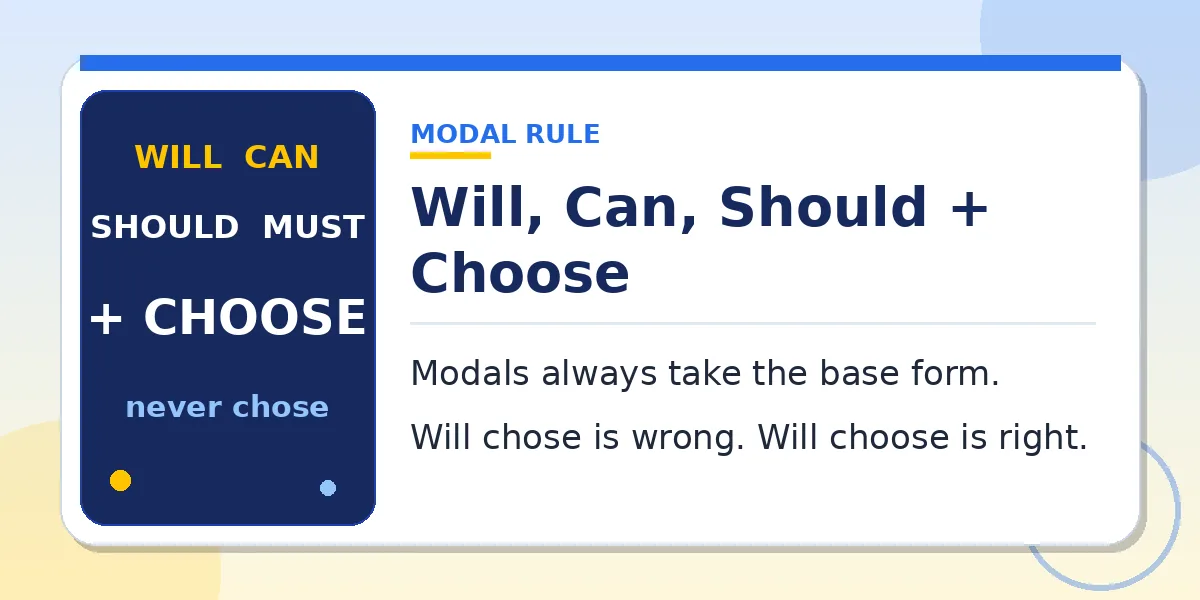
Modals also settle choose or chose in favour of choose. Modal verbs express ability, possibility, advice, or necessity. They include will, can, could, should, would, must, may, and might. Always use the base form choose after a modal. Will: I will choose tomorrow. Can: You can choose either one. Could: She could choose another option. Should: We should choose carefully. Would: He would choose the blue car. Must: They must choose today. May: You may choose your partner. Might: I might choose a different date. Do not use chose or chosen directly after a modal. Incorrect: I will chose the red one. Correct: I will choose the red one. Incorrect: She might have chose the wrong answer. Correct: She might have chosen the wrong answer. Notice the second correction. The phrase might have takes the past participle chosen.
Chose vs. Have Chosen: What Is the Difference?
This section separates choose or chose from have chosen. Both forms describe decisions made in the past. However, they use different tenses. Chose is the simple past. Have chosen is the present perfect.
| Form | When to use it | Example |
|---|---|---|
| Chose | A completed past action | I chose a major last year. |
| Have chosen | A past decision connected to the present | I have chosen my major. |
| Has chosen | Present perfect with a singular subject | She has chosen a new course. |
| Had chosen | A decision completed before another past event | They had chosen before the meeting. |
Use chose when you place the decision at a finished time. I chose this phone yesterday. She chose her college in May. We chose the blue design last week. Use have chosen when the decision matters to the present. You do not need to name a finished past time. I have chosen a new phone. She has chosen her college. We have chosen the blue design. The present perfect does not always mean the decision is permanent. It connects a past action to the present.
Choose vs. Choice: Verb or Noun?
Choose is a verb. Choice is a noun. They are related, but they have different jobs in a sentence.
| Word | Part of speech | Meaning | Example |
|---|---|---|---|
| Choose | Verb | To select or decide | Please choose a seat. |
| Chose | Verb | Selected in the past | I chose the front seat. |
| Chosen | Past participle | Selected | The chosen seat is near the window. |
| Choice | Noun | An act, option, or decision | That was a difficult choice. |
Use choice when you need a noun. You have a choice between two colors. It was my first choice. Making a choice can be difficult. We have no choice but to wait. The final choice belongs to you. Common expressions include make a choice, have a choice, first choice, and multiple-choice question. A useful test is to check what the sentence needs. If it needs an action, use choose or another verb form. If it needs a noun, use choice.
Pronunciation and Memory Tricks
Choose and chose have different vowel sounds. Their pronunciation can help you remember the difference. Pronunciation also helps with choose or chose.
| Word | US pronunciation | Rhyme |
|---|---|---|
| Choose | /tʃuːz/ | Shoes |
| Chose | /tʃoʊz/ | Nose |
| Chosen | /ˈtʃoʊzən/ | Starts like chose |
In American English, choose rhymes with shoes. Chose rhymes with nose. Cambridge gives the US pronunciation of choose as /tʃuːz/ and chose as /tʃoʊz/. The UK pronunciation uses a different vowel for chose. The spelling stays the same in American and British English. The main pronunciation difference is the vowel sound in chose.
Easy Memory Tricks for Choose or Chose
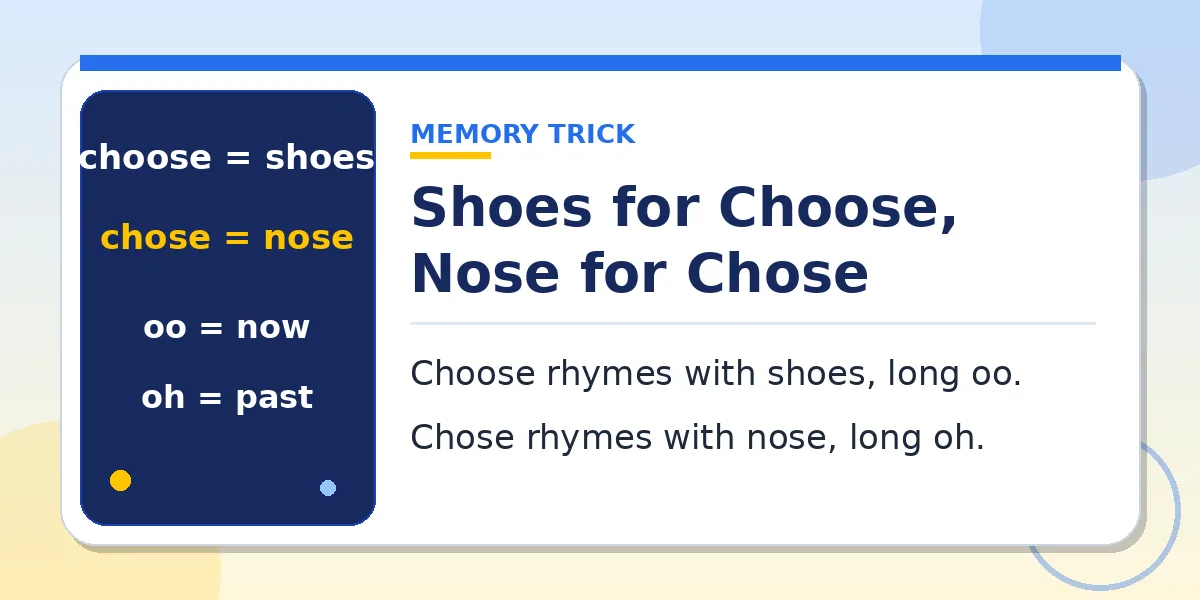
Use these simple tricks to remember the correct form. Remember the double O: Choose has two O’s. Connect it with a decision you make now or in the future. Example: I choose my outfit every morning. Use the rhyme test: Choose rhymes with shoes. Chose rhymes with nose. This makes it easier to recognize each form when speaking. Check the helping verb: Did + choose. Will + choose. Can + choose. Have + chosen. Has + chosen. Had + chosen. If the sentence has no helping verb, check whether the action is present or past. Try the pick and picked test: I choose a new book every month. / I pick a new book every month. I chose a new book yesterday. / I picked a new book yesterday. This trick can help identify the tense. However, it does not replace the helping verb rules.
Common Mistakes with Choose, Chose, and Chosen
These errors often happen when writers mix up the verb forms. These errors are the usual traps in choose or chose.
| Incorrect sentence | Correct sentence | Reason |
|---|---|---|
| I choose it yesterday. | I chose it yesterday. | Use the simple past. |
| I will chose later. | I will choose later. | Use the base form after will. |
| Did you chose this? | Did you choose this? | Did carries the past tense. |
| She has chose a dress. | She has chosen a dress. | Has needs the past participle. |
| The winner was chose. | The winner was chosen. | Passive voice needs the past participle. |
| He choses the same one. | He chooses the same one. | Use chooses with a singular subject. |
| I choosed the blue one. | I chose the blue one. | Choose has an irregular past form. |
| They have choosen a date. | They have chosen a date. | Chosen is the correct participle. |
| She chose to went home. | She chose to go home. | Use the base verb after to. |
Is “Choosed” a Word?
Choosed is not the standard past tense of choose. The correct past form is chose. The same applies to chosed and choosen. Use chose for the simple past and chosen for the past participle. Also, do not use choses as the past tense. Use chooses only for a singular third-person subject in the present tense.
Similar Irregular Verbs: Choose, Chose, and Chosen
Choose belongs to a group of irregular verbs. These verbs change form instead of following the regular -ed pattern.
| Base form | Simple past | Past participle |
|---|---|---|
| Choose | Chose | Chosen |
| Freeze | Froze | Frozen |
| Speak | Spoke | Spoken |
| Break | Broke | Broken |
| Steal | Stole | Stolen |
| Wake | Woke | Woken |
| Weave | Wove | Woven |
| Prove | Proved | Proven |
These patterns can help you learn irregular verbs. However, not every verb follows the same pattern. For example, lose becomes lost in both the simple past and past participle. You can review more common irregular forms in the Purdue OWL irregular verbs list. It lists choose, chose, and chosen as the three main forms.
Practice: Choose, Chose, or Chosen?
Test your understanding with these 12 sentences. Use this set to test choose or chose in real sentences. Fill in each blank with the correct verb form.
- I usually ___ the window seat when I fly.
- Yesterday, Maya ___ the blue notebook.
- You should ___ your words carefully.
- Have they ___ a date for the meeting?
- Why did you ___ that answer?
- What made him ___ a different route?
- The finalists were ___ by the panel.
- She ___ a new topic every semester.
- We are ___ a name for the project.
- By Monday, they will have ___ a new manager.
- When I lived there, I used to ___ that bus.
- He ___ to wait rather than leave.
Answer Key and Explanations
- Choose. The sentence describes a regular habit with I.
- Chose. The decision happened yesterday, so use the simple past.
- Choose. The modal should takes the base form.
- Chosen. Use the past participle after have.
- Choose. The helping verb did carries the past tense.
- Choose. The verb made carries the past tense.
- Chosen. The sentence uses passive voice with were.
- Chooses. Use the present form with the singular subject she.
- Choosing. The sentence uses the present progressive form.
- Chosen. Use the past participle after will have.
- Choose. Use the base form after used to.
- Chose. The sentence describes a completed past decision.
Frequently Asked Questions About Choose or Chose
1. Is it choose or chose?
Use choose for the base form and present tense. Use chose for a completed past action. For example, write “I choose coffee today” and “I chose coffee yesterday.” The sentence’s tense determines the correct spelling.
2. Is “choosed” a real word?
Choosed is not the standard past tense of choose. Choose is an irregular verb, so its past tense changes to chose. Write “I chose the blue shirt,” not “I choosed the blue shirt.”
3. Is it “have chose” or “have chosen”?
The correct phrase is have chosen. Have, has, and had take the past participle chosen. For example, write “I have chosen a new course.” Do not write “I have chose a new course.”
4. Is it “did you choose” or “did you chose”?
The correct question is “Did you choose?” The helping verb did already shows the past tense. Therefore, the main verb must stay in its base form. The same rule applies to negative sentences with did not.
5. What is the past tense of choose?
The simple past tense of choose is chose. Use it for a decision made in the past. For example, “She chose the red dress yesterday.” Chosen is the past participle, not the simple past form.
6. What is the past participle of choose?
The past participle of choose is chosen. Use it with have, has, or had in perfect tenses, and in passive sentences. For example, write “They have chosen a date.” Never use chose after have, has, or had.
7. How do you pronounce choose and chose?
In American English, choose rhymes with shoes, while chose rhymes with nose. Their vowel sounds differ, so pronunciation can help you remember the spelling. Say choose with a long oo sound, and say chose with a long oh sound.
Final Takeaway: Choose, Chose, or Chosen?
Use this summary whenever choose or chose slows you down. The difference becomes easier when you remember each verb form: Choose is the base form and present tense. Chooses is the present form for he, she, or it. Chose is the simple past tense. Chosen is the past participle. Choosing is the present participle and gerund. Remember this simple pattern: I choose today. I chose yesterday. I have chosen already. Also, check the helping verb. Write did choose, will choose, and have chosen. These patterns will help you use the correct form.
Related Grammar Guides
Explore more grammar explanations from ClarifyWords:
- Whose vs. Who’s
- Its vs. It’s
- Loose vs. Lose
- Fewer vs. Less
- Which vs. That
- A vs. An
- Lead or Led
- Lay or Laid
- Laid or Layed
- Analysis vs. Analyses
Find more explanations in the ClarifyWords Grammar category.