More or Less: Meaning, Examples, Synonyms, and How to Use It
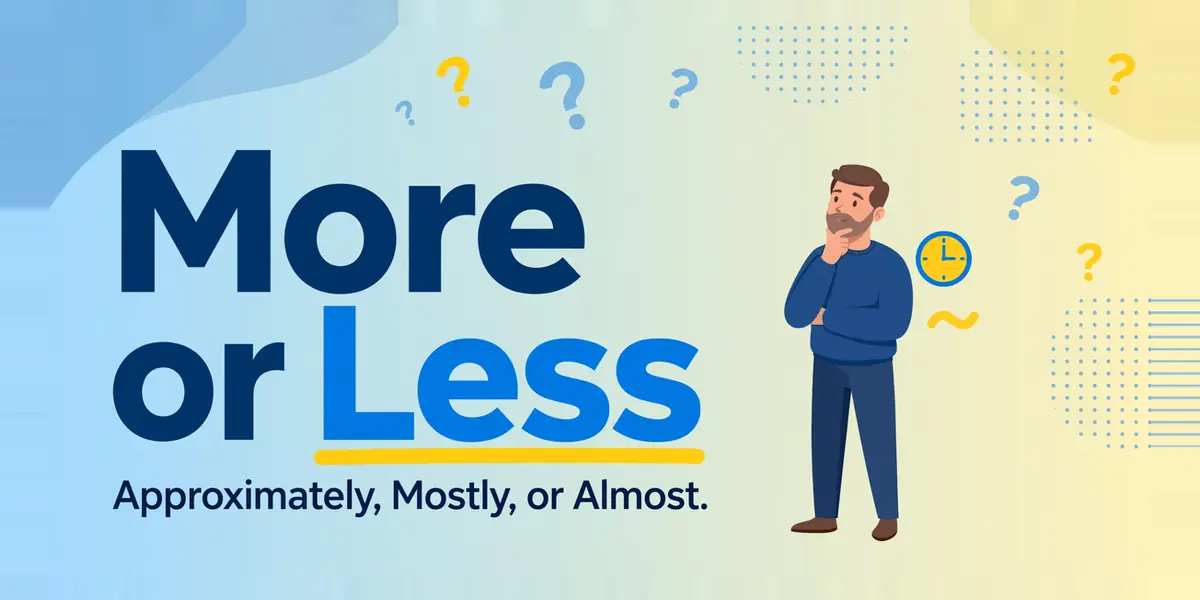
The phrase more or less means approximately, mostly, or almost, depending on the sentence. People use it to show that a number, statement, or comparison is close but not exact.
For example, “The project is more or less finished” means it is almost complete. “It costs $50, more or less” means the price is about $50.
The phrase is common in everyday English. Understanding its different meanings helps you use it correctly.
Quick Answer: What Does More or Less Mean?
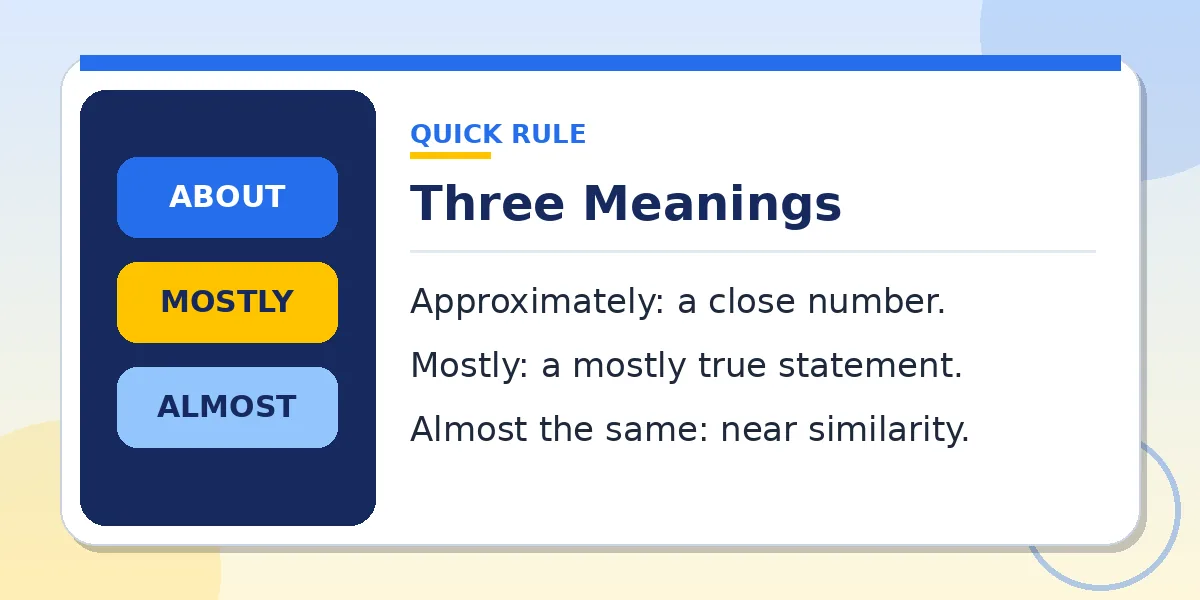
More or less is an English idiom that means approximately, mostly, or almost, depending on context.
Here are three simple examples:
- Approximately: “The trip takes two hours, more or less.”
- Mostly: “The work is more or less complete.”
- Almost the same: “The two rooms are more or less identical.”
The expression can refer to something slightly above or below an estimate. It can also soften a statement.
Table of Contents
- More or Less as a Fixed Idiom vs. a Literal Comparison
- The Three Main Meanings of More or Less
- How to Use More or Less in a Sentence
- More or Less vs. More or Fewer vs. More or Less Than
- Synonyms for More or Less
- Is More or Less Hyphenated?
- Does More or Less Have a Mathematical Symbol?
- Common Mistakes When Using More or Less
- Why Do People Use More or Less?
- More or Less in Legal or Property Descriptions
- Easy Memory Trick
- Practice Questions
- Frequently Asked Questions
More or Less as a Fixed Idiom vs. a Literal Comparison
The expression has two uses that are easy to confuse. It can work as a fixed idiom or as a literal comparison. Knowing the difference helps you understand the intended meaning.
More or Less as a Fixed Idiom
As a fixed idiom, more or less means approximately, mostly, or almost. The complete expression communicates an idea that is close but not exact. It does not describe a choice between two quantities.
Examples:
- “The meeting is more or less over.” This means the meeting is almost finished.
- “There were more or less 40 guests.” This means approximately 40 guests attended.
- “I more or less agree with your decision.” This means I agree with some reservations.
In each example, the phrase expresses an idea that is close but not completely exact.
More or Less in a Literal Comparison
In a literal comparison, more and less describe separate quantities or degrees. They do not form the fixed idiom.
For example:
- “This box contains more books than that one.”
- “This bottle holds less water than the other bottle.”
- “She has more experience but less free time.”
These sentences compare amounts or qualities. They do not express approximation.
How to Tell Which Meaning Is Intended
Look at the purpose of the sentence. If you can replace the complete expression with approximately, mostly, or almost, it probably functions as the fixed idiom. If the sentence compares two amounts or degrees, it uses a literal comparison.
For example:
- “The journey takes three hours, more or less.” Approximately three hours.
- “This journey takes more time than the other one.” A direct comparison.
The Three Main Meanings of More or Less
The expression has three common meanings. Each one depends on the surrounding words and the situation.
1. More or Less Means Approximately or Roughly
The first meaning is approximately, about, or roughly. Use it when giving an estimate instead of an exact figure. The actual amount may be slightly higher or lower.
Examples:
- “The new laptop costs $800, more or less.”
- “More or less 30 people attended the event.”
- “The package weighs five pounds, more or less.”
- “We should arrive in 20 minutes, more or less.”
In these sentences, the speaker does not claim complete accuracy. The figures are estimates. This meaning works well with prices, measurements, distances, weights, and time.
2. More or Less Means Mostly or To Some Extent
The second meaning describes something that is generally true but not completely true. It can also describe partial completion or partial agreement.
Examples:
- “The assignment is more or less finished.”
- “I more or less understand the instructions.”
- “She was more or less happy with the result.”
- “We more or less agreed on the final plan.”
These sentences suggest that something is mostly true. However, a small part may remain uncertain or unfinished. For example, a more or less finished assignment may still need a few corrections.
3. More or Less Means Almost or Practically the Same
The third meaning describes two things that are nearly alike. They may have small differences, but the difference is not important.
Examples:
- “The two apartments are more or less the same size.”
- “Their answers were more or less identical.”
- “We are more or less the same age.”
- “It is business more or less as usual.”
Here, the phrase suggests little difference between the things being compared. It does not mean they are perfectly identical. Small differences may still exist.
How to Use More or Less in a Sentence

The expression can appear in several positions. Its placement depends on what it describes.
Before a Number or Measurement
Place it before a number to introduce an estimate.
Examples: “More or less 50 students joined the class.” “The building is more or less 100 feet tall.” “More or less 20 guests arrived early.” This structure means about or approximately the stated amount.
After a Number or Measurement
You can also place it after an amount. This position often appears at the end of a sentence or clause.
Examples: “The repair costs $300, more or less.” “The journey takes four hours, more or less.” “The property covers 16 acres, more or less.” The expression signals that the stated figure is not exact.
Before an Adjective
Place it before an adjective to describe something that is mostly true.
Examples: “I am more or less ready.” “The explanation is more or less accurate.” “The room is more or less clean.” The phrase softens the description. It suggests that the statement is generally accurate, with some exceptions.
Before a Verb or Verb Phrase
The expression can appear before a verb or verb phrase. It often shows partial agreement, completion, or acceptance.
Examples: “He more or less admitted his mistake.” “We have more or less completed the project.” “She more or less accepted the offer.” These sentences suggest that the action happened almost completely or was acknowledged to some extent.
Before a Noun Phrase
You can use the phrase before a noun phrase to describe similarity.
Examples: “They reached more or less the same conclusion.” “We are more or less the same age.” “Both teams followed more or less the same strategy.” This structure usually means nearly the same or practically identical.
As a Standalone Answer
The expression can also work as a complete reply. It gives a qualified yes rather than a definite answer.
Example: Person A: “Have you finished the report?” Person B: “More or less. I just need to check a few details.” The reply means the report is mostly finished, but some work remains.
At the End of a Clause
You can place the phrase after an amount or estimate. A comma often separates it from the rest of the sentence.
Examples: “The tickets cost $75, more or less.” “The journey covers 200 miles, more or less.” “The meeting lasted an hour, more or less.” This position is especially common when the speaker adds an estimate after giving a figure.
More or Less vs. More or Fewer vs. More or Less Than
These expressions may look similar, but they serve different purposes. Understanding their grammar prevents common mistakes.
More or Less vs. More or Fewer
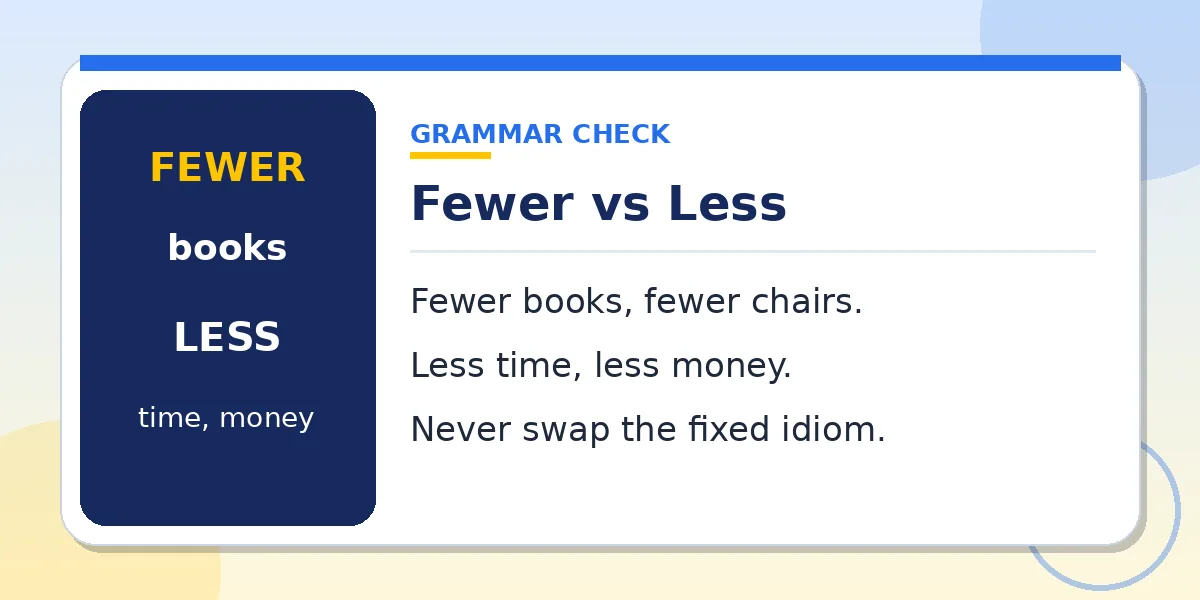
More or less is a fixed idiom. It means approximately, mostly, or almost. More or fewer is a literal comparison. It describes a higher or lower number of countable items.
Compare these examples:
- “The project is more or less finished.” This means it is almost complete.
- “We received more books and fewer magazines.” This compares two quantities.
- “The two designs are more or less identical.” This describes near-similarity.
Do not replace the fixed idiom with more or fewer. The expressions do not have the same meaning.
More or Less Than: When Is It Correct?
The phrase more or less than can cause confusion. Its meaning depends on the sentence structure. Consider these examples in a table:
| It costs $500, more or less. | Approximately $500. |
| It costs more than $500. | Above $500. |
| It costs less than $500. | Below $500. |
| The two items are more or less the same. | Nearly identical. |
Notice that more or less does not always need the word than. If you want to compare two quantities, use the correct comparative structure. If you want to express approximation, use more or less without than.
More vs. Less vs. Fewer
The words more, less, and fewer also follow different grammar patterns.
| More | Countable and uncountable nouns | More books, more water. |
| Fewer | Countable plural nouns | Fewer mistakes. |
| Less | Uncountable amounts and degrees | Less time, less money. |
Use fewer for countable plural items in standard formal writing. Use less for uncountable amounts.
For example: Correct: “We have fewer chairs than before.” Correct: “We have less space than before.” Correct: “She needs more time to finish.” You may also hear less with plural countable nouns in everyday speech. However, fewer remains the safer choice in formal writing.
For more examples, read our guide to fewer vs. less: https://clarifywords.com/fewer-vs-less/
Synonyms for More or Less
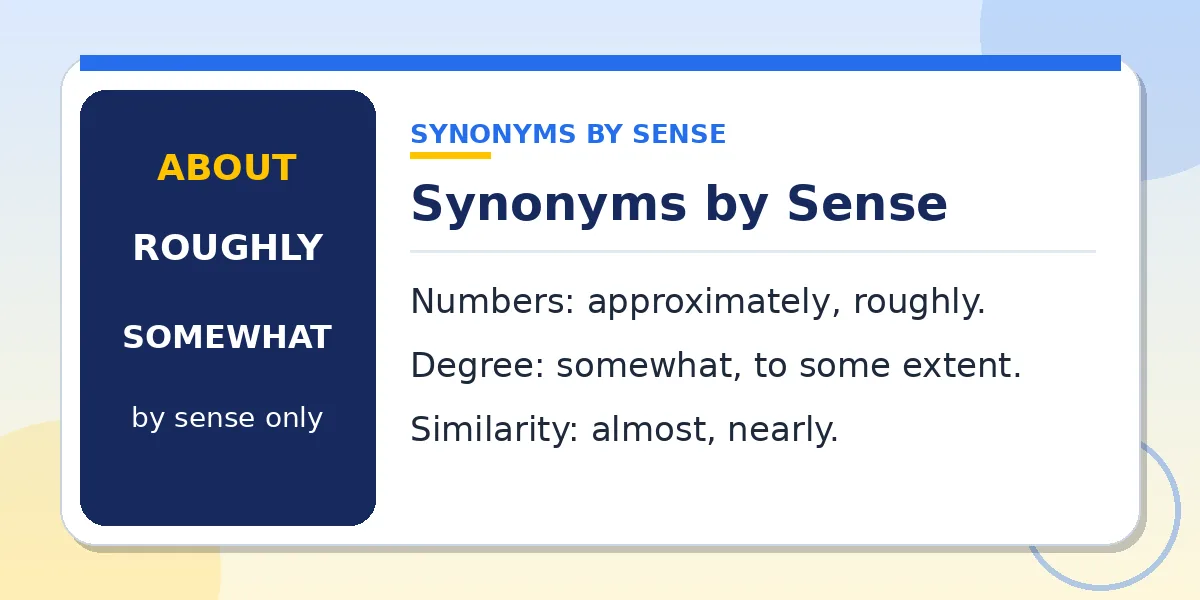
Several expressions can replace the phrase. However, the best choice depends on its meaning and the level of formality.
Synonyms for Approximately or Roughly
Use these alternatives when describing an estimated number, amount, or measurement.
| Approximately | Neutral or formal | Approximately 50 people attended. |
| Roughly | General estimate | It takes roughly two hours. |
| About | Everyday English | It costs about $40. |
| Around | Conversational | Around 100 people came. |
| Give or take | Informal | It will take an hour, give or take. |
| Plus or minus | Measurement-focused | The weight is five pounds, plus or minus. |
For formal writing, approximately is often the clearest replacement. In everyday conversation, about and around sound more natural.
Synonyms for Mostly or To Some Extent
Use these alternatives when describing partial truth, feelings, agreement, or completion.
| Somewhat | Neutral | I am somewhat satisfied. |
| Fairly | Neutral | The task is fairly simple. |
| Pretty much | Conversational | We are pretty much finished. |
| To some extent | Neutral or formal | The statement is true to some extent. |
| Rather | Context-dependent | The result is rather accurate. |
These words do not always have exactly the same strength. Choose the one that best matches your intended meaning.
Synonyms for Almost or Practically the Same
These alternatives work when describing similarity or near-completion.
| Almost | Neutral | The results are almost identical. |
| Nearly | Neutral | The two versions are nearly the same. |
| Practically | Neutral | The work is practically complete. |
| Virtually | Neutral or formal | The products are virtually identical. |
| Just about | Conversational | We are just about ready. |
Informal Alternatives: Kind Of, Sort Of, and Kinda
The expressions kind of, sort of, and kinda can overlap with the degree-related meaning. However, they are not suitable replacements in every sentence.
For example: “I kind of like the idea.” This sounds natural. “There were more or less 50 people.” This gives an approximate number. “There were kind of 50 people.” This sounds unnatural.
A simple test can help. If you mean approximately, use more or less, about, or roughly. If you mean somewhat or to some extent, kind of may work.
Words You Should Not Automatically Use as Synonyms
Some expressions look similar but communicate different ideas.
| Essentially | In its basic or fundamental nature, not necessarily an approximate number. |
| More specifically | With greater detail or precision, the opposite of hedging. |
| More often than not | Usually or in most cases, a frequency idea. |
| So-so | Average or mediocre quality, not approximation. |
For example, “The room costs more or less $500” gives an estimate. “The room costs essentially $500” does not give the same kind of estimate.
What Is the Opposite of More or Less?
There is no single opposite that works in every situation. The best choice depends on the intended meaning.
| Approximately | Exactly. |
| Roughly | Precisely. |
| Somewhat | Completely. |
| Almost | Fully. |
| Nearly | Entirely. |
In general, the opposite idea is exactness or completeness rather than approximation or partial truth.
Is More or Less Hyphenated?
The expression is usually written as three separate words. However, a hyphenated form also appears in some contexts. The correct choice depends on how you use it.
More or Less Without Hyphens
Use the open form in ordinary sentences. This is the usual spelling when the phrase modifies a verb, adjective, or whole clause.
Examples: “I am more or less ready.” “The work is more or less complete.” “The price is $200, more or less.” These examples do not need hyphens.
When More-or-Less Can Be Hyphenated
A hyphenated form can appear when the expression works as a compound modifier before a noun. Example: “A more-or-less accurate account.” Merriam-Webster lists the headword in hyphenated form. However, its sentence examples also use the open form in many cases. The Chicago Manual of Style explains that compounds involving more and less can often remain open unless ambiguity requires hyphens.
More or Less or More-or-Less: Which Should You Choose?
For everyday writing, the open form is a practical default. Use the hyphenated form when your chosen dictionary or style guide supports it in an attributive construction. Follow your publication’s house style when editing formal content. Also, avoid writing moreorless as one word.
Does More or Less Have a Mathematical Symbol?
There is no single mathematical symbol for the complete expression. However, the approximately equal to symbol covers its numerical sense.
The Closest Mathematical Symbol: Approximately Equal To (≈)
The symbol ≈ means approximately equal to. It shows that two values are close but not exactly equal. For example: 10.1 ≈ 10. This means 10.1 is approximately equal to 10. The symbol works for numerical approximation. However, it cannot express every meaning of the English phrase, such as partial agreement or near-similarity in opinions.
Difference Between ≈, Less Than, and Greater Than
These symbols have different mathematical meanings.
| ≈ | Approximately equal to | 10.1 ≈ 10. |
| < | Less than | 5 < 8. |
| > | Greater than | 9 > 4. |
| ≤ | Less than or equal to | 5 ≤ 5. |
| ≥ | Greater than or equal to | 8 ≥ 8. |
Use ≈ for an approximate value, not for a strict comparison.
Common Mistakes When Using More or Less
The phrase is simple, but a few common mistakes can change its meaning.
1. Confusing the Idiom With a Comparison
The expression does not always compare two quantities. It often means approximately or mostly.
- Correct: The room was more or less empty.
- Incorrect: The room was more or less than the other room.
For a direct comparison, name what you are comparing.
2. Using More or Less Instead of More or Fewer
The idiom stays unchanged when it means approximately or mostly. Do not replace it with more or fewer.
- Correct: We invited more or less the same number of guests.
- Incorrect: We invited more or fewer the same number of guests.
Use more or fewer when comparing countable items.
3. Mixing Up Less and Fewer
Use fewer for countable items. Use less for amounts, time, money, and other uncountable quantities.
- Correct: Fewer students attended the class.
- Correct: We spent less money this month.
For a fuller explanation, read our guide to fewer vs. less: https://clarifywords.com/fewer-vs-less/
4. Using the Phrase Incorrectly for Frequency
More or less does not mean usually or often. Its meaning is closer to approximately or mostly.
- Incorrect: I more or less go to the gym.
- Better: I go to the gym more or less every day.
The second sentence means you go on nearly every day, with occasional exceptions.
5. Using It When Exact Information Matters
The phrase signals approximation or uncertainty. Avoid it when a precise figure is necessary.
- Casual: The meeting lasted more or less an hour.
- Precise: The meeting lasted 60 minutes.
Use an exact number in reports, contracts, and formal records when accuracy matters.
6. Confusing More or Less With Kind Of
These expressions sometimes overlap, but they do not always mean the same thing.
- More or less ready means almost ready.
- Kind of ready suggests partial readiness or uncertainty.
Choose the phrase that expresses your intended meaning.
7. Treating the Spelling as One Word
The standard expression uses three separate words. Do not write it as moreorless. The hyphenated form can appear in some compound modifiers. For example, a dictionary may use more-or-less before a noun.
8. Using It as a Perfect Synonym for Almost
Almost usually suggests that something has not quite reached a point. More or less can allow a small range above or below a point. For example, almost 100 people suggests slightly fewer than 100. More or less 100 people suggests around 100, possibly a little above or below.
Why Do People Use More or Less?
People use this expression to make statements less exact or less absolute. It helps when a speaker does not know the exact figure or does not want to claim complete certainty. It also makes conversation sound more natural. Instead of giving an exact number, someone can offer a reasonable estimate.
Here are four common reasons, as a table:
| To estimate | It costs more or less $50. | The price is around $50. |
| To soften a claim | The project is more or less complete. | Most of the work is finished. |
| To show partial agreement | More or less, I agree. | I agree, but not entirely. |
| To avoid false precision | The trip takes more or less two hours. | The journey takes around two hours. |
The phrase can also help someone express uncertainty without sounding overly cautious. However, it should not replace exact information when details matter. A clear estimate works well in conversation, but a precise figure works better in formal records.
More or Less in Legal or Property Descriptions
You may see the phrase in property descriptions, deeds, and land records. For example: The property contains 16 acres, more or less. This wording indicates an approximate land area. The actual measured acreage may differ slightly. The phrase does not automatically guarantee a particular tolerance. Its legal effect depends on the jurisdiction, the deed wording, and the surrounding facts. In Georgia, Code Section 44-5-35 addresses certain conveyances that qualify a stated quantity with the phrase more or less. This is a rule specific to that state, not a universal rule for every US property sale. Property owners should check the law in their own jurisdiction. If a property description matters to a purchase or dispute, consult a qualified real estate attorney. This section is general information, not legal advice.
Easy Memory Trick
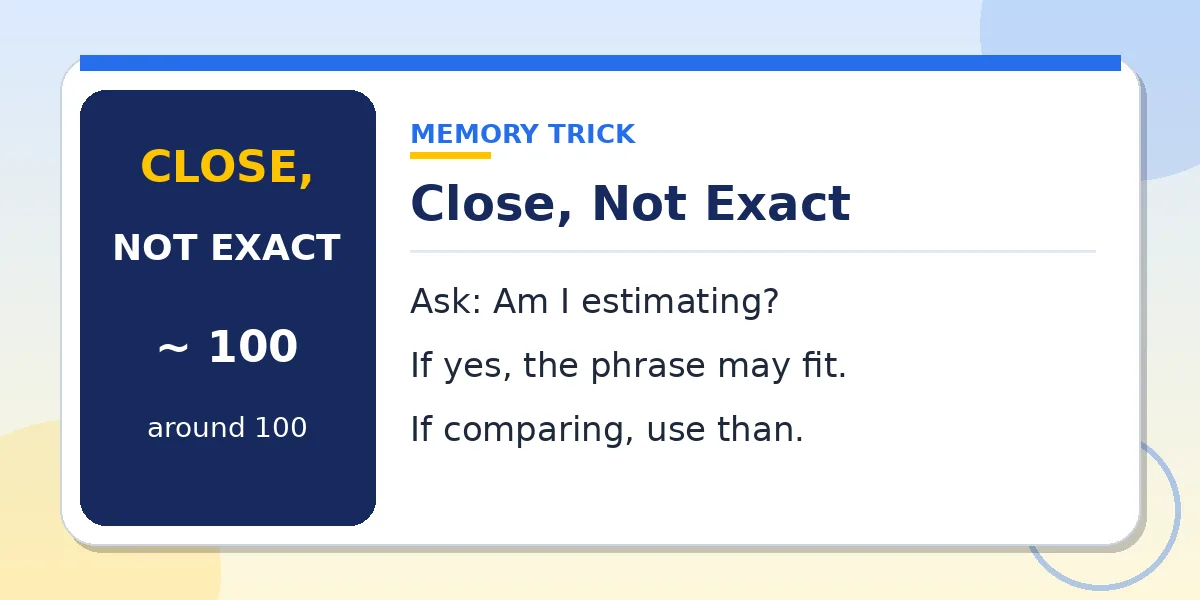
Remember this simple idea: More or less = approximately or mostly. Use it when something is close to a figure or true in a general way.
- More or less $100 means around $100.
- More or less finished means mostly finished.
- More or less the same means nearly the same.
For a quick check, ask yourself: Am I estimating, or am I making a direct comparison? If you are estimating, the expression may fit. If you are comparing two quantities, choose the correct comparative form.
Practice Questions
Test your understanding with these ten questions. Choose the best answer for each one.
- What does the phrase mean in this sentence? The repair will cost more or less $200.
A. Exactly $200
B. Approximately $200
C. Less than $100 - Which sentence uses the phrase correctly?
A. The office was more or less empty.
B. The office was more or less than the other office.
C. The office was moreorless empty. - What does this sentence mean? I am more or less ready for the exam.
A. I am completely unprepared.
B. I am mostly ready.
C. I have already taken the exam. - Which phrase is better for a direct comparison of countable items?
A. More or less
B. More or fewer
C. More or less than - Which mathematical symbol most closely represents numerical approximation?
A. ≈
B. <
C. ≥ - Which word best replaces the phrase in this sentence? It costs more or less $40.
A. Exactly
B. Approximately
C. Completely - What is the best opposite for the number sense of the phrase?
A. Roughly
B. Exactly
C. Somewhat - What does this reply mean? “Are you done?” “More or less.”
A. No, I have not started.
B. Mostly done, with a small amount of work left.
C. Done to the exact minute. - Which word fits this sentence? We have ___ chairs than before.
A. Fewer
B. Less
C. More or less - What does this sentence mean? The two plans are more or less identical.
A. Completely different
B. Nearly the same
C. Exactly identical in every detail
Answer Key
- B. Approximately $200. The speaker gives an estimate rather than an exact price.
- A. The office was more or less empty. The phrase means the office was almost empty.
- B. I am mostly ready. The sentence suggests that the person is nearly prepared.
- B. More or fewer. Use more or fewer when comparing the number of countable items.
- A. ≈ This symbol means approximately equal to, making it useful for numerical estimates.
- B. Approximately. It gives a close number without claiming exactness.
- B. Exactly. For numbers, exactness is the opposite of approximation.
- B. Mostly done, with a small amount of work left. It is a qualified yes, not a firm yes.
- A. Fewer. Chairs are countable, so fewer is the safer formal choice.
- B. Nearly the same. Small differences may still exist, but they do not matter much.
Frequently Asked Questions
1. What does more or less mean in simple words?
More or less means approximately, mostly, or almost, depending on context. Use it for a close number, a mostly true statement, or two things that are nearly the same. It signals closeness, not exactness, in everyday English.
2. Is more or less formal or informal?
More or less is slightly informal and common in everyday conversation. It also appears in neutral business writing, but a formal report, exam, or legal text usually needs approximately or an exact figure instead. Choose the clearer option there.
3. Is more or less hyphenated?
The standard form is three separate words in ordinary sentences, such as I am more or less ready. Some dictionaries show more-or-less before a noun, as in a more-or-less accurate account. Use the open form and follow your house style.
4. What is another word for more or less?
Good alternatives depend on meaning. For numbers, use approximately, roughly, about, or around. For partial truth, use somewhat, fairly, or to some extent. For near similarity, use almost, nearly, practically, or just about.
5. What is the opposite of more or less?
There is no single opposite for every sense, so match the meaning you intend. For a number, use exactly or precisely. For partial truth, use completely or entirely. In general, the opposite idea is exactness and certainty, not approximation.
6. Can more or less mean kind of or sort of?
Sometimes, but only for degree, not for numbers. Both phrases soften a statement, such as I more or less agree or I kind of agree. For numbers, use more or less, because kind of fifty people sounds unnatural.
7. Can more or less mean almost every day?
Yes, when it sits with a frequency phrase. I exercise more or less every day means you exercise nearly every day, with occasional exceptions. It does not mean simply usually or often, and it never means sometimes on its own.
Final Takeaway
More or less is a useful hedge when a number, statement, or comparison is close but not exact. Keep the fixed idiom separate from a literal comparison, choose synonyms by sense, and use an exact figure when precision matters.