

Red or Blue: Meaning, Difference, and Examples
Red and blue can communicate very different ideas. Their meanings depend on where you see them and how people use them. In colour, red often signals warmth or urgency, while blue often suggests calmness or trust. In US politics, red stands for Republicans and blue stands for Democrats. In The Matrix, the red pill represents truth, while the blue pill represents a comfortable illusion. Understanding red or blue starts with the context. The colours have different emotional associations, scientific properties, and cultural meanings. This guide explains each meaning in clear, simple language.
Quick Answer: What Is the Difference Between Red and Blue?
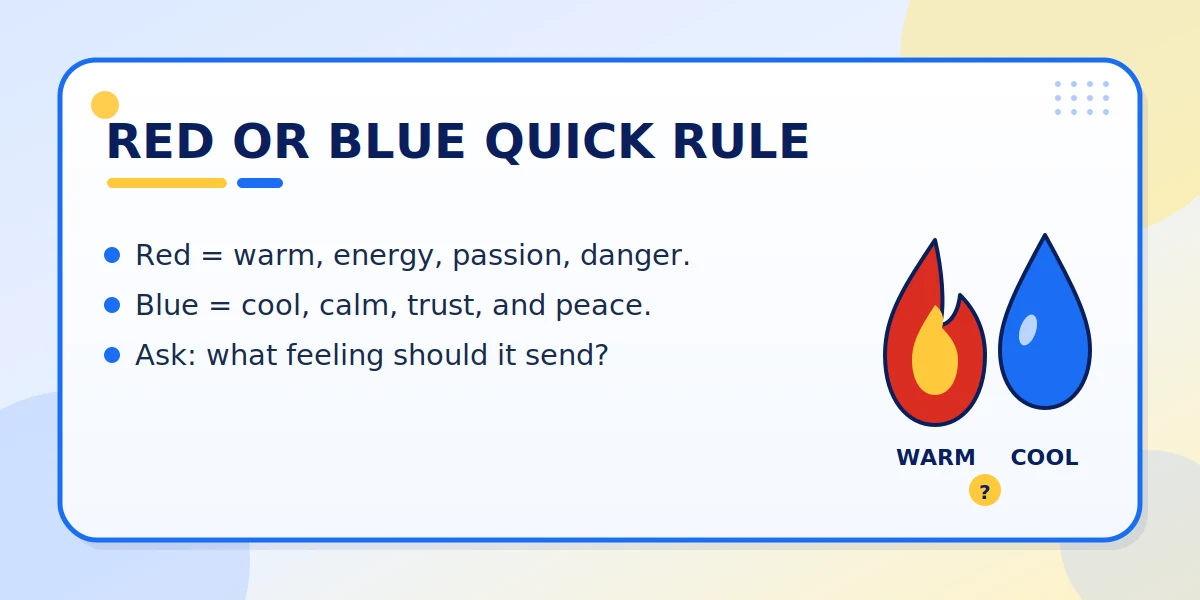
Red is commonly associated with passion, energy, warmth, danger, and urgency. Blue is often associated with calmness, trust, stability, and peace. The meaning changes in different contexts:
- As colours: Red is a warm colour, while blue is a cool colour.
- In colour psychology: Red can suggest excitement or urgency. Blue can suggest calmness or reliability.
- In US politics: Red represents the Republican Party. Blue represents the Democratic Party.
- In The Matrix: The red pill represents discovering the truth. The blue pill represents staying in a comfortable illusion.
- In colour mixing: Red and blue pigments generally make purple or violet. Red and blue light make magenta.
Neither colour is always better. The right choice depends on the message, audience, and situation.
Table of Contents
- Red vs Blue: Comparison Table
- What Does the Colour Red Mean?
- What Does the Colour Blue Mean?
- Red vs Blue in Colour Psychology
- Warm Colours, Cool Colours, and Wavelengths
- Red States vs Blue States in US Politics
- Red Pill vs Blue Pill in The Matrix
- Red and Blue in Flags, Brands, and Design
- Common Idioms With Red and Blue
- How to Choose Red or Blue
- Common Mistakes About Red and Blue
- Memory Trick
- Practice Questions and Answer Key
- Frequently Asked Questions
- Related Guides
- Final Takeaway
Red vs Blue: Comparison Table
| Feature | Red | Blue |
|---|---|---|
| Colour temperature | Warm | Cool |
| Common associations | Passion, energy, danger, urgency | Calm, trust, stability, peace |
| Emotional impression | Intense and stimulating | Relaxing and reassuring |
| Visible spectrum | Longer wavelengths | Shorter wavelengths |
| RGB colour model | Primary light colour | Primary light colour |
| Pigment mixing | Combines with blue to make purple or violet | Combines with red to make purple or violet |
| US political meaning | Republican Party | Democratic Party |
| The Matrix meaning | Truth and reality | Comfortable illusion |
These descriptions show common associations, not fixed rules. Culture, personal experience, and context shape how people interpret colour.
What Does the Colour Red Mean?
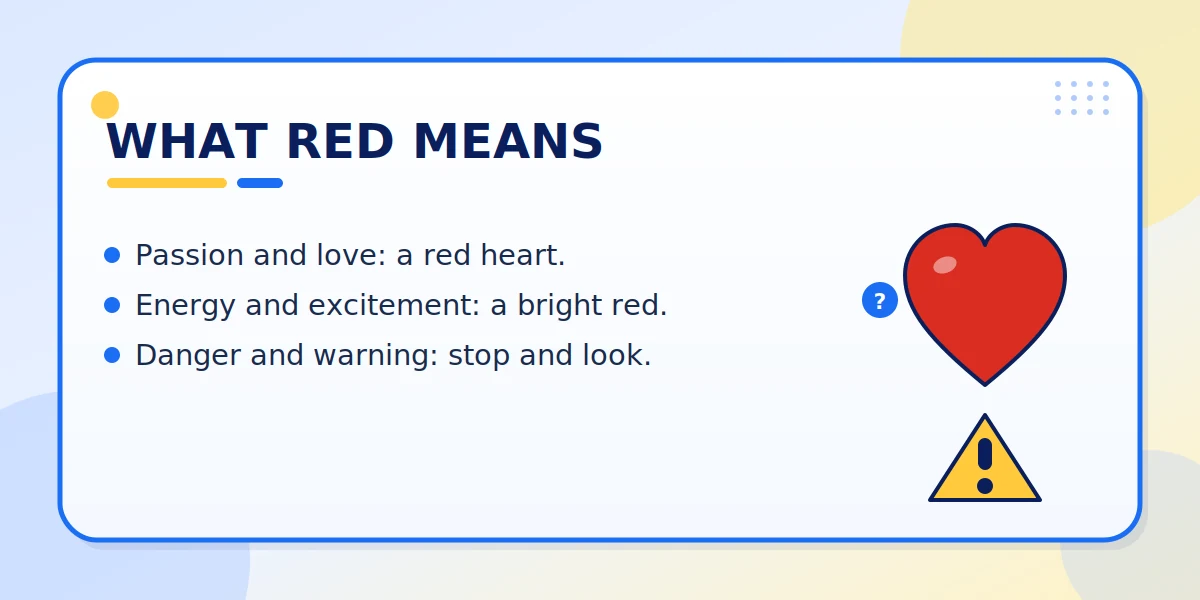
Red is a strong, noticeable colour. People often connect it with intense emotions and physical energy. When people compare red or blue, red usually feels louder and bolder.
Red Symbolism and Common Associations
Red commonly represents:
- Passion and love: Red hearts often symbolize romance and affection.
- Energy and excitement: Bright red can create a lively, active impression.
- Danger and warning: Red signs and lights can signal a risk or need for attention.
- Anger: The expression “seeing red” describes becoming very angry.
- Warmth and strength: Red can suggest heat, confidence, and power.
These associations explain why red appears in warning signs, promotional displays, and romantic imagery.
Red in Different Cultures
Red does not have one universal meaning. In some East Asian cultures, it represents luck, celebration, and prosperity. In many Western settings, red can suggest love, danger, anger, or urgency. These meanings are common, not absolute. The cultural setting matters when choosing red for a message, product, or design.
Examples of Red in Everyday Life
- A red traffic light tells drivers to stop.
- A red heart often represents love.
- A red sale sign draws attention to a promotion.
- A red carpet can represent a special event or celebration.
- A red warning label signals a possible danger.
In each example, the colour helps communicate a message quickly.
What Does the Colour Blue Mean?
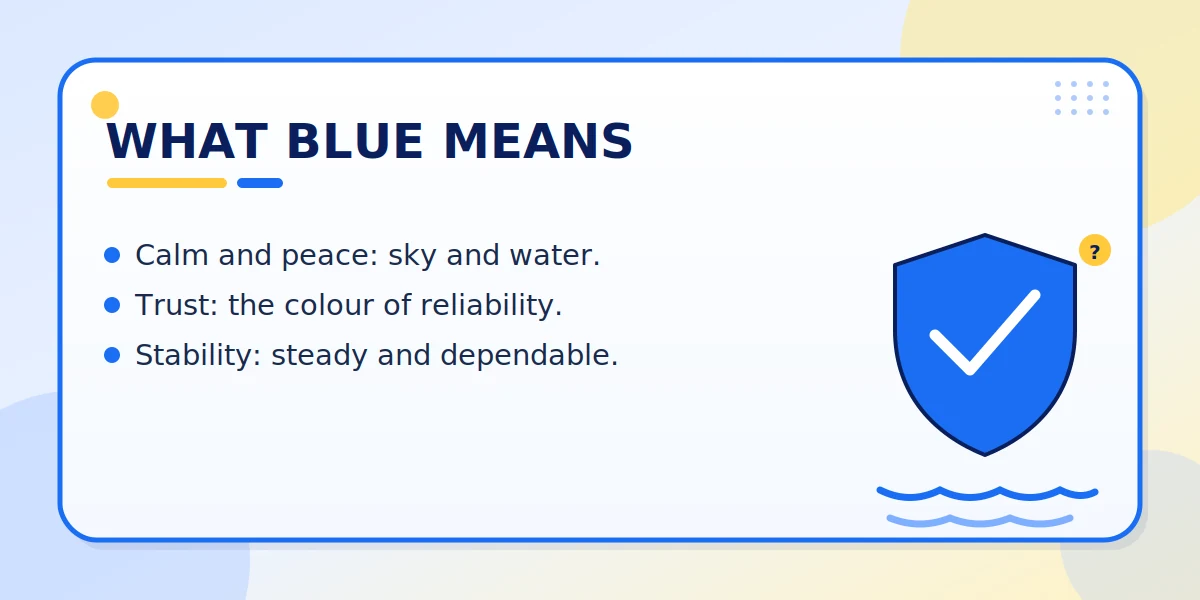
Blue often creates a calmer impression than red. People commonly connect it with the sky, water, trust, and stability. In a choice of red or blue, blue often feels safer and quieter.
Blue Symbolism and Common Associations
Blue commonly represents:
- Calmness: Blue can suggest peace and relaxation.
- Trust: Businesses often use blue to communicate reliability.
- Stability: Dark blue can create a steady, dependable impression.
- Peace: Blue skies and water often appear in peaceful images.
- Sadness: The expression “feeling blue” means feeling sad.
Blue can also suggest professionalism and responsibility. However, its meaning depends on the design, setting, and audience.
Blue in Different Cultures
Blue can carry different meanings across cultures. Some traditions connect it with spirituality, protection, and peace. Do not assume every audience will interpret blue in the same way. Cultural background and personal experience affect how people respond to colour.
Examples of Blue in Everyday Life
- A clear blue sky can suggest a peaceful day.
- Blue business branding can communicate reliability.
- Blue uniforms may create a professional appearance.
- Blue signs often provide directions or information.
- Blue decorations can create a calm atmosphere.
Red vs Blue in Colour Psychology
Colour psychology explores how colours relate to emotions, thoughts, and behaviour. Red and blue often create different impressions in design, branding, and daily life. The choice of red or blue can change how a design feels.
How Red Can Affect Emotions and Behaviour
Red can attract attention and create a sense of urgency. It often appears in warnings, alerts, and promotional messages. Some designs use red to suggest excitement, movement, or strong emotion. A bright red button, for example, can draw the eye quickly. Red does not automatically make everyone feel excited or angry. The shade, setting, and viewer all matter.
How Blue Can Affect Emotions and Behaviour
Blue often communicates calmness and reliability. Companies may use it when they want a brand to appear trustworthy. Blue also appears in designs intended to feel peaceful or organized. A soft blue background can create a calm visual space. Blue does not always make people relaxed. Its effect depends on the person and the situation.
What Research Says About Red and Blue
A 2009 study by Ravi Mehta and Rui Zhu examined colour and cognitive task performance. The researchers tested how colour affected thinking in controlled experiments. Red improved performance on detail-oriented tasks. Blue improved performance on creative tasks in the study. These findings do not prove that red always improves focus or blue always improves creativity. They describe results from specific tasks and conditions.
A 2020 study in Psychological Science examined colour and emotion associations across 4,598 participants from 30 nations. It found red was the colour most often linked with love and with anger. Patterns still differed across cultures.
Does Your Favourite Colour Reveal Your Personality?
No single colour preference can reliably explain someone’s personality. A person may prefer blue because it feels calm, familiar, or easy to use in design. Personal taste can reflect memories, culture, design preferences, and individual experience. Treat colour preference as a clue, not a diagnosis.
Red vs Blue: Warm Colours, Cool Colours, and Wavelengths
Red and blue occupy different parts of the visible light spectrum. They also belong to different colour temperature groups.
Is Red a Warm Colour?
Yes. Red is generally classified as a warm colour. It can remind people of fire, heat, sunlight, and autumn leaves. Warm colours often create a lively or intense visual impression. Red is one of the most familiar examples.
Is Blue a Cool Colour?
Yes. Blue is generally classified as a cool colour. It often brings to mind water, ice, and the sky. Cool colours can create a calm or distant visual impression. Blue is a common example in this group.
Red and Blue Wavelengths
Visible light includes a range of wavelengths that human eyes can detect. Red appears toward the longer end of the visible spectrum. Blue appears toward the shorter end.
Approximate ranges are:
- Red: 620 to 750 nanometres.
- Blue: 450 to 495 nanometres.
These ranges are approximate. Different scientific references may use slightly different boundaries.
What Do Red and Blue Make When Mixed?
The result depends on whether you mix light or physical pigments. These are two different colour systems.
When mixing paint or traditional pigments: Red and blue generally produce purple or violet. The exact result depends on the pigments and their proportions.
When mixing RGB light: Red and blue light produce magenta. Adding green light at full intensity to red and blue produces white.
The distinction matters because paint and light do not mix in the same way. Red and blue are not complementary colours. In the traditional RYB colour wheel, red’s complement is green. In additive RGB light, red’s complement is cyan.
Red States vs Blue States in US Politics
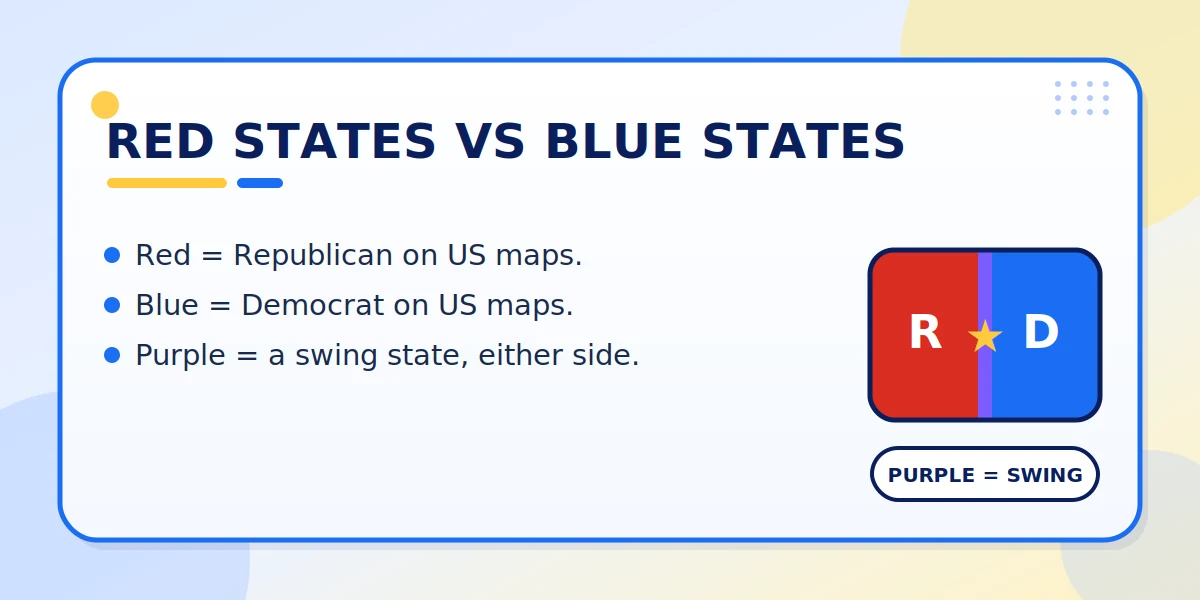
In modern US political language, red and blue describe voting patterns. Red states generally support Republican candidates in presidential elections. Blue states generally support Democratic candidates. These labels are shorthand. They do not describe every person who lives in a state.
What Is a Red State?
A red state is a US state that tends to vote for Republican candidates in presidential elections. The Republican Party is represented by red on modern US election maps. A state may be called red when it has voted Republican in recent presidential elections. That does not mean every resident supports the Republican Party. Many red states have Democratic voters, independent voters, and communities with mixed political views.
What Is a Blue State?
A blue state is a US state that tends to vote for Democratic candidates in presidential elections. The Democratic Party is represented by blue on modern US election maps. A state may be called blue when it has voted Democratic in recent presidential elections. Blue states also include Republican voters and people who support other parties or candidates.
What Is a Purple State?
A purple state is a politically competitive state where both major parties have substantial support. The terms swing state and battleground state describe similar situations. These states can be important in presidential elections because either party can win. Purple represents a mixture of red and blue. It is a useful visual label, not an official political category. Other parties have colours too. The Green Party uses green, and the Libertarian Party uses gold or yellow.
Why Are Republicans Red and Democrats Blue?
The modern colour convention became established around the 2000 presidential election. Before then, television networks and newspapers used different colour assignments. Two days after Election Day in November 2000, The New York Times and USA Today published colour-coded maps. They used red for Republican George W. Bush and blue for Democrat Al Gore. The close election and Florida recount kept those maps in public view. Their colours became familiar to viewers across the country. Tim Russert also helped popularize the phrases “red states” and “blue states” through election coverage on Meet the Press. The historical record is more complicated than one person or one map creating the convention. The Smithsonian’s account explains how the convention became fixed and how earlier maps varied.
Red States and Blue States in the 2024 Election
Political labels can change from one election to another. A state that voted Republican in one presidential election may vote Democratic in another. Any state classification should identify the election year. For example, a map based on the 2024 presidential election should be labelled as a 2024 map. In the 2024 presidential election, reliably red states included Texas, Florida, Ohio, Tennessee, Alabama, and Idaho. Reliably blue states included California, New York, Massachusetts, Illinois, Oregon, and Washington. Seven battleground states, Arizona, Georgia, Michigan, Nevada, North Carolina, Pennsylvania, and Wisconsin, were each decided by roughly one to four points. The Federal Election Commission compiles official presidential results reported by state election officials. Its 2024 presidential results provide a reliable basis for checking state outcomes. A two-colour map also has limits. A state won by a narrow margin may appear the same colour as one won by a wide margin.
How the Electoral College Relates to Red and Blue States
The Electoral College is the system used to elect the US president. Each state receives electoral votes based on its representation in Congress. Most states use a winner-take-all system. The statewide popular vote winner receives all that state’s electoral votes. Maine and Nebraska are exceptions. They can allocate some electoral votes by congressional district. The National Archives explains how electoral votes are distributed. Red and blue labels summarize state voting results. They are not separate rules within the Electoral College itself.
Why Red and Blue Political Meanings Differ Around the World
US political colour meanings are not universal. In many countries, red is associated with left-wing, socialist, or labour movements. Blue is often associated with conservative or right-wing parties in some political systems. For example, the United Kingdom commonly uses red for the Labour Party and blue for the Conservative Party. Political colours depend on each country’s history, parties, and political traditions. Never assume the US system applies everywhere.
Red Pill vs Blue Pill Meaning in The Matrix
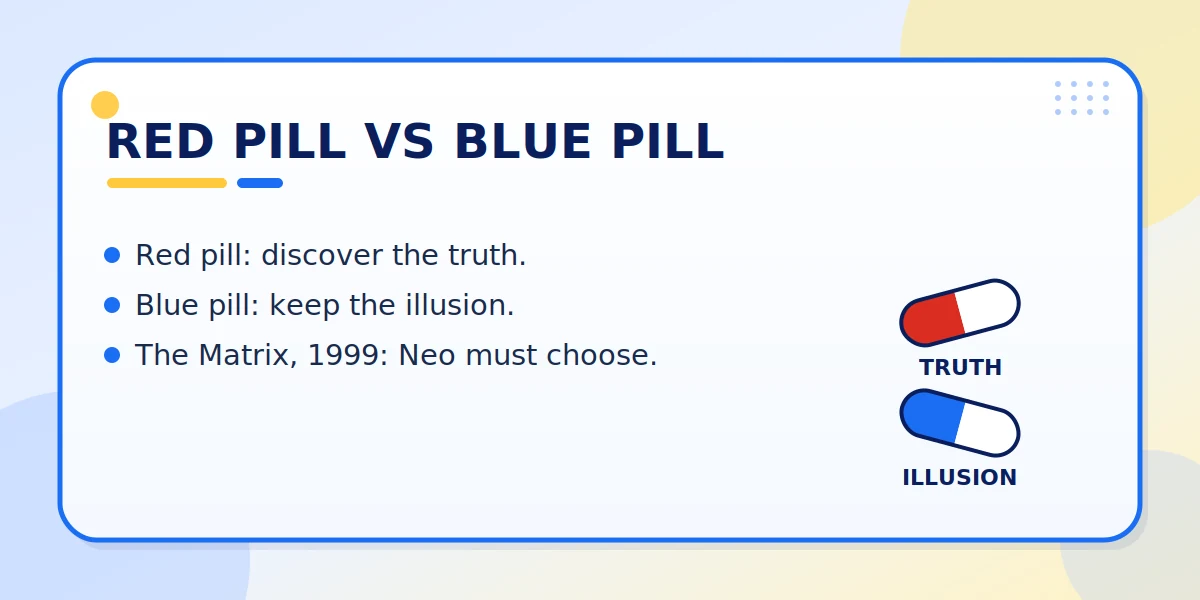
The red pill and blue pill became widely recognized symbols through the 1999 film The Matrix. In the film, Morpheus offers Neo a choice between two pills. The choice represents two different ways of understanding reality.
What Does the Red Pill Mean?
The red pill represents choosing to discover the truth. In the film, taking it allows Neo to learn the real nature of his world. The choice suggests accepting difficult knowledge instead of remaining comfortable. People now use “red pill” to describe learning a truth that changes how they see a situation.
What Does the Blue Pill Mean?
The blue pill represents choosing the familiar illusion. In the film, taking it means returning to ordinary life without learning the truth. The blue pill can symbolize comfort, familiarity, or avoiding difficult information. Its meaning comes from the film, not from a literal medical choice.
Red Pill vs Blue Pill: Main Difference
| Red Pill | Blue Pill |
|---|---|
| Truth and reality | Comfortable illusion |
| Awareness | Continued ignorance |
| Difficult knowledge | Familiar comfort |
| Choosing to wake up | Choosing to remain unaware |
The expressions appear in online discussions and everyday conversations. Their meaning can change with context. Cambridge Dictionary defines the red pill through the idea of seeing the world as it really is, even when that knowledge is painful.
Red and Blue in Flags, Brands, and Design
Red and blue often appear in national flags, company logos, advertisements, and public information. Their meanings depend on the design and the message. Designers weigh red or blue against the message they want to send.
What Red and Blue Mean on Flags
Flag colours can represent a country’s history, identity, values, or important events. Red may represent courage, sacrifice, or revolution. Blue may represent peace, justice, freedom, or the sea. However, these meanings are not universal. Each flag has its own history and official interpretation.
Why Brands Use Red
Brands may choose red when they want to communicate:
- Energy and excitement.
- Passion or strong emotion.
- Urgency or attention.
- Boldness and confidence.
Red can make a logo or promotional message stand out. It often works well when a brand wants a lively, energetic image.
Why Brands Use Blue
Brands may choose blue when they want to communicate:
- Trust and reliability.
- Calmness and security.
- Stability and professionalism.
- Clarity and confidence.
Blue appears in many business and technology designs. It can help create a dependable impression, although the full design also matters.
Should You Choose Red or Blue for a Design?
Choose a colour based on the message and the people who will see it. Red may suit an energetic campaign or an urgent notice. Blue may suit a design that needs to feel calm and trustworthy. Also consider contrast, readability, accessibility, and cultural meaning. A colour that looks attractive may still be hard to read or may carry a different meaning in another culture.
Common Idioms and Expressions With Red and Blue
English uses red and blue in many expressions. Their meanings are often figurative rather than literal. You can also hear red or blue in everyday speech.
Common Expressions With Red
- Seeing red: Becoming very angry. Example: “He was seeing red after someone damaged his car.”
- Red flag: A warning sign or reason for concern. Example: “Repeated missed payments are a red flag for the lender.”
- Caught red-handed: Caught while doing something wrong. Example: “The child was caught red-handed taking cookies before dinner.”
- Red tape: Excessive rules, paperwork, or official procedures. Example: “The permit took months because of government red tape.”
Common Expressions With Blue
- Feeling blue: Feeling sad or unhappy. Example: “She felt blue after her best friend moved away.”
- Out of the blue: Happening unexpectedly or without warning. Example: “An old classmate called me out of the blue.”
- Once in a blue moon: Very rarely. Example: “We eat at that restaurant once in a blue moon.”
- True blue: Loyal, faithful, or dependable. Example: “Everyone knows he is a true blue friend.”
These expressions show how colour words can develop meanings beyond their basic visual definitions.
How to Choose Red or Blue
Neither colour is the right choice for every situation. Start with the feeling or message you want to communicate. Then consider the audience and the setting.
Choose Red When You Want to Communicate
- Energy or excitement.
- Passion or strong emotion.
- Urgency or immediate attention.
- Warmth or boldness.
Red can work well for warning signs, lively promotions, and designs that need a strong visual presence.
Choose Blue When You Want to Communicate
- Calmness or relaxation.
- Trust and reliability.
- Stability and professionalism.
- Peace and security.
Blue can work well for business branding, informational designs, and calm visual settings.
Questions to Ask Before Choosing
Before deciding, consider these questions:
- What message should the colour communicate?
- Who is the intended audience?
- Does the cultural context affect its meaning?
- Will text and important details remain easy to read?
- Does the colour suit the product, purpose, or brand?
The best choice is the one that supports the message. Do not select a colour only because it is popular.
Common Mistakes About Red and Blue
Several common misunderstandings can cause confusion. These are the most important ones to avoid. Most mistakes about red or blue come from treating one meaning as the only meaning.
Assuming Red Always Means Republican
Red represents the Republican Party on modern US political maps. Other countries may use red for left-wing parties. Always check the country and political context before interpreting the colour.
Assuming Blue Always Means Democratic
Blue represents Democrats in modern US election maps. In other countries, blue may represent conservative parties. The political meaning is not universal.
Calling Red and Blue Complementary Colours
Red and blue are not complementary colours in the standard colour models discussed here. In the traditional RYB colour wheel, red’s complement is green. In additive RGB light, red’s complement is cyan.
Confusing Light Mixing With Paint Mixing
Red and blue pigments generally make purple or violet. Red and blue light make magenta. These results differ because pigments absorb and reflect light, while coloured lights combine their wavelengths.
Treating Colour Psychology as a Universal Rule
Red does not always cause excitement, and blue does not always create calmness. Research identifies patterns, not guarantees. Use colour psychology as guidance, not as a guarantee.
Treating Every Red or Blue State as Politically Uniform
A red or blue state label describes an election result or voting tendency. It does not mean every resident shares the same political views. People within each state hold different political views.
Easy Memory Trick: Red vs Blue
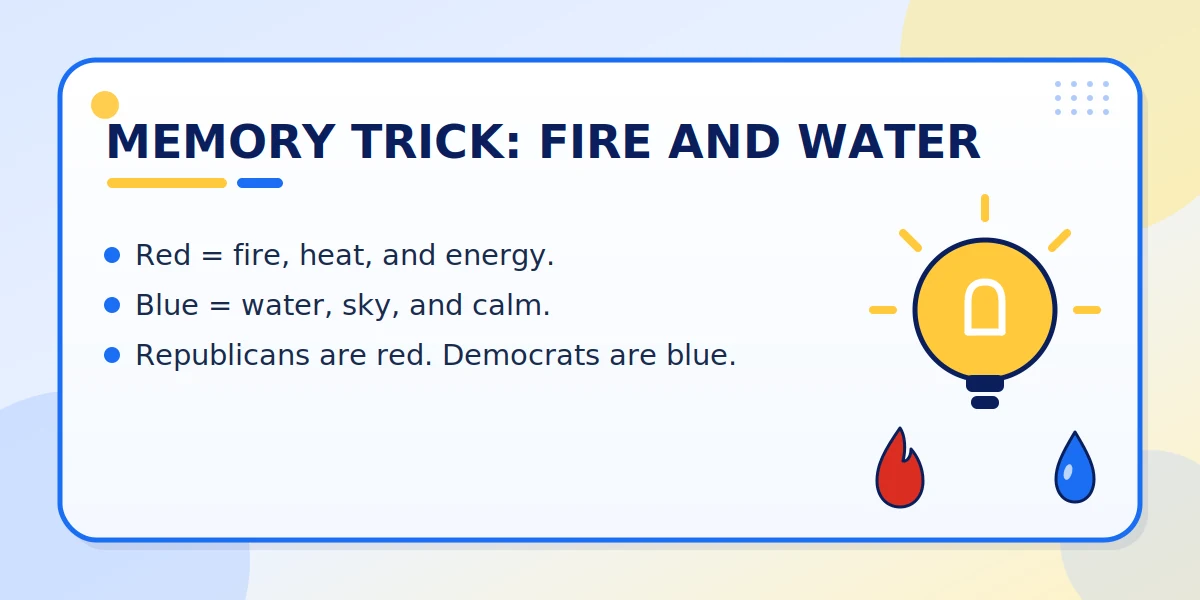
Use these simple associations to remember the difference:
- Red: Think of fire, heat, energy, passion, and warning signs.
- Blue: Think of water, sky, calmness, trust, and stability.
- US politics: Republicans are red. Democrats are blue.
- The Matrix: Red reveals reality. Blue preserves the illusion.
Remember that these are common associations. The context determines what each colour means.
Practice Questions: Red or Blue
Test what you have learned with these 10 questions. Choose the best answer for each one.
- Which colour is commonly associated with warmth and energy? A. Blue B. Red C. Green D. White
- Which colour is commonly associated with calmness and trust? A. Orange B. Yellow C. Blue D. Red
- Which political party does red represent on modern US election maps? A. Democratic Party B. Republican Party C. Green Party D. Libertarian Party
- Which political party does blue represent on modern US election maps? A. Republican Party B. Green Party C. Democratic Party D. Libertarian Party
- What does the term “purple state” mean? A. A state with no political parties B. A state where both major parties are competitive C. A state that always votes Republican D. A state that always votes Democratic
- Which presidential election helped establish the modern red-state and blue-state convention? A. 1976 B. 1988 C. 1992 D. 2000
- What do red and blue pigments generally make when mixed? A. Green B. Orange C. Purple or violet D. White
- What do red and blue lights make when mixed? A. Magenta B. Green C. Yellow D. Black
- What does the red pill represent in The Matrix? A. Choosing a comfortable illusion B. Discovering the truth C. Forgetting the past D. Avoiding a decision
- What does “out of the blue” mean? A. Happening very rarely B. Feeling sad C. Happening unexpectedly D. Becoming angry
Answer Key
- B. Red. Red is commonly associated with warmth, passion, and energy.
- C. Blue. Blue often represents calmness, trust, and stability.
- B. Republican Party. Modern US election maps use red for Republicans.
- C. Democratic Party. Modern US election maps use blue for Democrats.
- B. A state where both major parties are competitive. Purple describes a politically mixed or closely contested state.
- D. 2000. The election helped establish the modern red and blue political convention.
- C. Purple or violet. Traditional pigment mixing generally produces a purple or violet result.
- A. Magenta. Red and blue light combine to make magenta in the RGB model.
- B. Discovering the truth. The red pill reveals the real world in the film.
- C. Happening unexpectedly. The expression describes something that occurs without warning.
Frequently Asked Questions About Red or Blue
Is Red or Blue a Better Colour?
Neither colour is always better. Red can suit designs that need energy or urgency. Blue can suit designs that need calmness or trust. Your purpose, audience, and cultural context should guide the choice.
Is Red Warmer Than Blue?
Yes. Red is generally classified as a warm colour, while blue is classified as a cool colour. Red can suggest fire and heat. Blue often brings water, ice, and the sky to mind.
Are Red and Blue Complementary Colours?
No. Red and blue are not complementary colours in these standard models. In the traditional RYB colour wheel, red’s complement is green; in additive RGB light, red’s complement is cyan.
Why Are Republicans Red and Democrats Blue?
The modern US convention became established around the 2000 presidential election. Major news maps used red for Republican George W. Bush and blue for Democrat Al Gore. Earlier media maps used different colour assignments.
What Is the Difference Between a Red State and a Blue State?
A red state generally votes Republican in presidential elections. A blue state generally votes Democratic. These labels describe voting patterns, not every resident’s political views or the political beliefs of every community.
What Does Red Pill or Blue Pill Mean?
The expressions come from the 1999 film The Matrix. The red pill represents discovering an uncomfortable truth. The blue pill represents choosing a familiar illusion instead of learning what is really happening.
What Do Red and Blue Make When Mixed?
When you mix red and blue pigments, they generally make purple or violet. When you mix red and blue light, the result is magenta. The difference comes from how pigments and light combine.
Related Guides
Explore these related ClarifyWords Vocabulary guides:
- Yes or No: https://clarifywords.com/yes-or-no/
- True or False: https://clarifywords.com/true-or-false/
- Win or Lose: https://clarifywords.com/win-or-lose/
- All or Nothing: https://clarifywords.com/all-or-nothing/
- Black or White: https://clarifywords.com/black-or-white/
- Rain or Shine: https://clarifywords.com/rain-or-shine/
You can find more word comparisons and meaning guides in the ClarifyWords Vocabulary category: https://clarifywords.com/category/vocabulary/
Final Takeaway: Red or Blue?
Red commonly represents warmth, passion, energy, and urgency. Blue often represents calmness, trust, stability, and peace. In US politics, red represents Republicans and blue represents Democrats. In The Matrix, the red pill represents truth, while the blue pill represents a comfortable illusion. When you face a choice of red or blue, consider your purpose and audience. The context matters more than the colour itself.