

Per Say or Per Se: Which Spelling Is Correct?

Have you ever written per say when you meant per se? You are not alone. These expressions sound alike, but only one is correct for the Latin phrase.
The correct spelling is per se. It means “by itself,” “in itself,” or “intrinsically.” Writers use it to describe something on its own, without considering its surrounding circumstances.
For example:
Correct: The idea is not wrong per se.
Incorrect: The idea is not wrong per say.
The confusion comes from pronunciation. The final part of per se sounds like the English word say. However, the spelling comes from Latin, so it remains se.
This guide explains the meaning, pronunciation, origin, and correct usage. You will also learn how the phrase appears in legal writing and how to avoid common mistakes.
Table of Contents
- Quick Answer: Is It Per Say or Per Se?
- Per Se vs. Per Say: Comparison Table
- What Does Per Se Mean?
- What Is the Latin Origin of Per Se?
- How Do You Pronounce Per Se?
- Why Do People Write Per Say Instead of Per Se?
- How to Use Per Se Correctly
- Punctuation and Italics: Should Per Se Be Italicized or Set Off With Commas?
- Per Se Synonyms and Similar Phrases
- What Does Per Se Mean in Law?
- When Is Per, Say Correct?
- Is Perse a Word?
- Common Per Se Mistakes: Wrong vs. Right Examples
- How to Remember the Correct Spelling
- Practice: Per Say or Per Se?
- Frequently Asked Questions About Per Say or Per Se
- Final Takeaway: Use Per Se, Not Per Say
- Keep Learning: More Spelling Guides
Quick Answer: Is It Per Say or Per Se?
The question per say or per se has one clear answer. Per se is correct when you mean “by itself” or “in itself.” Per say is never correct for this meaning.
Per se is a Latin phrase. It entered English in the 1500s and is still common in everyday, academic, and legal writing. Per say has no dictionary entry and no Latin root. It is a spelling error caused by sound.
Correct: The policy is not harmful per se.
Incorrect: The policy is not harmful per say.
If you mean “in itself,” write per se. That rule covers almost every case you will meet.
Per Se vs. Per Say: Comparison Table
This table answers per say or per se at a glance. The correct spelling is per se, not per say. The phrase comes from Latin and means “by itself” or “in itself.”
| Feature | Per Se | Per Say |
|---|---|---|
| Correct spelling | Yes | No, not for the Latin phrase |
| Meaning | By itself or in itself | No standard meaning as this phrase |
| Origin | Latin | Sound based misspelling |
| Pronunciation | /ˌpɜːr ˈseɪ/ in US English | Often written to match the sound |
| Grammatical use | Adverbial phrase | Incorrect when intended to mean per se |
| Example | The decision is not unfair per se. | The decision is not unfair per say. |
Remember that per say is not an accepted alternative spelling. If you mean “in itself,” write per se.
There is one separate exception. The words per and say can appear next to each other in a sentence with different meanings. We explain that construction later.
What Does Per Se Mean?
Per se means “by itself,” “in itself,” or “intrinsically.” It describes something considered on its own, rather than as part of a larger situation.
Merriam-Webster defines the phrase as meaning “by, of, or in itself.” Dictionary.com also explains it as something considered in its own nature. Collins says per se means “by itself” or “in itself,” and is used when you are talking about the qualities of one thing considered on its own.
Writers who ask about per say or per se want the same thing: the right spelling and the right use. The phrase helps a writer avoid making an overly broad statement. It separates one thing from its wider context.
Simple Examples of Per Se
Here are several examples that show how the phrase works:
The idea is not bad per se, but the timing is wrong.
Working late is not unhealthy per se.
The rule does not prohibit the activity per se.
The movie is not boring per se, but its story moves slowly.
The expense is not a problem per se, but the budget is limited.
The technology is not dangerous per se. Its use can create risks.
In each sentence, per se separates the subject from its wider context.
What Does Per Se Mean in Everyday English?
In everyday writing, per se often means “in itself” or “on its own.”
Writers use it when they want to make a careful distinction. It helps show that something is not necessarily good, bad, harmful, or useful by its nature.
Do not use it simply to mean “really,” “actually,” or “so to speak.” Those expressions have different meanings.
Consider this example:
I do not dislike the job per se. I dislike the long commute.
The speaker does not object to the job itself. The commute creates the problem.
The phrase is more formal than many everyday alternatives. In casual conversation, you can often replace it with “by itself” or “in itself.”
Do not use it simply to mean “really,” “actually,” or “so to speak.” Those expressions have different meanings.
What Is the Latin Origin of Per Se?
Per se comes from Latin. Its two parts help explain its meaning.
Per means “by” or “through.”
Se is a reflexive pronoun that can mean “itself” or “oneself.”
Together, the words express the idea of something considered by itself.
The phrase entered English during the 1500s. Merriam-Webster gives 1574 as the first known use of the adverb per se in English. Longman places its English origin within the period from 1500 to 1600.
These dates describe recorded English usage. They do not establish the exact year when someone first created the expression.
What Do Per and Se Mean Separately?
Per is a Latin preposition. It means “by” or “through.” It also appears in English phrases such as “per day” and “per person.”
Se is a Latin reflexive pronoun. It means “itself,” “oneself,” or “themselves,” depending on context.
The spelling is se, not say. The Latin root explains the spelling, even though the sound points the other way.
How Was Per Se Used Historically?
One early use referred to letters as letters. For example, the expression “A per se” treated the letter A as something in itself.
The phrase also appeared in Shakespeare’s Troilus and Cressida. In Act 1, Scene 2, Alexander describes Ajax as “a very man per se.”
The Folger Shakespeare Library confirms this wording in its digital text. In this context, the expression suggests someone who stands apart or is exceptional.
Today, the phrase has a broader role in English. It appears in everyday writing, academic discussions, and legal language.
How Do You Pronounce Per Se?
The phrase is commonly pronounced pur SAY. The second part receives the main stress.
Merriam-Webster gives this pronunciation: (ˌ)pər-ˈsā.
Oxford Learner’s Dictionaries provides these IPA transcriptions:
| English variety | IPA |
|---|---|
| US English | /ˌpɜːr ˈseɪ/ |
| UK English | /ˌpɜː ˈseɪ/ |
The exact vowel sound can vary slightly between speakers. However, the final syllable sounds like the English word say.
Why Does Per Se Sound Like Per Say?
The spelling confusion comes from the way the phrase sounds.
When people hear per se, they may assume the final word is say. That assumption leads them to write per say.
However, pronunciation does not determine the spelling of every expression. This phrase keeps its original Latin spelling.
Remember that se is the correct written form, even though it sounds like say.
Why Do People Write Per Say Instead of Per Se?
People often write per say because they spell the phrase according to its sound.
The mix-up behind per say or per se is simple: the ear hears say, but the word is se. People trust what they hear and write the familiar English word.
This type of mistake is sometimes called an eggcorn. An eggcorn occurs when someone mishears or reinterprets a word or phrase and replaces it with a familiar expression.
The replacement may seem logical because it sounds similar. However, it does not preserve the original spelling or meaning.
For example, someone may hear:
The suggestion is not unreasonable per se.
They may remember the final sound as say and write:
The suggestion is not unreasonable per say.
The second sentence contains a spelling error. The correct Latin expression remains per se.
This mistake is easy to avoid once you connect the spelling with its Latin origin.
Is Per Say an Eggcorn?
Yes, when it is used as a replacement for per se.
An eggcorn is a sound based error. The writer hears the phrase, finds a familiar word that fits the sound, and uses it. The result looks sensible but is wrong.
Per say fits that pattern exactly. Say is a common English word, and it sounds just like se. The mistake feels natural, which is why so many people make it.
A common spelling mistake is not the same as a legitimate separate use of the words per and say. That separate use is covered later in this guide.
How to Use Per Se Correctly
Use per se when you want to describe something in itself, without including its wider effects or circumstances.
The phrase generally functions as an adverbial expression. It can qualify an adjective, an action, or a broader statement.
Once you know the answer to per say or per se, the next step is using the phrase well. The examples below show the most natural placements.
Use Per Se to Mean “In Itself”
Here are examples that show its basic use:
The proposal is not unreasonable per se.
The software is not difficult per se.
The decision was not unfair per se.
The activity is not harmful per se.
Each sentence evaluates the subject on its own.
For instance, the software may not be difficult by nature. A user’s lack of experience may make it harder to operate.
Use Per Se to Qualify a Statement
The phrase is especially useful when a writer wants to separate two related ideas.
Examples:
I do not dislike the job per se; I dislike the commute.
The speaker distinguishes the job from the travel required to reach it.
The expense is not a problem per se, but the timing is.
The cost itself is manageable. The timing creates the difficulty.
The change is not harmful per se, although it may create other issues.
The change is not automatically harmful. Its effects depend on the circumstances.
Can You Use Per Se at the Beginning or End of a Sentence?
The phrase can appear in different positions. Its placement depends on the sentence and the idea it modifies.
It often appears after the word or statement it qualifies.
Examples:
The rule is not unfair per se.
The plan, per se, is not the problem.
The decision does not create a legal violation per se.
The last example shows sentence-final placement. In most cases, placing the phrase after the idea it qualifies creates a clearer sentence. Sentence-initial use is rare and usually sounds stiff in ordinary writing.
Punctuation and Italics: Should Per Se Be Italicized or Set Off With Commas?
Writers often ask whether per se needs commas or italics. The answer depends on its role in the sentence and the style requirements.
Do You Put Commas Around Per Se?
Use commas when the phrase interrupts a sentence as a parenthetical expression.
For example:
The idea, per se, is not unreasonable.
Here, the phrase adds a qualification to the sentence. The commas set it apart.
However, commas are not automatically required every time you use per se.
For example:
The idea is not unreasonable per se.
The phrase appears at the end of the clause. It does not need a comma in this construction.
Compare these examples:
| Sentence | Punctuation |
|---|---|
| The proposal, per se, is not unreasonable. | Commas set off the parenthetical phrase. |
| The proposal is not unreasonable per se. | No comma is needed at the end. |
| The rule itself is not harmful per se, but its use may be. | A comma separates the two independent clauses. |
Choose punctuation based on sentence structure. Do not add commas automatically.
Should Per Se Be Italicized?
There is no single formatting choice that applies to every publication.
Some legal and academic writing italicizes per se because it is a Latin expression. General writing and news writing often use roman type.
The MLA Style Center provides general guidance on styling foreign terms. It explains that unfamiliar foreign expressions may be italicized, while familiar or naturalized terms may appear in roman type.
That guidance does not specifically require italics for every use of per se.
You may see both forms:
Italic form: The decision was not unfair per se.
Roman form: The decision was not unfair per se.
Follow the style guide or publication requirements for your document. Consistency matters more than choosing one format for every situation.
Per Se Synonyms and Similar Phrases
Several English expressions have meanings similar to per se. They can help you avoid repetition or make a sentence easier to understand.
However, these alternatives do not work in every context. If per say or per se feels too formal for a sentence, a plain synonym often works better.
Common Synonyms for Per Se
| Similar phrase | General meaning |
|---|---|
| In itself | Considered on its own |
| By itself | Without help or other factors |
| In and of itself | In its own nature |
| On its own | Independently |
| As such | In that particular capacity |
| Intrinsically | By its essential nature |
| Essentially | In its basic nature or meaning |
| In essence | In its most important sense |
| Inherently | As a natural or permanent quality |
Per Se vs. In Itself vs. In and of Itself
These expressions often communicate similar ideas.
For example:
The rule is not unfair per se.
The rule is not unfair in itself.
The rule is not unfair in and of itself.
All three sentences suggest that the rule is not inherently unfair.
The phrase in and of itself can add emphasis. However, it may also make a sentence longer than necessary.
Per Se vs. Essentially
Essentially often introduces the basic nature or main point of something.
Per se more specifically separates something from its surrounding circumstances.
Compare:
The plan is not expensive per se.
This means the plan itself is not expensive, although other factors may affect its cost.
Essentially, the plan costs more than expected.
This summarizes the main point about the plan.
The expressions have related meanings, but they are not interchangeable in every sentence.
Per Se vs. So to Speak
So to speak signals figurative or approximate language.
For example:
He became the team’s unofficial leader, so to speak.
This suggests that the description is not completely literal.
By contrast:
He is not the team’s leader per se.
This means he is not officially or inherently the leader.
Use each expression according to its meaning.
What Does Per Se Mean in Law?
In legal writing, per se generally describes something treated as inherently or legally so under a particular rule. The legal uses of per say or per se are the most formal ones you will meet, so they deserve a careful look.
Its meaning depends on the legal doctrine and jurisdiction. Different areas of law use the expression in different ways.
Four common examples are negligence per se, defamation per se, per se antitrust violations, and per se DUI laws.
| Legal term | General meaning |
|---|---|
| Negligence per se | A legal violation may establish breach of duty under certain conditions. |
| Defamation per se | Certain defamatory statements may qualify for presumed damages. |
| Per se antitrust violation | Certain business restraints are treated as unlawful without a full rule of reason analysis. |
| Per se DUI | Driving at or above a specified blood alcohol level can be illegal without separate proof of impairment. |
These are general explanations, not legal advice. The applicable rules depend on the facts and governing law.
What Is Negligence Per Se?
Negligence per se is a doctrine that can apply when someone violates a safety statute or regulation.
Under the relevant legal conditions, that violation may establish the breach of duty element in a negligence claim.
Courts generally consider whether the rule protects the injured person’s class and addresses the type of harm that occurred.
For example, imagine a driver violates a safety law designed to protect pedestrians. A pedestrian suffers the kind of injury that the law aims to prevent.
The violation may support a negligence per se claim. However, the result depends on the applicable law and any recognized exceptions.
Cornell Law School’s Legal Information Institute explains the doctrine and its requirements.
What Is Defamation Per Se?
Defamation per se refers to certain defamatory statements that the law may treat as especially harmful.
In some circumstances, a person may seek presumed damages without proving specific financial loss.
Traditional categories can include certain accusations of serious crimes or professional incompetence.
However, the categories and legal requirements vary by state. Not every false or damaging statement qualifies as defamation per se.
Cornell Law School’s Legal Information Institute explains that the doctrine depends on the nature of the statement and the applicable legal standards.
What Is a Per Se Antitrust Violation?
Antitrust law uses per se to describe certain business restraints that courts treat as unlawful without conducting a full rule of reason analysis.
Examples can include naked price fixing, bid rigging, and market division among competing businesses.
The US Department of Justice explains the distinction between per se treatment and the rule of reason approach.
Under the rule of reason, courts examine the competitive effects of an agreement and any relevant justifications.
Not every agreement involving competitors or prices is automatically a per se violation. The specific conduct and legal context matter.
What Does Per Se DUI Mean?
A per se DUI law makes it illegal to drive with a blood alcohol concentration at or above a specified legal limit.
The government does not need to prove separate evidence of impairment for this type of charge. The measured BAC can establish the violation.
In most US states, the standard adult limit is 0.08 percent BAC. Utah uses a lower limit of 0.05 percent BAC.
Lower limits may apply to underage drivers and certain commercial drivers.
The National Highway Traffic Safety Administration explains the general per se BAC framework. Utah’s official highway safety authority confirms its lower threshold.
When Is “Per, Say” Correct?
The words per and say can appear next to each other in a sentence. However, this does not make per say a correct spelling of the Latin expression.
In this separate construction, each word has its own meaning.
Per can mean “for each.”
Say can introduce an example or an estimate.
Consider this sentence:
The fee is $10 per person, say, for a group of five.
Here, per means “for each person.” The word say introduces an example or estimate.
The words do not form one expression. They simply happen to appear next to each other.
Per Se vs. Per, Say
Compare the two uses:
| Expression | Meaning |
|---|---|
| The idea is not wrong per se. | The idea is not wrong in itself. |
| The fee is $10 per person, say, for a group of five. | The fee is $10 for each person, for example. |
This distinction matters when checking spelling. If you mean “in itself,” always write per se.
Is Perse a Word?
Yes. Perse is a separate English word, but it does not mean “by itself.”
Merriam-Webster lists perse as an adjective meaning a dark grayish blue resembling indigo.
It is a rare color term. It is not another spelling of the Latin phrase per se.
Compare the meanings:
Per se: By itself or in itself.
Perse: A dark grayish blue color resembling indigo.
Per say: A misspelling when intended to mean per se.
Do not use perse when you mean the Latin expression. Keep the two words separate.
Common Per Se Mistakes: Wrong vs. Right Examples
The easiest way to avoid spelling errors is to recognize the forms that commonly appear in writing.
Most errors in per say or per se come from sound, not from carelessness. The correction bank below covers spelling, meaning, and punctuation.
Spelling Mistakes
| Wrong | Right |
|---|---|
| The plan is not bad per say. | The plan is not bad per se. |
| The rule is not unfair persay. | The rule is not unfair per se. |
| The decision is not wrong per-say. | The decision is not wrong per se. |
| The problem is not serious perse. | The problem is not serious per se. |
The correct expression always has two words: per se.
Meaning and Usage Mistakes
Some writers spell the phrase correctly but use it incorrectly.
| Incorrect use | Better wording |
|---|---|
| I per se think the plan will work. | I think the plan will work. |
| The movie was per se amazing. | The movie was genuinely amazing. |
| She was upset, per se. | She was upset. |
| The rule is per se bad because I dislike it. | The rule is not bad per se, but I dislike its effects. |
Use per se only when you mean “in itself” or “by itself.”
Do not insert it into a sentence just to sound formal. If removing the phrase does not change the intended meaning, you may not need it.
Punctuation and Formatting Mistakes
Watch for these additional errors:
- Adding commas automatically: Commas depend on the phrase’s role in the sentence.
- Assuming italics are always required: Follow your publication’s style requirements.
- Joining the words: Write per se, not perse.
- Using the phrase as a filler: It should express a specific distinction.
- Confusing pronunciation with spelling: The final sound does not change the Latin spelling.
For more help with commonly confused words, explore our guides to affect vs. effect, principal vs. principle, and loose vs. lose.
How to Remember the Correct Spelling
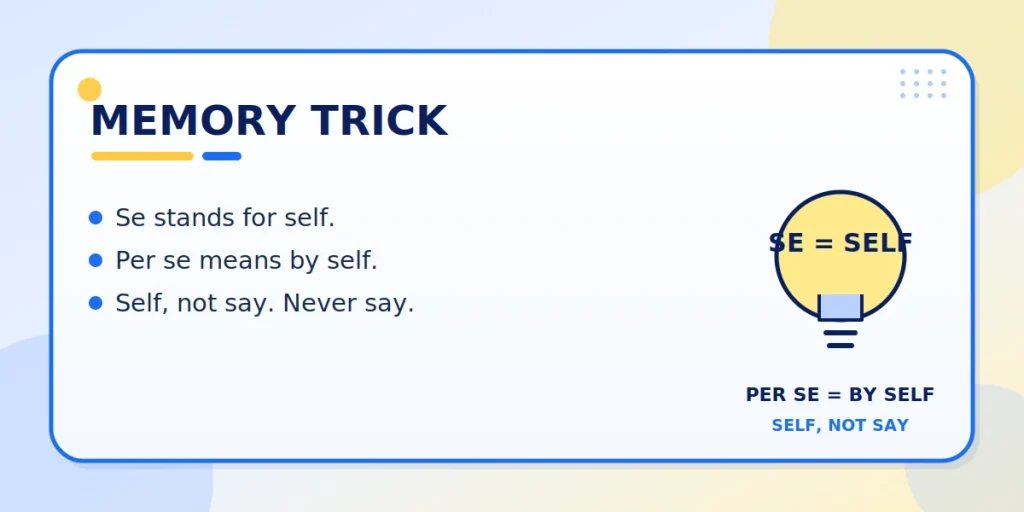
Use this simple memory trick:
Remember that SE is the Latin part meaning “itself.”
The phrase is per se, not per say.
The fastest way to settle per say or per se is the se test. Ask what se stands for. It stands for self. Per se means “by self,” which is the same as “by itself.”
You can also remember this example:
The idea is not wrong per se.
The final sound may resemble say, but the spelling stays se.
When you are unsure, replace the phrase with “in itself.” If the sentence keeps its meaning, per se is probably the expression you need.
Practice: Per Say or Per Se?
Test your understanding with these 10 questions. Choose the correct spelling or identify the meaning.
Practice Questions
- Which spelling is correct when you mean “in itself”: per say or per se?
- Complete the sentence: “The suggestion is not unreasonable ___, but it needs more detail.”
- What does per se mean?
- True or false: Per say is an accepted alternative spelling of the Latin phrase.
- Correct this sentence: “The policy is not harmful per say.”
- Which pronunciation is commonly used for per se: “pur SAY” or “per see”?
- In the sentence below, are per and say one expression or two separate words? “The fee is $10 per person, say, for a group of five.”
- Does per se always require commas around it?
- What does per se mean in the expression “negligence per se”?
- Is perse, meaning a dark grayish blue, another spelling of per se?
Answer Key with Explanations
- Per se. It is the correct spelling of the Latin phrase.
- Per se. The sentence means the suggestion is not unreasonable in itself.
- By itself, in itself, or intrinsically.
- False. Per say is a common sound based spelling mistake.
- The policy is not harmful per se.
- Pur SAY. The final syllable sounds like the English word say.
- Two separate words. Per means “for each,” while say introduces an example or estimate.
- No. Commas depend on sentence structure and whether the phrase is parenthetical.
- A legal doctrine. Under certain conditions, a statutory or regulatory violation may establish breach of duty.
- No. Perse is a separate adjective for a dark grayish blue color.
For more spelling guidance, visit our Spelling Differences category.
Frequently Asked Questions About Per Say or Per Se
Is It Per Se or Per Say?
Per se is correct when you mean “by itself” or “in itself.” Per say is a common spelling mistake caused by pronunciation. The final syllable sounds like say, but its Latin spelling remains se.
What Does Per Se Mean in Simple Terms?
Per se means something considered on its own, without including its wider circumstances or effects. For example, a rule may not be unfair per se, although applying it unfairly can create problems.
How Do You Pronounce Per Se?
In US English, per se is commonly pronounced “pur SAY.” Merriam-Webster gives the pronunciation as (ˌ)pər-ˈsā. Oxford lists /ˌpɜːr ˈseɪ/ for US English and /ˌpɜː ˈseɪ/ for UK English, and both stress the second syllable.
Should Per Se Be Italicized?
It depends on your publication’s style requirements. Some legal and academic writing italicizes Latin expressions, while general writing often uses roman type. Follow your required style guide and keep your formatting consistent throughout the document.
Do You Put Commas Around Per Se?
Use commas when per se interrupts a sentence as a parenthetical expression. For example, “The idea, per se, is not unreasonable.” A sentence ending with the phrase usually needs no extra comma.
Is Per Say Ever Correct?
Not when you mean the Latin phrase per se. However, the separate words per and say can appear next to each other. For example, per can mean “for each,” while say introduces an estimate.
What Does Per Se Mean in Legal Terms?
In law, per se generally describes something treated as inherently or legally so under a specific rule. Examples include negligence per se, defamation per se, certain antitrust violations, and per se DUI laws.
Final Takeaway: Use Per Se, Not Per Say
The correct spelling is per se when you mean “by itself,” “in itself,” or “intrinsically.” It comes from Latin and keeps its original two word spelling. That is the whole answer to per say or per se.
Per say is a common sound based spelling mistake. The final syllable sounds like say, but the correct spelling is se.
Remember the simple rule: SE means itself.
The next time you face per say or per se, choose per se. Use it when you want to describe something on its own. For example, the idea is not wrong per se.
Keep Learning: More Spelling Guides
- Gray vs Grey: Which Spelling Is Correct?
- Judgment vs Judgement: Which Spelling Is Correct?
- Defense vs Defence: Which Spelling Is Correct?
- Toward vs Towards: Which Spelling Is Correct?
- Aluminium or Aluminum: Which Spelling Is Correct?
- Passed vs Past: Meaning, Differences, and Examples
- Spelling Differences