True or False: Meaning, Examples, Questions, and How to Answer Them
Quick Answer
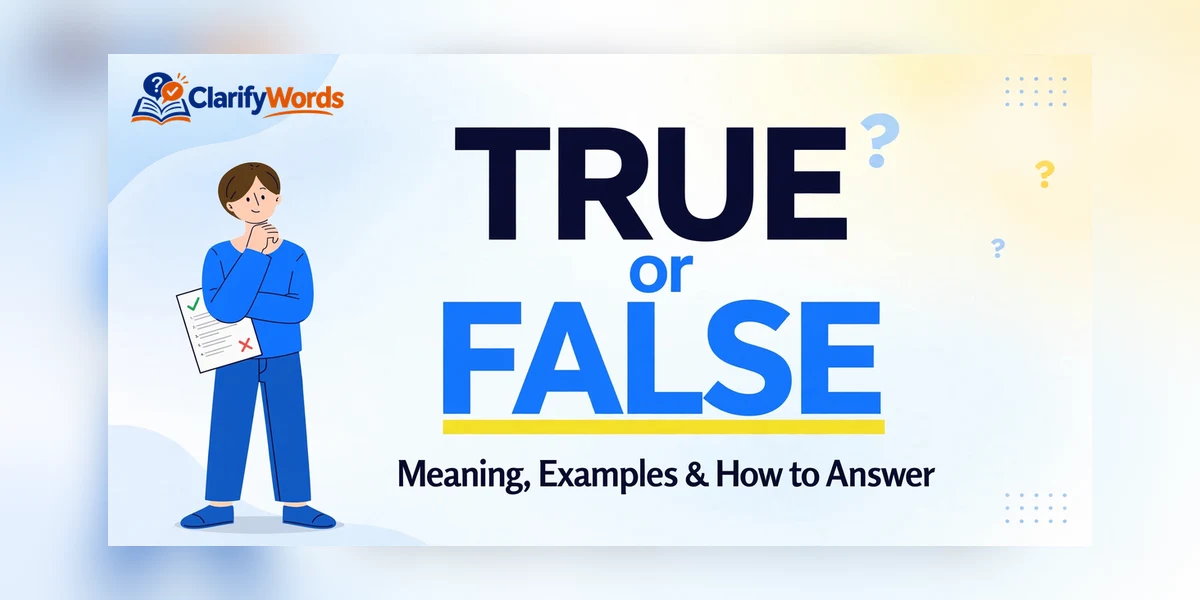
True means a statement agrees with facts or reality. False means it does not. A true or false question asks you to judge a statement and choose one of these two answers. Every part of a statement must be correct for the whole statement to be true.
This guide explains the phrase, shows how people use it, and compares it with yes or no questions. You will also learn how to answer true or false questions, how to write them, and how to practise with clear examples.
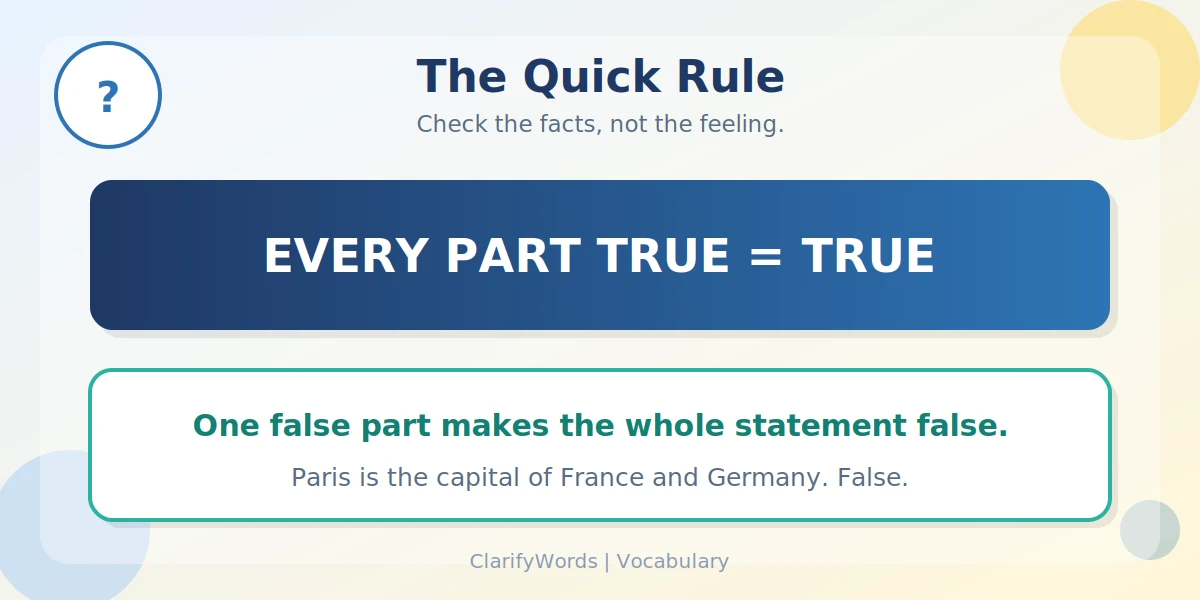
Table of Contents
- What Does True or False Mean?
- What Do True and False Mean Separately?
- What Is a True or False Question?
- Examples in Everyday Sentences
- How to Answer True or False Questions
- True or False vs. Yes or No
- Meaning in Logic and Computing
- How to Write Good True or False Questions
- Practice Questions
- Common Mistakes to Avoid
- Frequently Asked Questions
What Does True or False Mean?
The phrase true or false describes two possible judgments about a statement. A statement is true when it matches the facts. A statement is false when it does not match the facts.
You often see these words in quizzes, school tests, surveys, and everyday conversations. They help people check whether information is correct.
For example:
- The Earth moves around the Sun. True.
- The Sun moves around the Earth. False.
The first statement agrees with established facts. The second does not.
When Do People Use the Phrase?
People use these words in several situations:
- School tests: Students mark statements as correct or incorrect.
- Quizzes: Players decide whether facts are accurate.
- Everyday conversations: Someone may ask whether a claim is true.
- Logic: A statement receives a truth value.
- Computing: Boolean systems use true and false values.
What Does T/F Mean?
T/F is a common abbreviation for true or false. You may see it beside questions on worksheets, exams and quizzes.
For example: Water freezes at 0°C under standard atmospheric pressure. T/F? The correct answer is True.
What Do True and False Mean Separately?
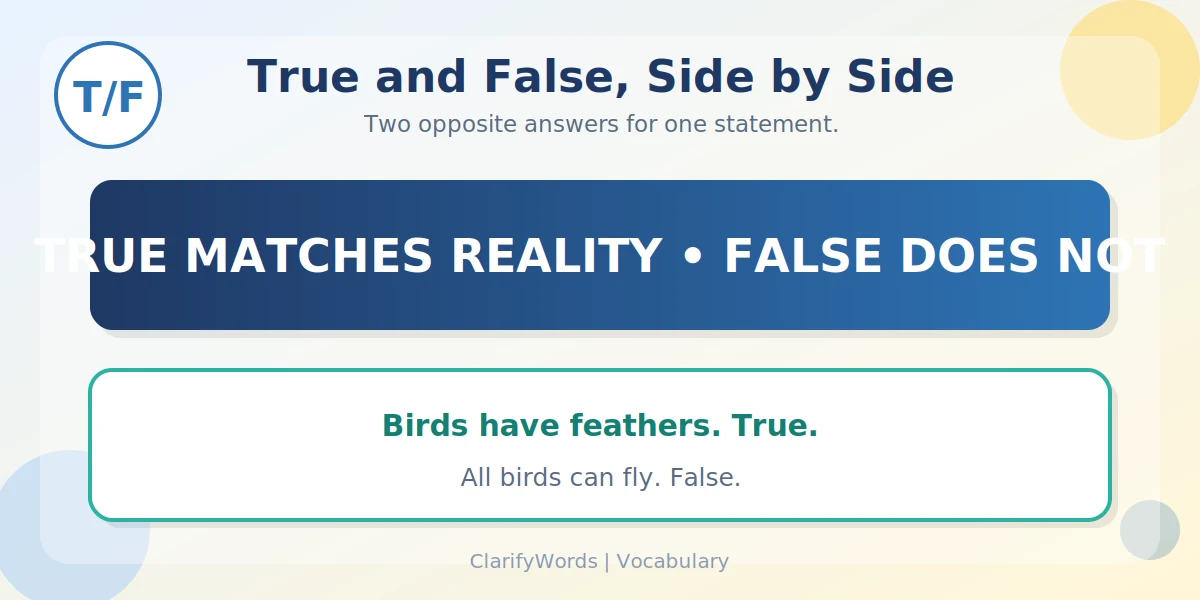
Although people often use the words together, each has its own meaning.
What Does True Mean?
According to Merriam-Webster, true can describe something that agrees with reality or fact. It can also describe something genuine or faithful.
Examples:
- The report contains true information.
- That is a true account of what happened.
- She told the truth about the mistake.
A true statement gives information that is correct in the context being discussed.
What Does False Mean?
Merriam-Webster defines false in terms of being untrue or not genuine. It can also describe something misleading.
Examples:
- The claim was false.
- The website shared false information.
- He gave a false name.
A false statement does not match the relevant facts. It may be a mistake, a misunderstanding, or a deliberate lie.
True vs. False: Key Differences
| True | False |
|---|---|
| Agrees with facts or reality | Does not agree with facts or reality |
| Describes something accurate | Describes something inaccurate |
| Supports a correct statement | Marks an incorrect statement |
| Example: Birds have feathers. | Example: All birds can fly. |
An Easy Memory Trick
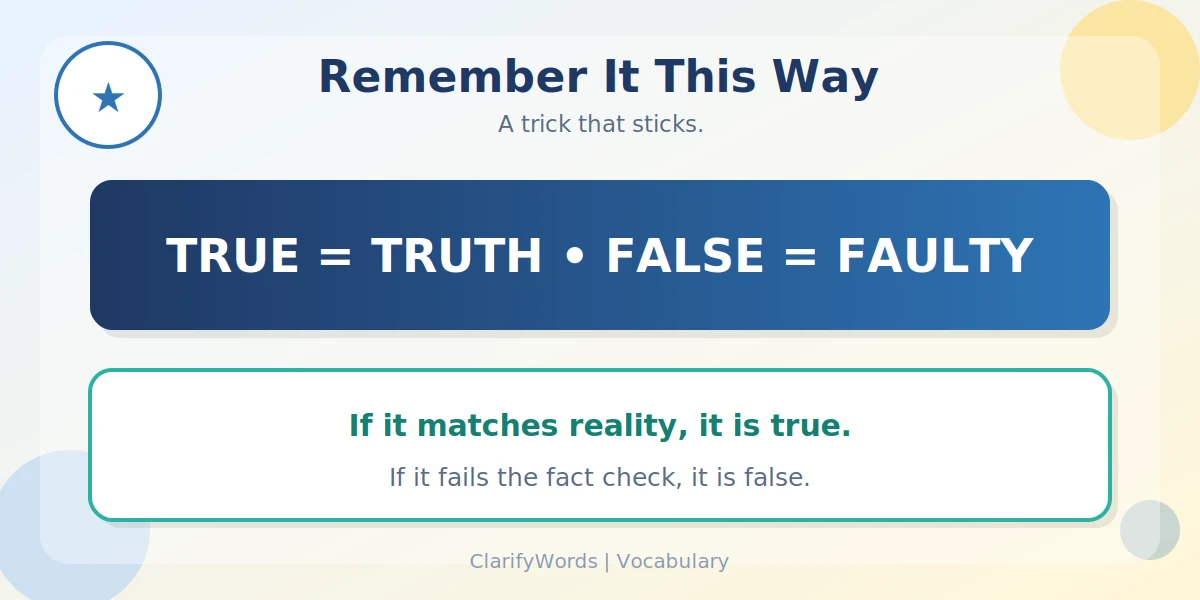
Use this simple reminder:
- True = Truth.
- False = Faulty or not factual.
Think of truth as information that matches reality. Think of false information as something that fails that check. Remember that a statement can sound believable and still be wrong. Always check what it actually says.
What Is a True or False Question?
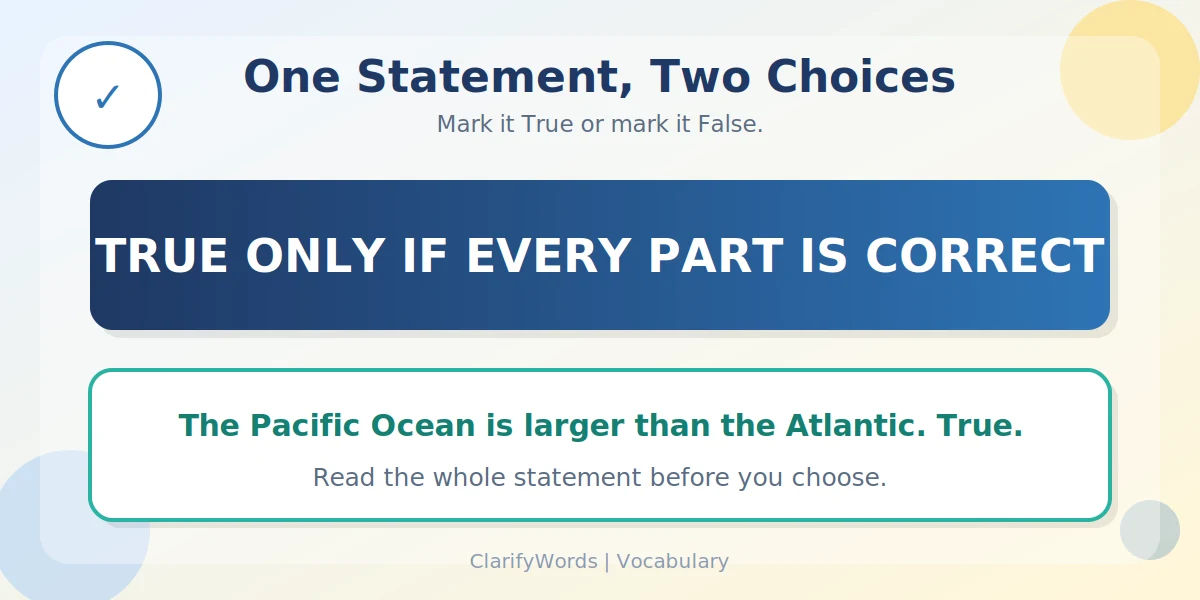
A true or false question gives you a statement and asks you to judge its accuracy. You normally choose one of two answers, True or False.
For example: The Pacific Ocean is larger than the Atlantic Ocean. The correct answer is True.
These questions appear in classrooms, training materials, online quizzes, and general knowledge games.
How Does This Question Type Work?
A typical question has three parts:
- A statement: It presents information for you to evaluate.
- Two answer choices: You select True or False.
- An answer key: The quiz or teacher identifies the correct choice.
Some worksheets use the letters T and F instead of full words. Others ask you to circle, tick, or select an answer.
What If Only Part of the Statement Is True?
The complete statement must be accurate to receive a True answer. If one important part is incorrect, the answer is False.
Consider this example: Paris is the capital of France and Germany. Paris is the capital of France, but not Germany. Therefore, the complete statement is False. This is one of the most important rules to remember. Do not mark a statement true just because its first part is correct.
Examples in Everyday Sentences
The words appear in ordinary speech as well as formal tests.
In Everyday Conversations
- Is it true that the shop closes early?
- That story is false.
- I cannot tell whether the rumor is true.
- The information in the message turned out to be false.
At School and During Exams
- Read each statement and mark True or False.
- There are ten true or false questions in this section.
- Check your answers before submitting the test.
- The teacher explained why the final statement was false.
In General Knowledge Quizzes
- The Great Wall of China is visible from the Moon with the naked eye. True or false?
- A group of lions is called a pride. True or false?
- Venus is the closest planet to the Sun. True or false?
The first statement is false. The second is true. The third is false because Mercury is closest to the Sun.
Using True and False Correctly in Sentences
| Sentence | Meaning |
|---|---|
| The answer is true. | The answer is correct. |
| That statement is false. | The statement is incorrect. |
| Tell me whether this claim is true. | Check the claim’s accuracy. |
| The article contains false details. | Some details are inaccurate. |
| Is the story true or made up? | Is it factual or invented? |
For related word-choice help, see the ClarifyWords guides to fewer vs less and who vs whom. You can also explore the differences between judgment vs judgement, its vs it’s, and whose vs who’s.
How to Answer True or False Questions
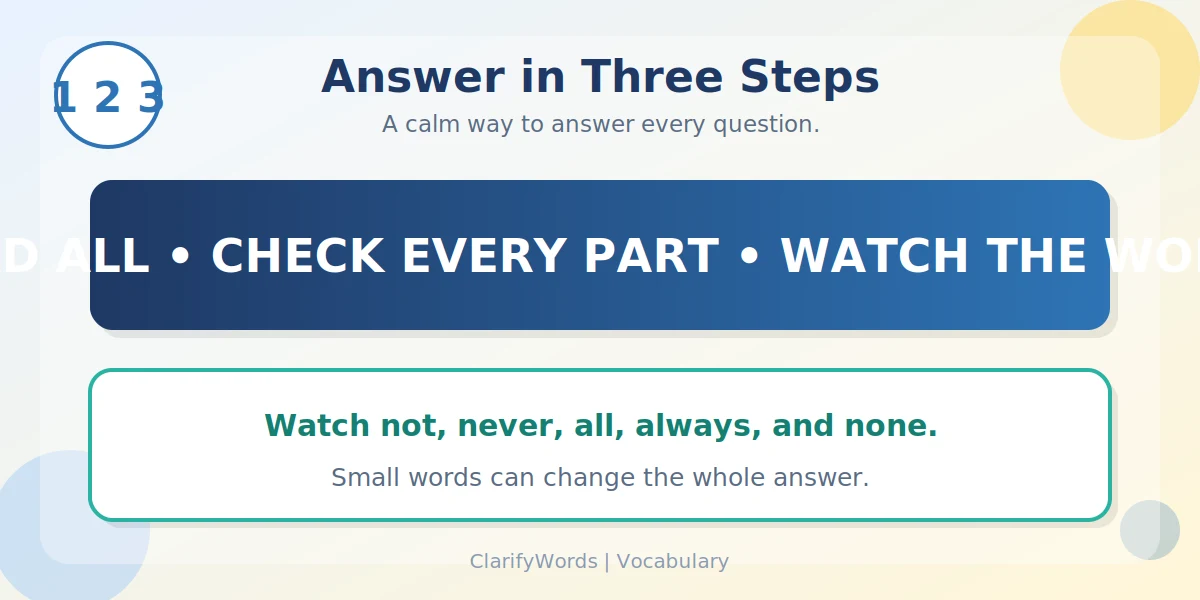
A good answer comes from checking the statement, not guessing based on how it sounds. Use these steps.
1. Read the Entire Statement
Do not stop after the first familiar fact. Read every word before choosing an answer. A sentence may begin with correct information and end with an incorrect detail. The final part can change the answer.
2. Check Every Part
Ask yourself whether each important detail is accurate.
For example: The Amazon River is in South America and flows through Egypt. The river is in South America, but it does not flow through Egypt. The statement is false.
3. Watch for Negative Words
Words such as not, never, and no can reverse a statement’s meaning.
Compare these sentences:
- Humans can breathe underwater without equipment. False.
- Humans cannot breathe underwater without equipment. True.
Missing one negative word can lead to the wrong answer.
4. Read Double Negatives Carefully
A double negative can make a sentence harder to understand.
For example: It is not impossible for some birds to swim. This means that some birds can swim. It does not mean that swimming birds are impossible. When you see two negative expressions, rewrite the sentence in simpler words before answering.
5. Pay Attention to Absolute Words
Words such as all, always, never, every, and none make broad claims.
For example: All mammals live on land. This statement is false because some mammals, such as whales, live in water. Absolute words deserve extra attention. However, they do not automatically make a statement false.
6. Notice Qualifiers
Qualifiers limit or narrow a statement. Examples include some, many, usually, often, and sometimes.
Compare:
- All snakes are poisonous. False.
- Some snakes are venomous. True.
A small word can change a statement from incorrect to correct.
7. Break Long Statements Into Smaller Parts
Long sentences may contain several claims. Check each claim separately.
For example: The Moon orbits Earth, produces its own light, and is larger than the Sun. The Moon orbits Earth, but it does not produce its own light or exceed the Sun in size. The whole statement is false.
8. Use Evidence Instead of Guessing
Look for facts you know or information provided in the question. In passage-based tests, use the passage rather than outside assumptions. Some verbal reasoning tests offer a third choice called Cannot Say. It means the passage does not provide enough information to decide.
9. Make an Educated Guess When Necessary
If the test does not penalize incorrect answers, leaving a question blank may waste an opportunity. A random guess between two choices has a 50% chance of being correct. That does not mean one answer is always more likely than the other.
True or False vs. Yes or No
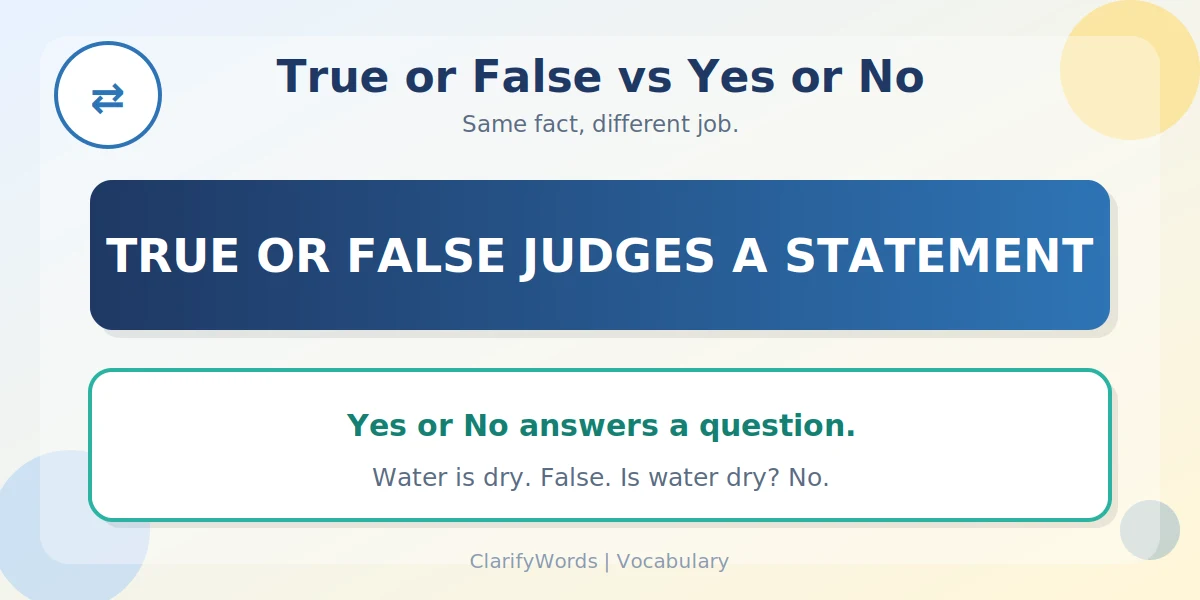
These expressions are related, but they do different jobs. True or false evaluates a statement. Yes or no answers a question or confirms something.
For a fuller explanation, read the ClarifyWords guide to yes or no.
Comparison Table
| True or False | Yes or No |
|---|---|
| Judges whether a statement is accurate | Answers a question |
| Usually applies to a statement | Usually follows a direct question |
| Example: The Earth is a planet. | Example: Is Earth a planet? |
| Answer: True | Answer: Yes |
Paired Examples
Example 1
- Statement: Water is made of hydrogen and oxygen. True or False?
- Question: Is water made of hydrogen and oxygen? Yes or No?
Both ask about the same fact. The answer format changes.
Example 2
- Statement: The library is open today. True or False?
- Question: Is the library open today? Yes or No?
The first asks you to judge a statement. The second asks you to answer a question. Use the right format for the task. Do not treat the two expressions as exact substitutes.
Meaning in Logic and Computing
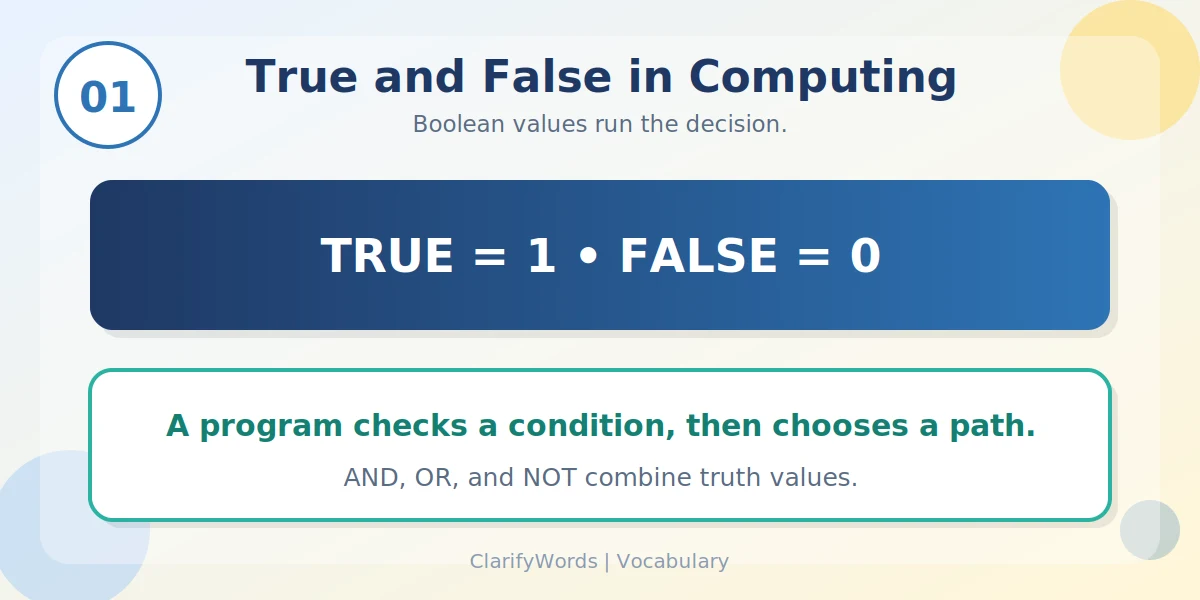
The distinction also matters in mathematics, formal logic, and computer science.
Truth Values in Logic
In classical logic, a proposition is a statement that can be judged true or false.
For example:
- Seven is greater than three. True.
- Seven is less than three. False.
The truth value describes whether the proposition is correct. Questions, commands, and many expressions of opinion are not propositions in this sense.
Boolean Logic in Computing
Computers often use Boolean values to represent two logical states: true and false. These values help programs make decisions. For example, a program may check whether a user is logged in.
A simple Python example looks like this:
is_logged_in = True
if is_logged_in:
    print('Welcome back!')
else:
    print('Please log in.')
The program checks the Boolean value and follows the matching branch. Some systems also represent Boolean states numerically as 1 and 0. The exact representation depends on the system.
How to Write Good True or False Questions
Clear questions help students show what they know. They also make quizzes easier to mark and understand. Follow these basic guidelines:
1. Test One Main Idea
Avoid combining several unrelated facts in one sentence. A question should test a clear point.
2. Use Verifiable Information
Choose claims that can be checked against reliable facts or course materials. Avoid vague statements and opinions.
3. Avoid Confusing Negative Wording
Negative sentences can be useful, but too many make questions harder to read. Avoid double negatives unless they test a specific skill.
4. Keep the Wording Clear
Use simple language and avoid unnecessary details. Students should understand what the statement asks them to judge.
5. Balance the Answer Choices
Do not make every answer True or every answer False. A balanced set can reduce predictable patterns, but the answers should follow the facts.
6. Prepare an Answer Key
Include the correct answer and a short explanation. Explanations help learners understand mistakes rather than just memorising answers.
Practice Questions
Try these 35 questions to test your understanding. Choose True or False for each statement. Check the numbered answer key below.
Easy Questions
- The Sun is a star.
- A week has seven days.
- Fish live naturally in water.
- The Moon is a planet.
- Ice is frozen water.
- Humans have three lungs.
- A triangle has three sides.
- Plants need light for photosynthesis.
- The Pacific Ocean is larger than the Atlantic Ocean.
- A square has four equal sides.
General Knowledge Questions
- Canberra is the capital of Australia.
- Venus is the closest planet to the Sun.
- The human body has 206 bones in a typical adult.
- The Sahara is a desert in Africa.
- Penguins are mammals.
- The chemical symbol for gold is Au.
- The Nile River flows through South America.
- Sound travels faster than light.
- Jupiter is the largest planet in our solar system.
- Mount Everest is the world’s highest mountain above sea level.
Tricky Questions
- All birds can fly.
- Some mammals live in water.
- A statement is true if one part of it is correct.
- The word ‘never’ always makes a statement false.
- A double negative can change a sentence’s meaning.
- Every rectangle is a square.
- In classical logic, a proposition has a truth value.
- A question is always a proposition.
- A random guess between two equally likely choices has a 50% chance of success.
- The words ‘yes’ and ‘true’ always serve the same purpose.
Questions for Kids
- Bees make honey.
- A cat is a type of fish.
- There are 12 months in a year.
- An elephant is smaller than a mouse.
- The Earth is the planet on which we live.
Answer Key With Explanations
- True. The Sun produces energy and light as a star.
- True. A standard week contains seven days.
- True. Fish are aquatic animals that generally live in water.
- False. The Moon is Earth’s natural satellite, not a planet.
- True. Ice is water in its solid state.
- False. Humans normally have two lungs.
- True. A triangle has three sides and three angles.
- True. Most plants use light energy during photosynthesis.
- True. The Pacific is the largest ocean on Earth.
- True. A square has four equal sides and four right angles.
- True. Canberra is Australia’s national capital.
- False. Mercury is the closest planet to the Sun.
- True. A typical adult human skeleton has 206 bones.
- True. The Sahara is a large desert in northern Africa.
- False. Penguins are birds, even though they cannot fly.
- True. Au comes from the Latin name aurum.
- False. The Nile River is in northeastern Africa.
- False. Light travels much faster than sound.
- True. Jupiter is the largest planet in our solar system.
- True. Everest has the highest elevation above sea level.
- False. Some birds, including penguins and ostriches, cannot fly.
- True. Whales and dolphins are mammals that live in water.
- False. Every important part of the statement must be correct.
- False. ‘Never’ can appear in a perfectly accurate statement.
- True. Two negative expressions can alter or soften a sentence’s meaning.
- False. A rectangle does not need four equal sides.
- True. Classical logic assigns propositions a truth value.
- False. A question does not normally make a claim that can be true or false.
- True. With two equally likely choices, each has a 50% chance.
- False. ‘Yes’ answers a question; ‘true’ evaluates a statement.
- True. Honeybees produce honey from collected nectar.
- False. Cats are mammals, not fish.
- True. A calendar year has 12 months.
- False. An elephant is much larger than a mouse.
- True. Earth is the planet humans live on.
Common Mistakes to Avoid
Even simple questions can cause confusion. Watch out for these common errors.
Assuming a Partly Correct Statement Is True
A statement may contain one accurate detail and one incorrect detail. Judge the entire sentence, not just the part you recognise.
Missing a Negative Word
Words such as not and never can reverse meaning. Read the full sentence before selecting an answer.
Treating Every Absolute Word as Wrong
Words such as all and always can signal a broad claim. They are not proof of a false statement. Check the facts.
Confusing Facts With Opinions
A factual claim can usually be checked. An opinion expresses a personal view or preference. For example, ‘Water freezes at 0°C under standard atmospheric pressure’ is a factual claim. A preference about winter weather is an opinion.
Mixing Up Yes/No and True/False
One format evaluates a statement. The other answers a question. Remember the difference when completing a test or quiz.
Guessing Before Reading Carefully
Do not choose an answer because the sentence sounds familiar. Look for details, limits, and words that change the meaning.
Frequently Asked Questions
These answers settle the most common true or false questions.
1. What Does True or False Mean in Simple Words?
It means deciding whether a statement is correct. True means it agrees with the facts. False means it does not. You commonly see this format in tests, quizzes and games.
2. What Is a True or False Question?
It is a question that presents a statement and asks you to judge its accuracy. You usually select True or False, and the answer key shows the correct choice. Read the whole statement before you choose.
3. Is a Statement True if Only Part of It Is True?
No. The complete statement must be accurate. If one important detail is wrong, the whole statement is false. Read every part before you answer. One wrong detail is enough to make the answer false, even if the rest sounds right.
4. What Is the Difference Between True or False and Yes or No?
True or False evaluates whether a statement is accurate. Yes or No answers a direct question or confirms something. The two formats are related, but they are not exact substitutes.
5. How Do You Answer True or False Questions?
Read the full statement, check each detail, and look for negative words or broad claims. Use evidence from the lesson or passage, and do not guess from sound alone. Check every part before you decide.
6. What Does T/F Mean?
T/F is short for true or false. It appears on worksheets, exams, and quizzes. When you see T/F beside a statement, choose whether that statement is correct. Mark T for a correct statement and F for an incorrect one.
7. Can an Opinion Be True or False?
A personal preference is usually an opinion, not a factual claim. However, a statement about someone’s opinion can be checked, for example whether a person actually holds that view. That check is about the person, not the preference itself.
For more word meanings and usage guides, explore these related ClarifyWords guides: yes or no, fewer vs less, who vs whom, judgment vs judgement, its vs it’s, and whose vs who’s. You can also browse all our Vocabulary guides.