

Analysis vs Analyses: What is the Difference?
Quick Answer
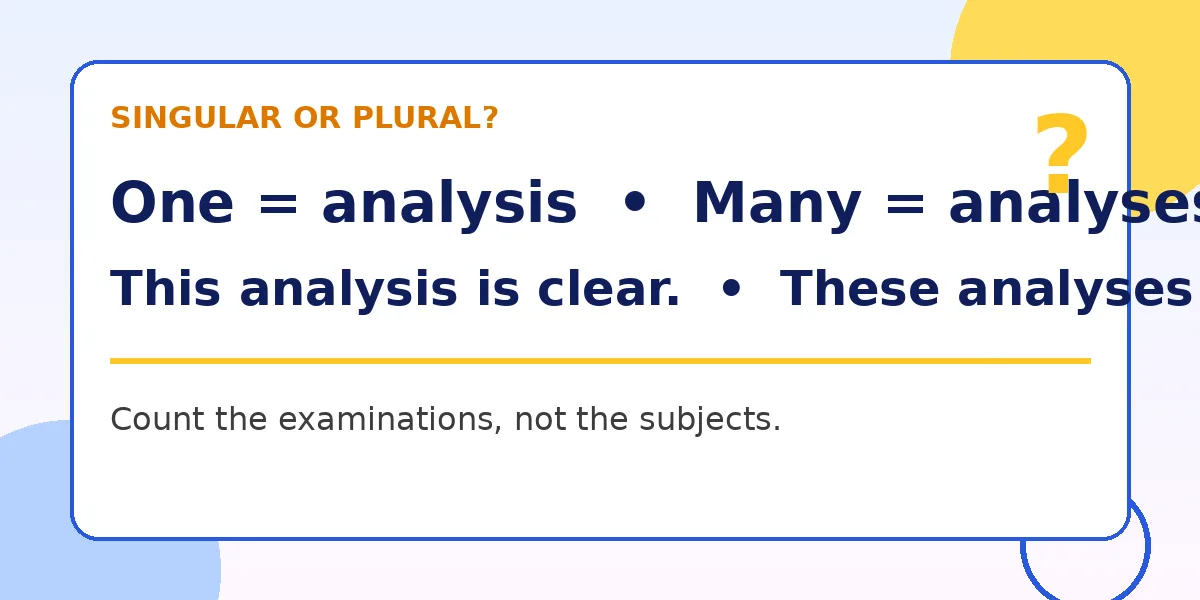
Analysis is the singular noun, while analyses is its plural form. Use analysis when you refer to one examination. Use analyses when you refer to more than one examination.
Singular: This analysis is based on recent data.
Plural: These analyses are based on recent data.
The spelling follows a Greek plural pattern. The ending changes from is to es. American English also uses analyzes as a verb, which creates another common source of confusion. In short, analysis vs analyses is a question of number, not meaning.
Table of Contents
- Comparison Table
- What Does Analysis Mean?
- What Does Analyses Mean?
- Why Is the Plural Spelled Analyses?
- How to Pronounce Both Words
- When to Use Each Form
- Analyze vs Analyse vs Analyses
- Subject Verb Agreement
- Common Mistakes and Corrections
- An Easy Memory Trick
- Practice Questions
- Frequently Asked Questions
- Related Guides
Comparison Table
Both words are nouns, but they have different grammatical numbers. This table settles analysis vs analyses at a glance and shows how to use each form correctly.
| Feature | Analysis | Analyses |
|---|---|---|
| Meaning | One examination or study | Two or more examinations |
| Grammatical number | Singular | Plural |
| Part of speech | Noun | Noun |
| Spelling | analysis | analyses |
| Pronunciation | /əˈnæləsɪs/ | /əˈnæləsiːz/ |
| Determiners | a, an, this, that | these, those, several, many |
| Verb agreement | is, was, shows | are, were, show |
| Example | This analysis is useful. | These analyses are useful. |
Remember that analyzes is not the plural noun. It is the American English verb form used with subjects such as he, she, or it.
What Does Analysis Mean?
In the analysis vs analyses pair, analysis is a noun that means a detailed examination of something. It involves studying its parts, features, or qualities. An analysis can explain a problem, reveal patterns, or help someone make a decision. You will often see it in academic, business, and scientific writing.
For example: The student wrote an analysis of the novel. Our team needs more analysis before making a decision. The financial analysis revealed several risks. Her analysis of the survey was thorough.
The word can be countable or uncountable, depending on its meaning.
When Is It Countable?
Use it as a countable noun when you refer to one particular examination, report, or study. Examples: The professor requested an analysis of the results. We completed two analyses of the survey. Each student submitted a detailed analysis. You can use numbers and articles with this meaning.
When Is It Uncountable?
Use it as an uncountable noun when you refer to the general process of examining something. Examples: The project needs more analysis. Further analysis is necessary. The decision requires careful analysis. In these examples, the word describes an activity or amount of examination. It does not refer to separate examinations. Oxford and Cambridge both identify the noun as countable and uncountable.
What Does Analyses Mean?
In the analysis vs analyses pair, analyses is the plural form of analysis. It refers to two or more examinations, studies, or detailed investigations. Use it when you discuss multiple reports or separate ways of examining information. Examples: The researchers completed three analyses of the survey. These analyses are based on different data sets. Several financial analyses were included in the report. The latest analyses show a change in customer behavior. Notice the plural words around analyses. These, several, and latest can refer to multiple examinations.
Can One Examination Cover Multiple Subjects?
Yes. The number of subjects does not always determine the noun number. The number of examinations matters. One examination of five companies: The team prepared an analysis of five companies. Three examinations of one company: The team prepared three analyses of the same company. Several examinations of different companies: The team compared several analyses of different companies. A single examination can cover many subjects. However, multiple examinations require the plural form analyses.
Why Is the Plural Spelled Analyses?
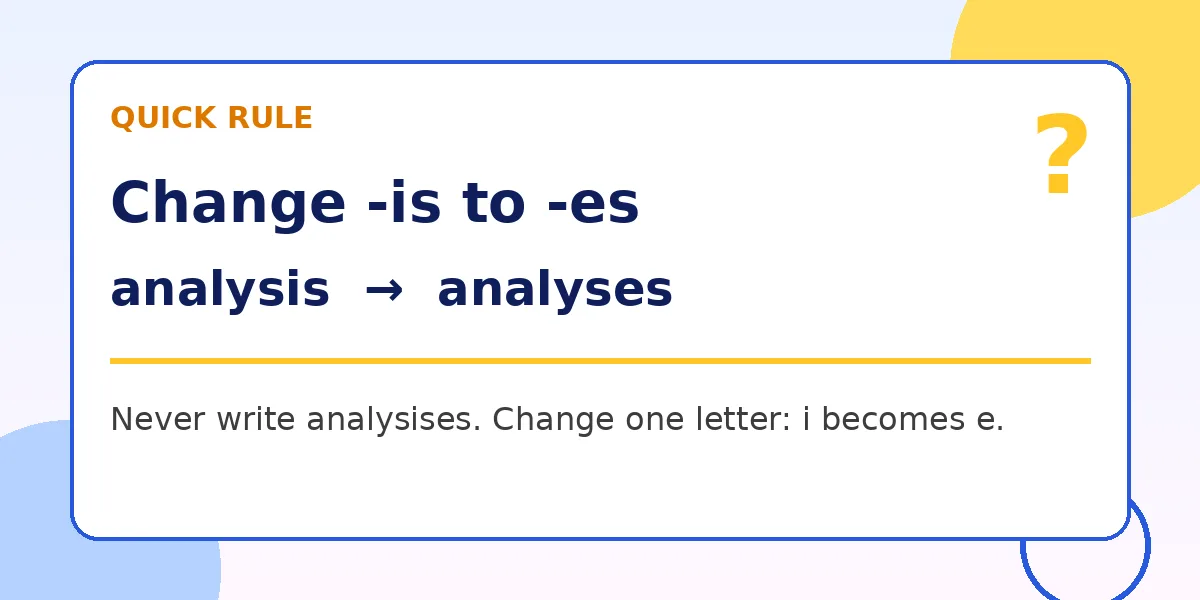
The analysis vs analyses spelling question has a simple answer. The plural follows a Greek derived spelling pattern. Words ending in is often change that ending to es in the plural. The transformation is: analysis becomes analyses. You do not add another s or es to the complete word. That is why analysises is incorrect. This pattern comes from the word’s Greek history. The English noun entered the language through Medieval Latin in the late 1500s.
The Is to Es Word Family
Several English nouns follow a similar plural pattern. Learning them together can make their spelling easier.
| Singular | Plural | Meaning |
|---|---|---|
| Analysis | Analyses | Detailed examinations |
| Thesis | Theses | Main arguments or academic papers |
| Crisis | Crises | Serious or difficult situations |
| Hypothesis | Hypotheses | Proposed explanations |
| Diagnosis | Diagnoses | Identifications of illnesses |
| Synthesis | Syntheses | Combinations of ideas or elements |
| Axis | Axes | Lines around which something rotates |
| Oasis | Oases | Fertile places in deserts |
| Parenthesis | Parentheses | Words or phrases inside brackets |
| Basis | Bases | Foundations or starting points |
| Ellipsis | Ellipses | Omissions or three dot marks |
| Synopsis | Synopses | Brief summaries |
| Nemesis | Nemeses | Sources of downfall or persistent rivals |
| Paralysis | Paralyses | Forms or instances of loss of muscle function |
These examples share a recognizable spelling pattern. However, not every word ending in is follows it. For example, appendix becomes appendices. Analyst becomes analysts because it follows the regular plural pattern.
How to Pronounce Both Words
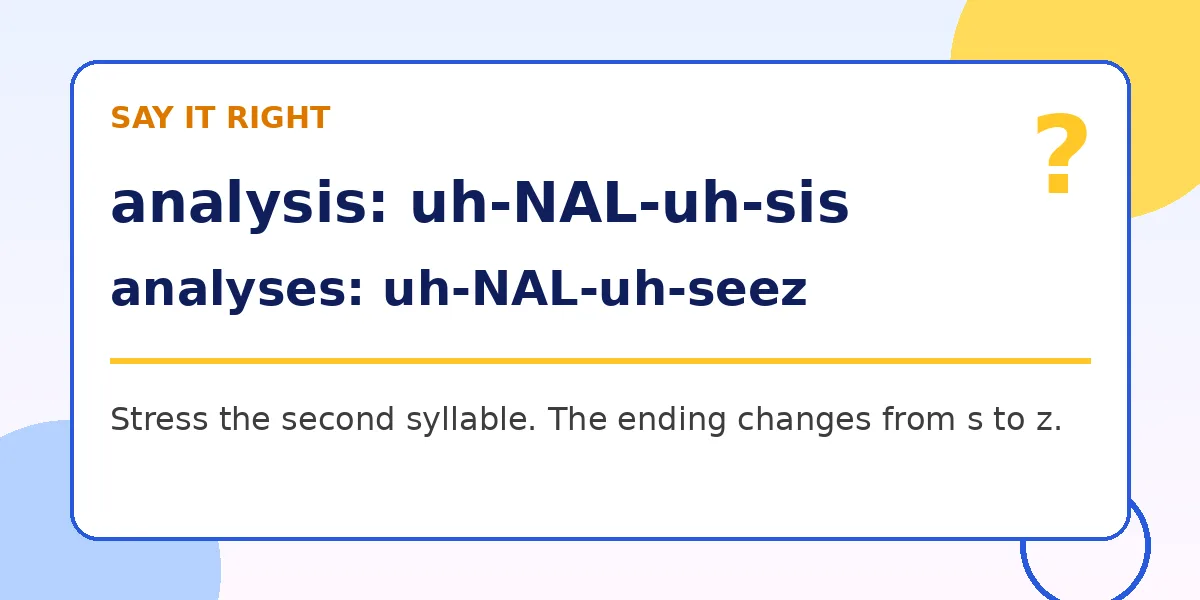
Pronunciation is another part of analysis vs analyses. The two forms look similar, but their final sounds are different. Analysis: /əˈnæləsɪs/. Analyses: /əˈnæləsiːz/. Both words have stress on the second syllable. The main difference comes at the end. The singular ends with an unvoiced s sound. The plural ends with a voiced z sound. You can hear the difference in these examples: The analysis is complete. The analyses are complete. Oxford and Cambridge provide pronunciation guides and audio examples for both forms.
When to Use Each Form
Choose the form based on whether you mean one examination or multiple examinations. Also consider whether you mean the general process. This is the heart of analysis vs analyses in everyday writing.
When to Use Analysis
Use analysis when you refer to one particular examination, report, or study. It also works for the general process.
- The analysis of the results is complete.
- She prepared an analysis of five companies.
- The project requires further analysis.
- A statistical analysis was included in the report.
- His analysis of the problem helped the team.
In the first and second examples, the word refers to one specific examination. In the third example, it refers to the general process.
When to Use Analyses
Use analyses when you refer to more than one examination or report.
- The researchers completed three analyses.
- These analyses are based on separate experiments.
- The company compared several market analyses.
- The latest analyses were published yesterday.
- Both analyses show similar results.
The plural form works with words such as several, many, both, these, and those.
Analyze vs Analyse vs Analyses
A full analysis vs analyses guide must also cover the verb family. These words belong to the same word family, but they do not all have the same grammatical role. Analysis and analyses are nouns. Analyze and analyse are verbs. Their spelling also depends on the English variety you use.
Analyze and Analyse
Both verbs mean to examine something carefully. The main difference is regional spelling. Analyze: American English. Analyse: British English. Examples: US: We analyze the survey results. UK: We analyse the survey results. Use the spelling that matches your intended audience. This article follows American English by default.
Word Family
Here are the main forms and their uses.
| Word | Part of speech | Meaning or use | Example |
|---|---|---|---|
| Analyze | Verb, US | Examine something carefully | Researchers analyze the results. |
| Analyse | Verb, UK | British spelling of analyze | Researchers analyse the results. |
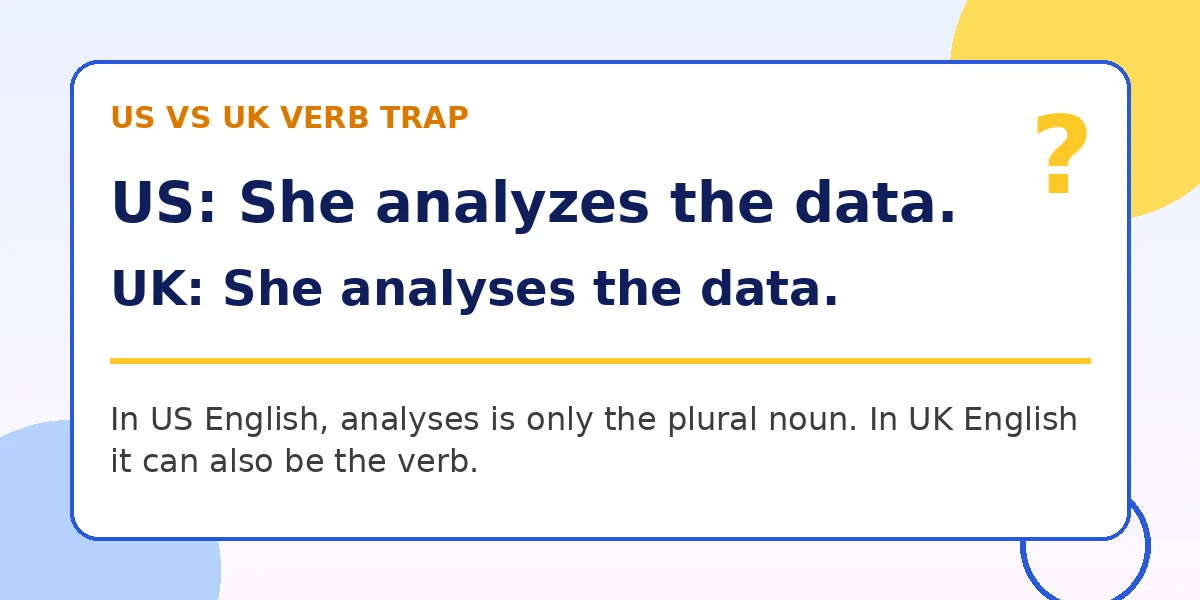
| Analyzes | Verb, US | Third person singular of analyze | She analyzes the data. |
| Analyses | Plural noun or UK verb | Multiple examinations, or the UK third person singular verb | The analyses are complete. |
| Analyst | Noun | A person who examines information | The analyst reviewed the report. |
| Analysts | Plural noun | More than one analyst | The analysts reviewed the report. |
| Analytical | Adjective | Related to careful examination | She has strong analytical skills. |
| Analytically | Adverb | In a way that involves analysis | He approached the problem analytically. |
Other verb forms: American English | British English — Analyzing | Analysing; Analyzed | Analysed; Analyzes | Analyses.
Remember that analysis is a noun, not a verb. Say "perform an analysis" or "analyze the data."
The US vs UK Verb Trap
This distinction can confuse readers because analyses has two possible uses in British English. In American English, analyzes is the third person singular verb. Analyses is the plural noun. US verb: She analyzes the data every week. Plural noun: The analyses are ready for review. In British English, analyses can be the third person singular verb of analyse. It can also be the plural noun. UK verb: She analyses the data every week. Plural noun: The analyses are ready for review. The spelling is identical in those British examples. The sentence structure tells you which meaning is intended.
How to Tell Whether It Is a Noun or Verb
Use this simple disambiguation test:
- Look at its job: Does the word name an examination or describe an action?
- Check the words around it: Determiners such as the, these, and several often introduce the noun.
- Check the subject: If a person or organization performs the action, the word may be a verb.
Compare: The analyses are detailed. Here, analyses is a plural noun. She analyses the results. Here, analyses is a British English verb. She analyzes the results. Here, analyzes is an American English verb. Context makes the difference clear.
Subject Verb Agreement
Agreement is where analysis vs analyses errors often appear. The noun number determines which verb form you should use. A singular noun takes a singular verb. A plural noun takes a plural verb.
| Subject | Correct verb | Example |
|---|---|---|
| This analysis | is | This analysis is complete. |
| That analysis | was | That analysis was useful. |
| The analysis | shows | The analysis shows a pattern. |
| These analyses | are | These analyses are complete. |
| Those analyses | were | Those analyses were useful. |
| The analyses | show | The analyses show a pattern. |
Agreement With the Singular Form
Use is, was, shows, and demonstrates with a singular countable noun. Examples: The analysis is accurate. This analysis was helpful. The analysis shows a clear pattern. Uncountable uses also take singular verbs. For example, "Further analysis is necessary" is correct. The sentence refers to the general process, not separate examinations.
Agreement With the Plural Form
Use are, were, show, and demonstrate with the plural noun. Examples: The analyses are consistent. Several analyses were submitted. These analyses show similar results. Avoid mixing a plural noun with a singular verb. For example, "The analyses is complete" is incorrect. Remember these common patterns: This analysis is. These analyses are. One analysis was. Several analyses were. More analysis is needed.
Common Mistakes and Corrections
Writers sometimes confuse the singular form, plural form, and related verb spellings in analysis vs analyses. Use this table to check your work.
| Incorrect | Correct | Explanation |
|---|---|---|
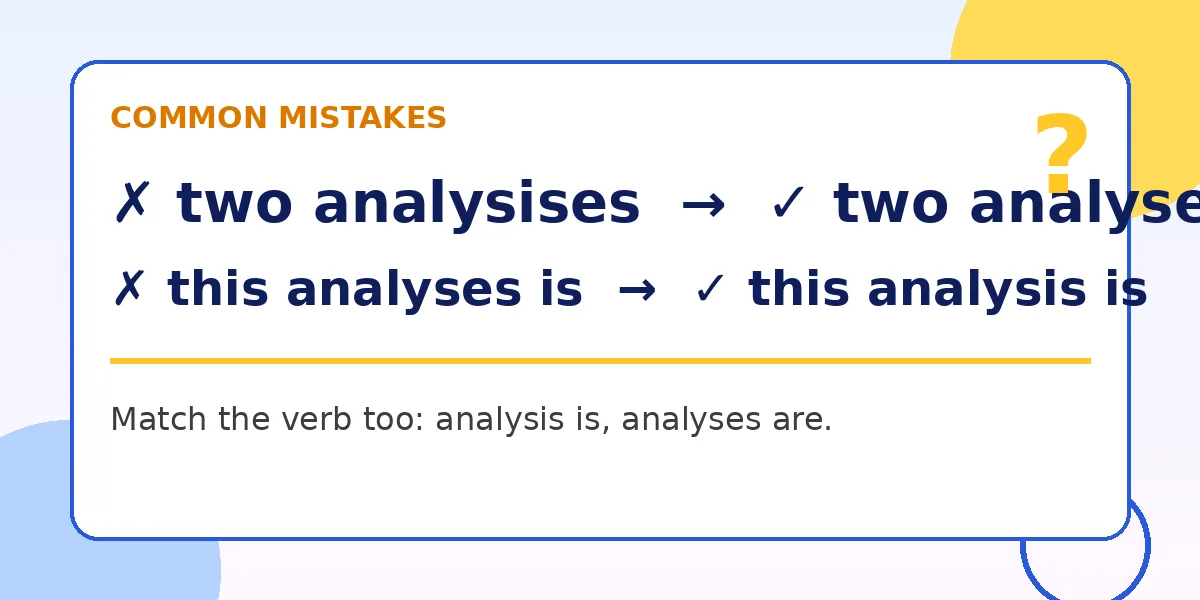
| Two analysises | Two analyses | The ending changes from is to es. |
| Three analysis | Three analyses | Three requires a plural noun. |
| These analysis are useful. | These analyses are useful. | These refers to multiple items. |
| This analyses is useful. | This analysis is useful. | This refers to one item. |
| The analyses is complete. | The analyses are complete. | A plural noun needs a plural verb. |
| The analysis are complete. | The analysis is complete. | A singular noun needs a singular verb. |
| She analyses the data. (US) | She analyzes the data. | Analyzes is the American verb form. |
| The researcher did an analyze. | The researcher did an analysis. | Analysis is the noun. |
Other Errors to Avoid
Using an apostrophe to make a plural: Do not write analysis’s when you mean multiple examinations. The correct plural is analyses. Confusing a noun with a verb: Analysis names an examination. Analyze describes the action of examining something. Mixing American and British spelling: Choose one spelling style and use it consistently. For American English, write analyze, analyzes, analyzing, and analyzed. Using the wrong possessive form: A singular possessive can be written as analysis’s. A plural possessive is analyses’. Examples: The analysis’s conclusion was clear. The analyses’ conclusions were different. An apostrophe shows ownership. It does not create a plural noun.
An Easy Memory Trick
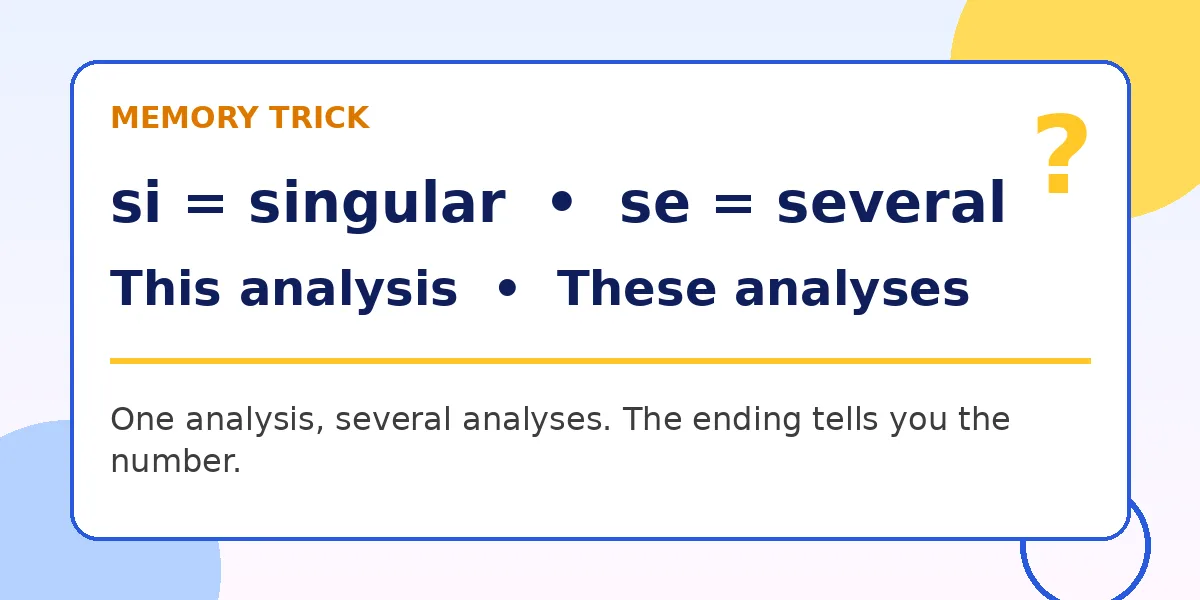
Remember this simple rule: sis means singular. Ses means several. The singular form ends in sis. The plural form ends in ses. You can also use the determiner trick: This analysis means one examination. These analyses means multiple examinations. Try remembering this sentence: One analysis, several analyses. Once you remember that pair, the spelling and subject verb agreement become easier.
Practice Questions
Test your understanding with these ten questions. Choose the correct word or verb form in each sentence.
- The researcher’s (analysis / analyses) is included in the report.
- The three (analysis / analyses) produced different results.
- This (analysis / analyses) is based on recent data.
- Several (analysis / analyses) are available for review.
- The company needs further (analysis / analyses) before investing.
- The latest (analysis / analyses) show a clear trend.
- She (analyzes / analyses) the data every week. (American English)
- The researcher (analyze / analyzes) the results. (American English)
- These (analysis / analyses) were completed yesterday.
- The (analysis / analyses) of the survey was detailed.
Answer Key
- Analysis. The sentence refers to one researcher’s examination.
- Analyses. Three indicates multiple examinations.
- Analysis. This identifies one particular examination.
- Analyses. Several requires a plural noun.
- Analysis. Further analysis refers to the general process.
- Analyses. The sentence refers to multiple examinations. Show is the correct plural verb.
- Analyzes. American English uses analyzes with she.
- Analyzes. A singular subject takes the third person singular verb.
- Analyses. These and were indicate a plural subject.
- Analysis. The sentence refers to one examination of the survey.
Frequently Asked Questions
1. Is Analysis Singular or Plural?
Analysis is a singular noun. It refers to one examination or the general process of studying something. Its plural form is analyses. For example, you write "this analysis is useful" but "these analyses are useful."
2. What Is the Plural of Analysis?
The plural is analyses, not analysises. The word follows a Greek derived spelling pattern. Change the final is to es. For example, one analysis becomes two analyses. This spelling is standard in both American and British English.
3. Is It Analyses or Analyzes?
Analyses is the plural noun in both American and British English. Analyzes is the American third person singular verb. British English uses analyses as that verb form. Check the sentence to determine whether it names examinations or describes an action.
4. Can Analysis Be Countable and Uncountable?
Yes. Analysis is countable when it refers to a particular examination or report, as in "an analysis." It is uncountable when describing the general process, as in "further analysis." The meaning determines its use.
5. How Do You Pronounce Analyses?
Analyses is pronounced /əˈnæləsiːz/, with a voiced z at the end. The singular form, analysis, ends with an unvoiced s sound instead. Both words place stress on the second syllable, so only the final sound changes.
6. Is Analyses a Verb in British English?
Yes. In British English, analyses is the third person singular form of the verb analyse. For example, "She analyses the results." It can also be a plural noun, as in "The analyses are complete."
Related Guides
Want to improve your grammar and word choice? Explore these related ClarifyWords guides:
- A vs An: What Is the Difference?: Learn when to use an before a singular countable noun, such as an analysis.
- Fewer vs Less: What’s the Difference?: Understand the difference between countable and uncountable nouns.
- Which vs That: What’s the Difference?: Learn how to choose the right word in a sentence.
- Lead or Led: What’s the Difference?: Compare two commonly confused verb forms.
- Lay or Laid: What’s the Difference?: Review the correct forms and uses of these verbs.
- Laid or Layed: Which Is Correct?: Learn why one spelling is standard and the other is incorrect.
- Learn or Learned: What’s the Difference?: Compare the present and past forms of learn.
- Learned or Learnt: What’s the Difference?: Explore the differences between American and British usage.
- More Grammar Guides: Find clear explanations of common grammar questions.
Final Takeaway
The analysis vs analyses choice is simple. Use analysis for one examination or for the general process of examining something. Use analyses for two or more examinations, and match it with a plural verb. Change is to es, never add es to the whole word, and in American English use analyzes for the verb.