

High or Low: Meaning, Differences, and Examples

High and low describe levels. They show position, amount, and degree. This guide explains both words in clear terms. You will learn the differences, contexts, and common phrases. If you are unsure which word fits a sentence, start with the scale in front of you.
Quick Answer
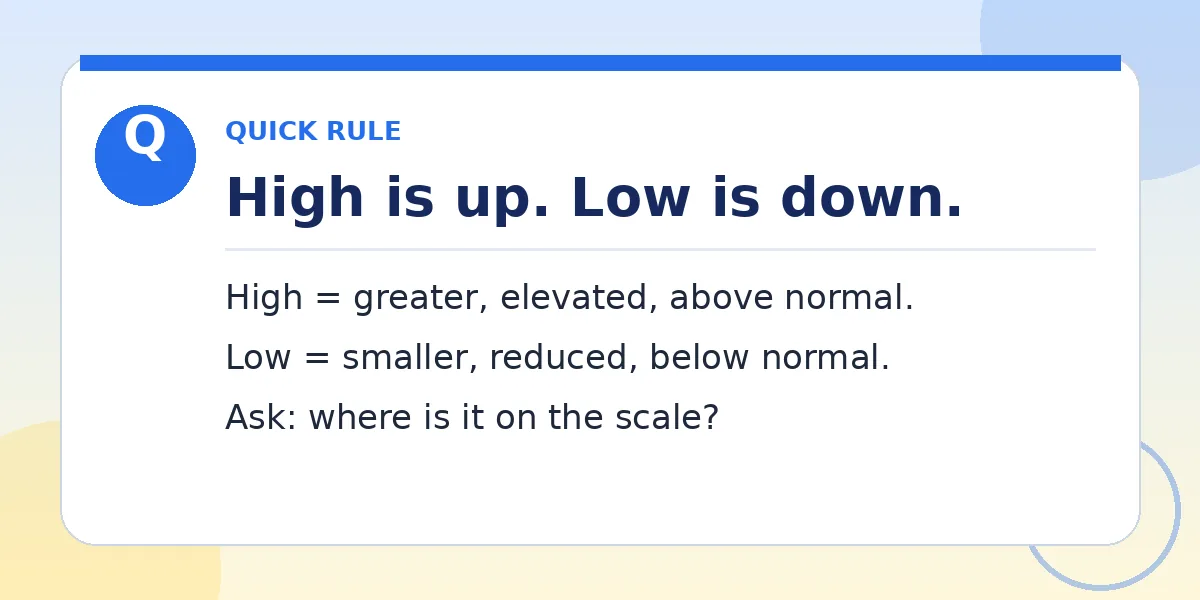
High means greater, higher, or above a normal level. Low means smaller, lower, or below a normal level. The right word depends on context. A high price differs from a high mountain. A low voice differs from a low score. In short, the question behind high or low is simple: is the level up or down, greater or smaller?
Table of Contents
- Quick Answer
- What High Means
- What Low Means
- High vs Low Comparison Table
- Meanings by Context
- High Is Not Always Good, Low Is Not Always Bad
- High vs Tall, Low vs Short
- Common Phrases
- Comparative and Superlative Forms
- The Hyphen Rule
- Memory Trick
- Common Mistakes
- Practice Questions
- FAQs
- Related Guides
What High Means
High describes something elevated or greater. It can refer to position, amount, or degree. A high mountain rises far above the ground. A high score shows strong performance. A high temperature means more heat. The word can function as an adjective, adverb, or noun. A new high in sales means a record level.
High also describes rank and importance. A high office carries real power. Learners who ask about high or low often start here, with rank and level mixed together. A high standard sets a strong expectation. A high note sits at the upper end of pitch. In each case, the core idea stays the same: the level is above normal.
What Low Means
Low describes something close to the ground or smaller. It can refer to position, amount, or degree. A low fence stands near the ground. A low score shows weak performance. A low temperature means less heat. The word can function as an adjective, adverb, or noun. A new low in sales means a minimum level.
Low also describes rank and mood. A low rank sits near the bottom of a scale. A low mood means sadness or fatigue. A low note sits at the lower end of pitch. In each case, the core idea stays the same: the level is below normal.
High vs Low Comparison Table
| Feature | High | Low |
|---|---|---|
| Position | Above normal | Below normal |
| Amount | Larger | Smaller |
| Height | Elevated | Close to ground |
| Quality | Often stronger | Often weaker |
| Sound | Higher pitch | Lower pitch |
| Mood | Energetic or positive | Sad or depressed |
| Example | High price | Low price |
Use the table as a first check, then read the context. The same word can feel positive in one sentence and negative in the next. That shift is normal, and it is why context matters more than the word alone.
Meanings by Context
Height
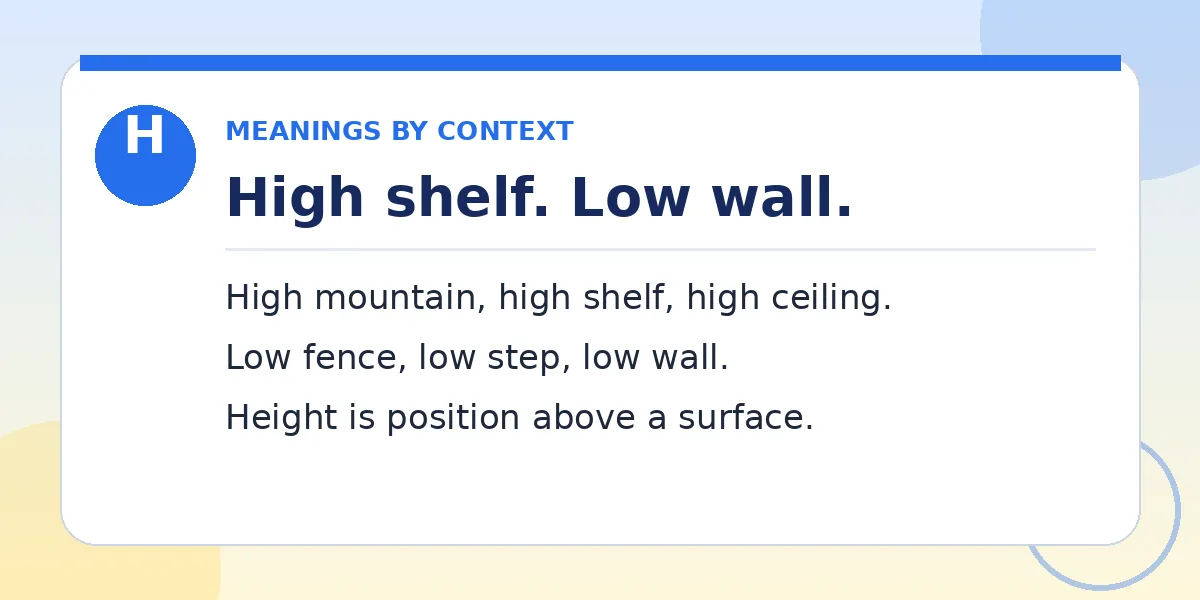
High describes elevation above a surface. A high shelf sits far from the floor. Low describes a position near the ground. A low wall stays close to the earth. Use high for mountains, shelves, and ceilings. Use low for fences, steps, and platforms.
A shelf can be too high to reach. A step can be too low to notice. Both sentences describe position, not quality. Keep the physical picture in mind, and the choice becomes easy.
Amount and Degree
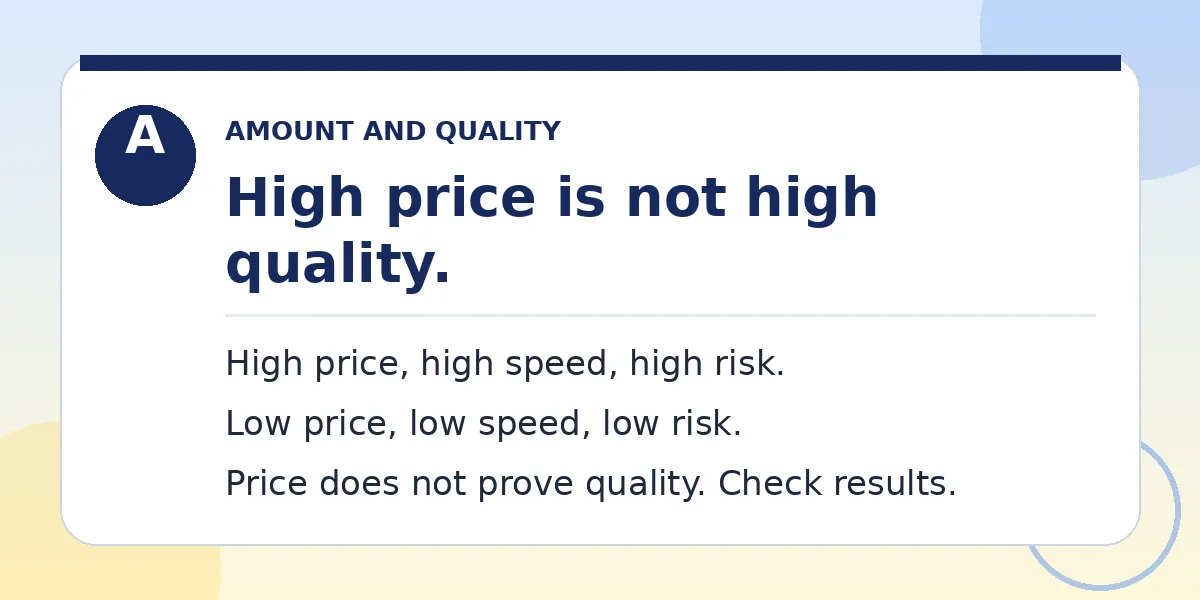
High describes a larger amount or stronger degree. High prices require more money. High speeds show faster movement. Low describes a smaller amount or weaker degree. Low prices require less money. Low speeds show slower movement. Amount and degree depend on the scale used.
Think of a thermometer, a price tag, and a speed limit. Each one has a scale. High sits near the top of that scale. Low sits near the bottom. The scale, not the word, tells you what counts as high or low in that sentence.
Quality and Rank
High quality means strong materials or careful work. Low quality means weak materials or poor work. High rank means a senior position. Low rank means a junior position. Quality and rank require clear standards. A high standard sets a strong expectation.
A high standard is not the same as a high price. A product can cost little and still meet a high standard. A product can cost a lot and still fail a basic test. Judge quality by results, not by price alone.
Sound and Voice
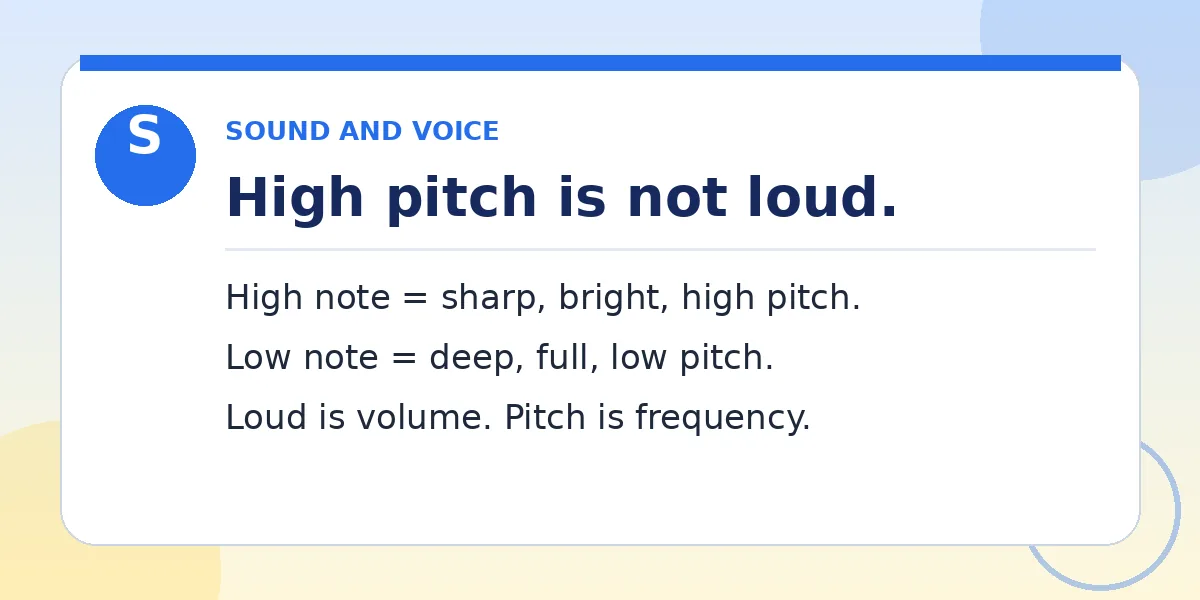
High pitch means a sound with a higher frequency. Low pitch means a sound with a lower frequency. A high note sounds sharp and bright. A low note sounds deep and full. Pitch differs from volume. A quiet sound can still have a high pitch.
This distinction trips up many learners. A loud voice is high in volume, not high in pitch. A soft voice is low in volume, not low in pitch. Ask two questions: how high is the note, and how loud is it? The answers can differ.
Mood and Life
High spirits mean energy and optimism. Low mood means sadness or fatigue. Life includes highs and lows. A high point marks a success. A low point marks a difficult time. Mood words describe feelings, not facts.
A low point does not last forever. A high point does not prove that every day will feel the same. Both words describe a moment on a longer scale. That scale is what makes the pair so useful in stories and everyday talk.
High Is Not Always Good, Low Is Not Always Bad
High risk can cause loss. High cost can strain a budget. High pressure can harm health. Low cost can save money. Low risk can protect an investment. Low pressure can support calm work. Judge each case by context. Do not assign fixed value to either word.
This is the key lesson of high or low. A high fever is bad news. A low fever risk is good news. A high score on a test is good news. A high score on a risk scale is bad news. The word only sets the level. The context decides the value.
Price needs the same care. A high price does not prove high quality. A low price does not prove low quality. Price can reflect brand, scarcity, service, or timing. Check the product itself before you judge it by its price tag.
High vs Tall, Low vs Short
High describes elevation, position, or distance above a surface. Tall usually describes people and vertically extended objects. For example, you describe a person as tall and a mountain as high. Low describes something close to the ground or below a certain level. Short describes limited physical height or length. A ceiling can be low, while a person can be short.
Use tall for a person, a tree, and a tower that rises straight up. Use high for a shelf, a mountain, and a level on a scale. Use short for a person, a rope, and a story. Use low for a ceiling, a score, and a level on a scale. If the thing is a person, tall and short usually win.
Common Phrases
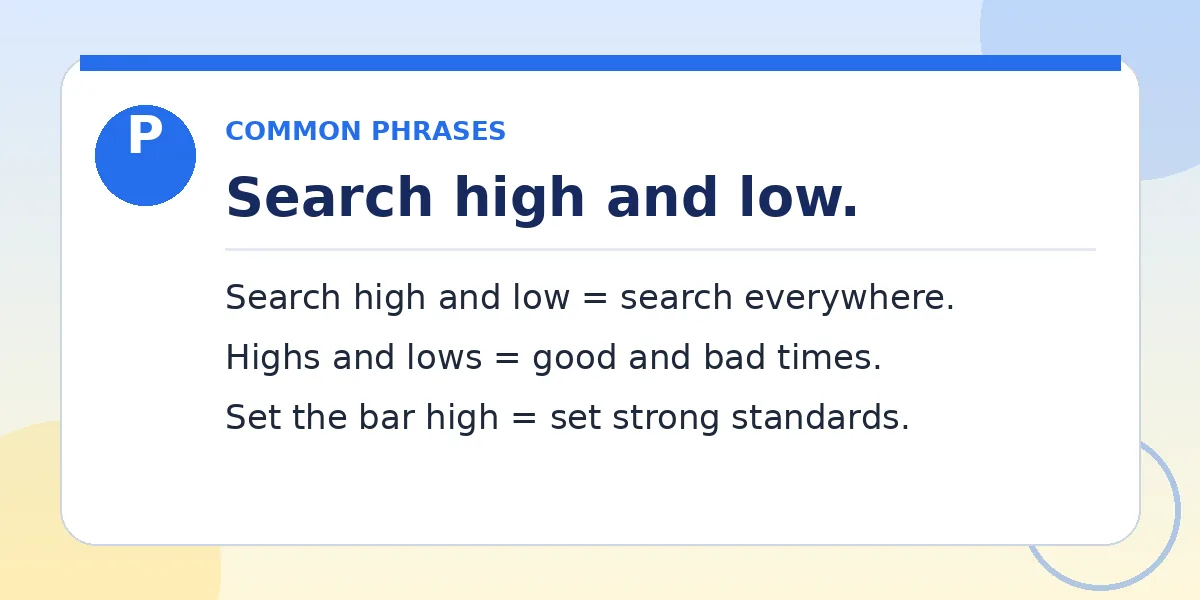
Search high and low means to search everywhere. People use it for lost items or thorough research. Highs and lows mean good and bad periods. Life, careers, and sports include both. Set the bar high means to set strong expectations. Set the bar low means to set weak expectations. High hopes mean strong expectations for success. A low point means the worst moment in a period.
These phrases show how the pair works beyond literal height, and they are a good reason to study high or low as a set, not as two lone words. “We searched high and low for the keys” means every place was checked. “Every career has highs and lows” means good times and bad times both occur. Learn the phrase as a whole, not word by word.
Comparative and Superlative Forms
The comparative form of high is higher, and its superlative is highest. For low, the forms are lower and lowest. Use comparative forms to compare two things. Use superlative forms for the greatest or smallest level. For example, this mountain is higher than that hill. This price is the lowest today.
Use higher and lower for two items only. Use highest and lowest for three or more. Say “this hill is higher than that one” for a pair. Say “this is the highest hill in the area” for a group. The same rule applies to lower and lowest.
The Hyphen Rule
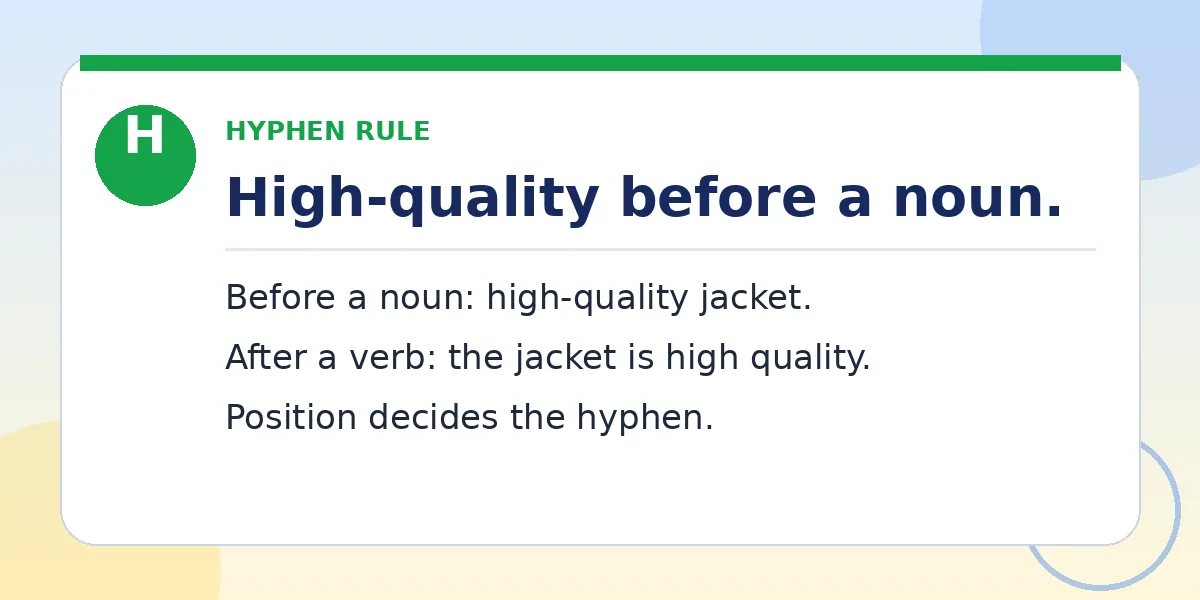
Use a hyphen when high or low forms a compound adjective before a noun. Examples include high-quality work, low-income housing, high-speed rail, and low-cost travel. Do not use a hyphen when the adjective follows the noun or verb. For example, the work is high quality. The housing serves low income families. The rule applies to compound adjectives only.
Test the position. If the phrase sits before the noun, hyphenate it: a high-quality jacket, a low-cost ticket. If it sits after a verb, leave it open: the jacket is high quality, the ticket is low cost. Position decides the hyphen.
Memory Trick
Think of a mountain and a valley. High is the mountain peak. Low is the valley floor. This image shows the basic contrast. Use it to recall the core meaning. Then check the context for the exact use.
When you face a sentence about high or low, picture the peak and the floor, and let that image settle the high or low choice before you check grammar. Ask where the thing sits on its scale. Near the peak means high. Near the floor means low. Then check whether the sentence is about height, amount, quality, sound, or mood.
Common Mistakes
Do not use high for a person’s height. Use tall for people. Do not use low for a person’s height. Use short for people. Do not assume high means good in every case. Do not assume low means bad in every case. Check hyphen use in compound adjectives. High-quality before a noun needs a hyphen. High quality after a verb does not.
Other common mistakes include mixing pitch with volume and price with quality. A high note is not a loud note. A low price is not a poor product. Slow down, name the scale, and the right word usually follows.
Practice Questions
- The mountain is very ___. (high / low)
- The price of bread is very ___ today. (high / low)
- She sang a ___ note. (high / low)
- His mood was ___ after the loss. (high / low)
- She sang in a ___ voice, deep and soft. (high / low)
- The shelf is too ___ for the child to reach. (high / low)
- This building is ___ than that house. (higher / lower)
- This is the ___ price in the store. (lowest / highest)
- They searched ___ for the missing keys. (high and low / low and high)
- She bought a ___ jacket for winter. (high-quality / high quality)
Answer Key
- High. High describes elevation above the ground.
- Low. Low describes a smaller amount.
- High. High describes a higher pitch.
- Low. Low describes a sad mood.
- Low. Low describes a lower pitch, deep in tone.
- High. High describes elevation above reach.
- Higher. Higher compares two buildings.
- Lowest. Lowest shows the smallest price.
- High and low. The phrase means everywhere.
- High-quality. The compound sits before the noun, so it needs a hyphen.
FAQs
1. Are high and low opposites?
Yes, high and low are direct opposites in most situations. High describes a greater level, position, or amount, while low describes a smaller one. However, the best opposite can depend on context, so check the scale first.
2. What does high or low mean?
High describes something elevated or greater in amount or degree. Low describes something closer to the ground or smaller in amount or degree. Both words can describe physical objects and abstract measurements, such as prices, scores, and moods.
3. Is high always good and low always bad?
No, that rule fails in many cases. High prices and high risks can be undesirable, while low prices and low risks can be helpful. These words describe levels, not positive or negative value, so judge by context.
4. What is the difference between high and tall, and low and short?
High describes elevation, position, or distance above a surface. Tall describes people and extended objects. For example, you describe a person as tall and a mountain as high, while a ceiling can be low and a person can be short.
5. What is the difference between low and short?
Low describes something close to the ground or below a certain level. Short describes physical height or length. A ceiling can be low, while a person can be short, so use low for levels and short for people and lengths.
6. What are the comparative and superlative forms of high and low?
The comparative form of high is higher, and its superlative is highest. For low, the forms are lower and lowest. Use comparative forms to compare two things and superlatives for the greatest or smallest level.
7. Can high and low be nouns?
Yes, both words can function as nouns. A new high means a peak or record, while a new low means a minimum level. The phrase highs and lows covers good and bad periods in life.
Final Takeaway
High and low describe levels across many contexts. Check height, amount, quality, sound, and mood. Use the mountain and valley image to recall the contrast. Choose the word that fits the scale in front of you, and remember that high or low is a question of level first and value second.