

Advice vs Advise: Meaning, Difference, and Examples

This guide explains advice vs advise with clear rules, examples, and practice.
Quick Answer
Advice is a noun. It means a suggestion, recommendation, or helpful opinion. The question of advice vs advise comes down to grammar, not meaning alone. Advise is a verb. It means to give advice, recommend an action, or formally inform someone.
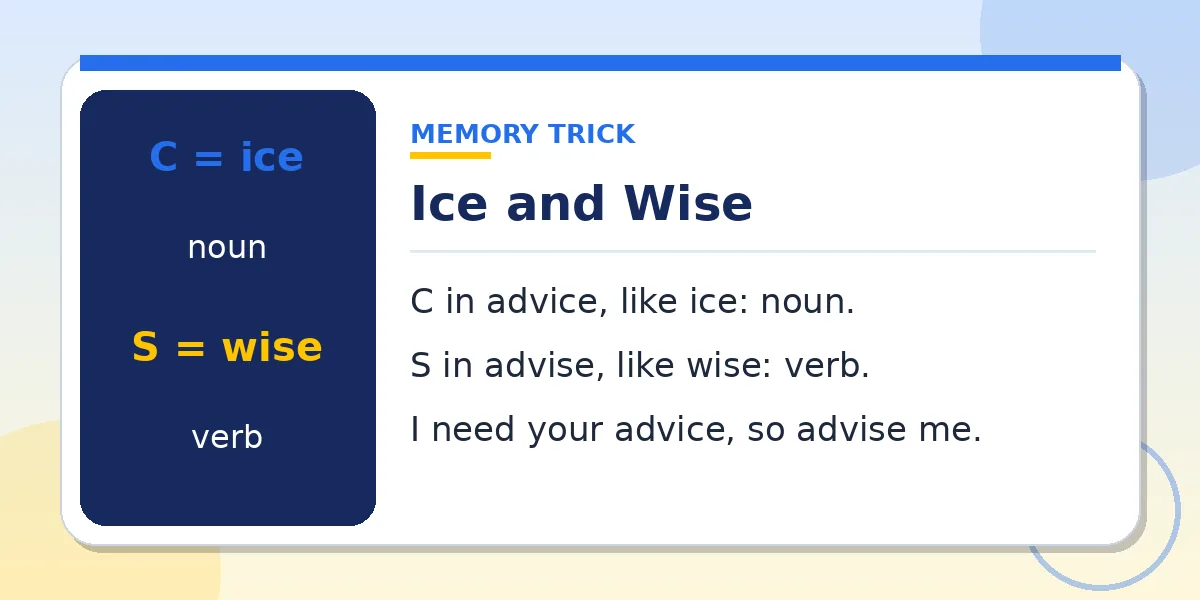
The easiest way to remember the difference is sound and spelling. Advice ends with a C, like ice. Advise ends with an S, like wise. Advice sounds like ad VICE. Advise sounds like ad VIZE.
Here is one sentence that uses both words correctly: I need your advice, so please advise me.
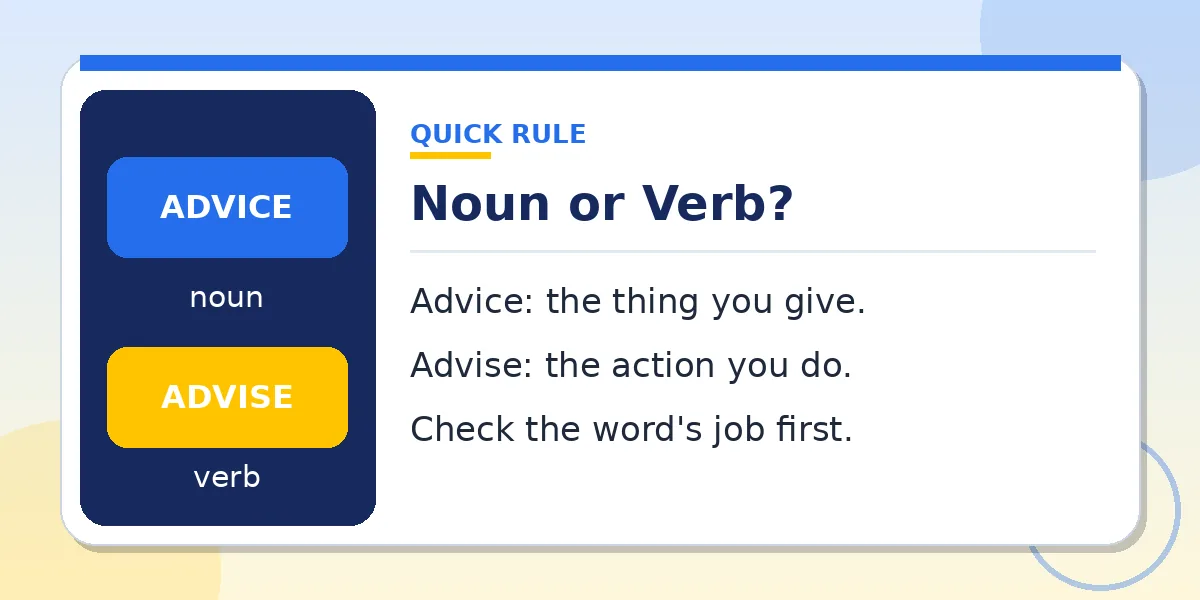
Table of Contents
- Key Differences
- What Advice Means
- What Advise Means
- Pronunciation
- Advice and Advise in Sentences
- Common Ways to Use Advise
- Please Advise or Please Advice?
- Advise Compared With Inform, Recommend, and Counsel
- Common Mistakes to Avoid
- Adviser, Advisor, and Advisory
- American and British English
- Easy Ways to Remember
- Practice Questions
- Frequently Asked Questions
- Related Guides
Key Differences
The core of advice vs advise is simple. The main difference between these two words is their part of speech. Advice names guidance or a recommendation. Advise describes the action of giving guidance.
| Feature | Advice | Advise |
|---|---|---|
| Part of speech | Noun | Verb |
| Meaning | A suggestion or recommendation | To give a suggestion or recommendation |
| Pronunciation | /ədˈvaɪs/ | /ədˈvaɪz/ |
| Ending sound | /s/, as in ice | /z/, as in wise |
| Countability | Usually uncountable | Not applicable |
| Example | She gave me helpful advice. | She advised me to wait. |
A Simple Test to Choose the Right Word
Try replacing the word with a similar word. If guidance, suggestion, or recommendation fits, use advice. If recommend, counsel, or suggest fits, use advise.
Consider these two sentences:
- I need your advice before making a decision.
- Can you advise me before I make a decision?
Both sentences are correct. The first names the guidance. The second asks someone to provide it.
You can also use both words in one sentence. For example: My father gave me advice and advised me to save money. In that sentence, advice is the thing given. Advise is the action performed.
What Advice Means
In advice vs advise, advice is the noun side. Advice is a noun that means an opinion, suggestion, or recommendation about what someone should do. People seek it in many contexts. You might receive advice from a teacher, friend, doctor, manager, or family member. It can help you decide with more confidence.
Examples of Advice in a Sentence
- My teacher gave me useful advice about studying.
- I need some advice before accepting the job offer.
- Her financial advice helped me save money.
- He ignored my advice and made the same mistake.
- We asked our manager for advice.
- Good advice can help you avoid costly errors.
In each sentence, advice refers to guidance or a recommendation. It does not describe an action.
Is Advice Countable or Uncountable?
In everyday English, advice is an uncountable noun. You cannot usually count it as one advice or two advices. Instead, use expressions such as some advice or a little advice. You can also say a lot of advice, a piece of advice, two pieces of advice, a word of advice, or several pieces of advice.
For example:
- Incorrect: She gave me an advice.
- Correct: She gave me some advice.
- Correct: She gave me a piece of advice.
Use how much advice, not how many advice. You can count individual pieces with piece, bit, or word:
- How much advice did you receive?
- How many pieces of advice did you receive?
Advice also takes a singular verb. Say “His advice is helpful,” not “His advice are helpful.”
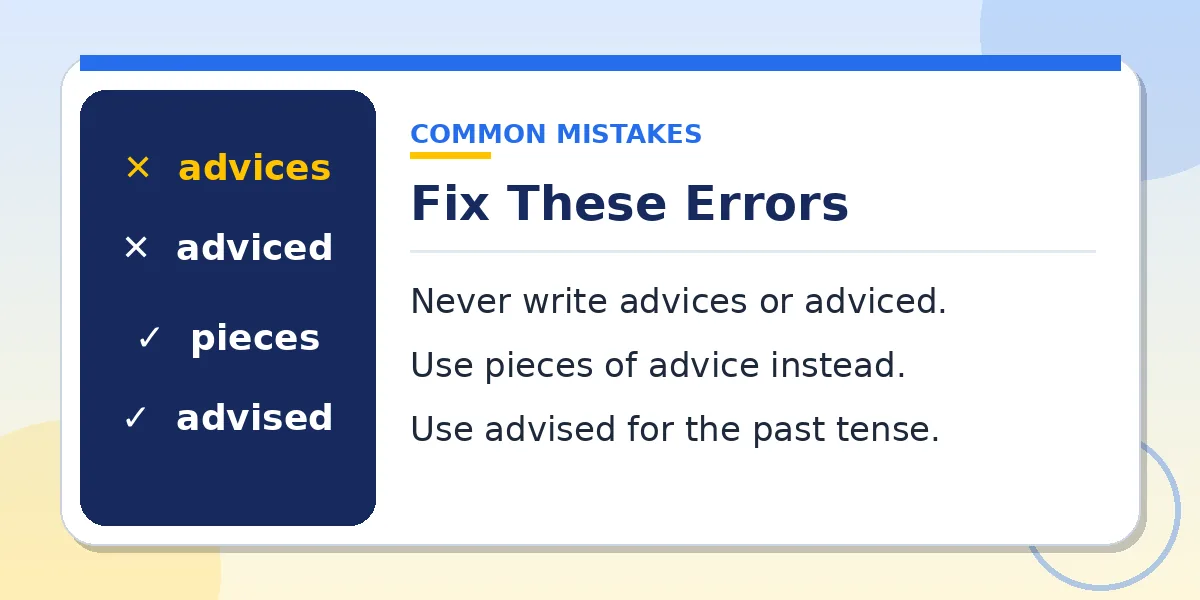
In everyday writing, avoid the plural advices. You may see it in specialized formal contexts involving notifications, such as a bank advice note. That narrow use does not change the everyday rule. For guidance and suggestions, advices is wrong.
What Advise Means
In advice vs advise, advise is the verb side. Advise is a verb. It means to give someone advice, recommend an action, or offer guidance. It can also mean to formally inform someone. Use advise when someone performs the action of giving guidance.
Advise has four main uses:
- To recommend an action.
- To give someone guidance.
- To suggest what someone should or should not do.
- To formally inform or notify someone.
Examples of Advise in a Sentence
- I advise you to read the instructions first.
- The doctor advised him to get more rest.
- My manager advised me against taking the offer.
- Please advise us about the next steps.
- The lawyer advised her that the contract needed review.
- We were advised of the schedule change.
Notice that advise describes an action in every example. It tells what someone does.
What Are the Different Forms of Advise?
Advise is a regular verb. Its common forms are:
| Verb form | Example |
|---|---|
| Base form | I advise my students to practice. |
| Third person singular | She advises new employees. |
| Past tense | He advised me yesterday. |
| Past participle | They have advised us before. |
| Present participle | She is advising the team. |
The correct past tense is advised, not adviced. The correct ing form is advising, not advicing.
For example:
- Incorrect: My teacher adviced me to study.
- Correct: My teacher advised me to study.
- Incorrect: He is advicing his friend.
- Correct: He is advising his friend.
Pronunciation
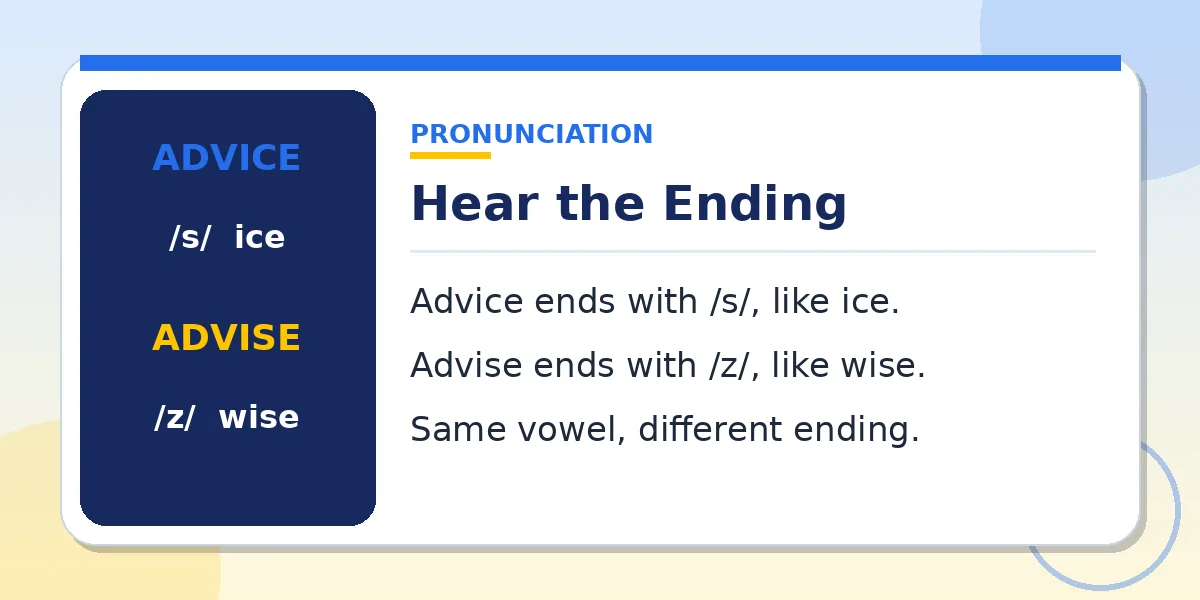
Pronunciation also separates advice vs advise. Although these two words look almost identical, their final sounds are different. Advice ends with an /s/ sound, like ice. Advise ends with a /z/ sound, like wise.
Both words have the same stressed vowel sound. The final consonant helps you tell them apart when speaking.
| Word | IPA | Rhymes with |
|---|---|---|
| Advice | /ədˈvaɪs/ | Ice, nice, price |
| Advise | /ədˈvaɪz/ | Wise, prize, surprise |
Say the words slowly and listen to the ending. The /s/ in advice is unvoiced. The /z/ in advise is voiced. This sound difference also appears in other English word pairs, such as device and devise.
Try this quick practice. Say each pair aloud and stress the final sound: advice and advise, ice and rise, nice and size, rice and rise. The final sound is the easiest way to hear the difference.
Advice and Advise in Sentences
Examples make advice vs advise easier to spot. Seeing both words in context makes the difference easier to understand. Compare these examples:
| Advice (noun) | Advise (verb) |
|---|---|
| I appreciate your advice. | I appreciate you advising me. |
| She gave me good advice. | She advised me to be careful. |
| We need professional advice. | We need someone to advise us. |
| His advice was helpful. | He advised us about the risks. |
| Thank you for the advice. | Thank you for advising me. |
You can also use both words in one sentence:
- My father gave me advice and advised me to save money.
- The teacher offered advice and advised us to review our notes.
- I asked for legal advice, and the lawyer advised me to wait.
Remember the basic rule. Advice is the thing someone gives. Advise is the action of giving it.
Common Ways to Use Advise
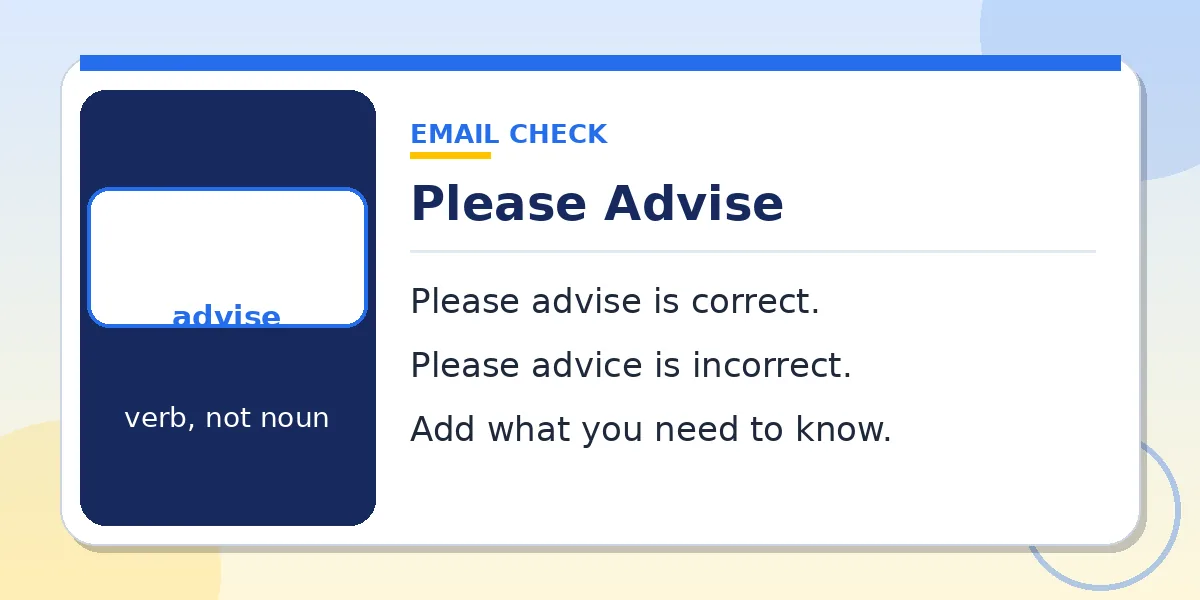
Verb patterns are where advice vs advise gets practical. The verb advise appears in several common sentence patterns. Learning these patterns helps you use it naturally.
1. Advise Someone to Do Something
Use advise plus someone plus to plus a verb when recommending an action.
Examples:
- I advise you to check the details.
- The doctor advised him to exercise regularly.
- She advised her brother to apply for the job.
You can also use a negative action:
- The teacher advised us not to skip class.
- I advised her not to make a quick decision.
2. Advise Someone Against Something
Use advise someone against plus a noun or ing form when recommending that they avoid something.
Examples:
- My lawyer advised me against signing the agreement.
- The doctor advised him against smoking.
- I would advise against taking unnecessary risks.
Do not use to after against in this pattern.
3. Advise Someone on or About Something
Use advise someone on or about plus a topic when giving guidance about a subject.
Examples:
- She advised me on career planning.
- Our accountant advised us about tax rules.
- The consultant advises businesses on financial matters.
Both on and about can introduce the topic.
4. Advise Someone That Something Is True
Use advise plus someone plus a that clause to give information or guidance.
Examples:
- The manager advised us that the office would close early.
- The doctor advised me that rest was important.
- They advised customers that prices might change.
This pattern can sound formal. In everyday conversation, told or let someone know may sound more natural.
5. Advise Someone of Something
Use advise someone of plus a noun when formally informing them about something.
Examples:
- We will advise you of any changes.
- The company advised employees of the new policy.
- Please advise us of your decision.
This use is common in formal and business communication. It means to notify someone, rather than simply recommend an action.
6. Advise Doing Something
You can use advise with an ing verb when making a general recommendation.
Examples:
- I advise checking the figures again.
- The doctor advised getting more sleep.
- We advise booking early.
The person receiving the advice does not need to appear in this pattern.
Can You Use Advise Without an Object?
Yes, you can use advise without naming the person receiving the advice in some sentence patterns.
For example:
- I advise waiting until tomorrow.
- We advise checking the information first.
- Please advise.
However, do not write “He advised to leave” when you mean that he recommended someone leave. Use one of these forms instead:
- He advised us to leave.
- He advised leaving early.
The rule is simple. Advise normally takes an object before a to infinitive. The ing form and the email closing “Please advise” are established exceptions.
Please Advise or Please Advice?
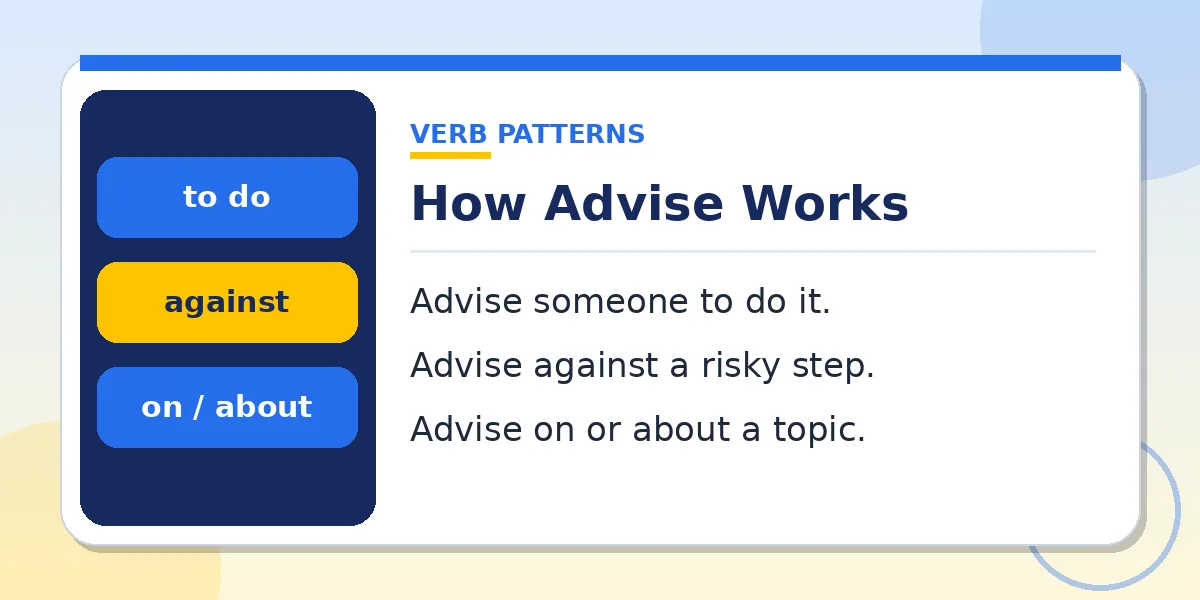
Email use is a common reason people search advice vs advise. The correct phrase is please advise. It uses advise because the writer asks someone to take action and provide guidance or information. Please advice is incorrect in standard everyday English.
What Does Please Advise Mean?
Please advise is a formal expression often used in emails and workplace messages. It asks someone to provide guidance, information, or a decision.
Examples:
- Please advise on how we should proceed.
- Please advise whether the meeting time works for you.
- Please advise us of any changes.
What Does Please Be Advised Mean?
Please be advised is another correct phrase, but it has a different purpose. It introduces information.
For example:
- Please be advised that the office will close at 3 p.m.
- Please be advised that your application is under review.
The difference is simple:
| Phrase | Meaning | Example |
|---|---|---|
| Please advise | Asking someone for guidance or information | Please advise on the next step. |
| Please be advised | Giving someone formal information | Please be advised that the deadline has changed. |
Is Please Advise Too Formal?
Please advise is grammatically correct. However, it can sound stiff, vague, or demanding in some messages. A more natural phrase may work better when you know what information you need.
Try these alternatives:
- Could you let me know what you recommend?
- Please share your thoughts.
- What would you suggest?
- Could you confirm the next step?
- I would appreciate your guidance.
For example:
- Less specific: Please advise.
- Clearer: Could you advise me on which option best fits our budget?
A clear request helps the reader understand exactly what you need.
Advise Compared With Inform, Recommend, and Counsel
This comparison helps with advice vs advise and related verbs. Advise, inform, recommend, and counsel are related verbs. However, they do not mean exactly the same thing.
| Word | Meaning | Example |
|---|---|---|
| Advise | Give guidance or recommend an action | The doctor advised me to rest. |
| Inform | Give someone facts or information | The office informed us of the delay. |
| Recommend | Suggest something as a good choice | She recommended this book. |
| Counsel | Give careful or expert guidance | The lawyer counseled his client. |
Advise Compared With Inform
Use advise when you recommend an action or provide formal notice. Use inform when you simply give someone facts.
- The doctor advised me to avoid heavy exercise.
- The doctor informed me that the results were ready.
The first sentence gives guidance. The second provides information. Note the formal exception: advise someone of something can mean to notify them. Still, in plain writing, inform or tell is often clearer for a simple fact.
Advise Compared With Recommend
Recommend usually means suggesting a choice or action. Advise can sound more direct and may suggest guidance or authority.
- I recommend this course for beginners.
- I advise you to complete the course before applying.
Both verbs can express suggestions. Their sentence patterns differ, so check the pattern before you swap them.
Advice Compared With Counsel
Counsel often suggests careful guidance, especially in personal, legal, or professional situations.
- The lawyer advised her to review the contract.
- The counselor counseled him about his career options.
In everyday writing, advise is more common. Counsel can sound more formal or specialized.
Common Mistakes to Avoid
Most errors in advice vs advise come from swapping noun and verb. These examples show common errors and their corrections.
| Incorrect | Correct | Why |
|---|---|---|
| Please advice me. | Please advise me. | Use the verb for the action. |
| I need an advice. | I need some advice. | Advice is usually uncountable. |
| She gave me many advices. | She gave me many pieces of advice. | Count pieces, not advice. |
| He adviced me. | He advised me. | The past tense is advised. |
| She is advicing him. | She is advising him. | The ing form is advising. |
| Can you advice me? | Can you advise me? | The sentence needs a verb. |
| That is good advise. | That is good advice. | The sentence needs a noun. |
| He advised to leave. | He advised us to leave. | Add the person before the infinitive. |
| His advice are helpful. | His advice is helpful. | Advice takes singular verb agreement. |
A useful habit is to check the word’s job in the sentence. If it names guidance, use advice. If it describes an action, use advise.
Adviser, Advisor, and Advisory
The words adviser, advisor, and advisory look similar. They have different roles in a sentence.
| Word | Part of speech | Meaning | Example |
|---|---|---|---|
| Adviser | Noun | A person who gives advice | She is a career adviser. |
| Advisor | Noun | A person who gives advice | He works as a financial advisor. |
| Advisory | Adjective or noun | Related to advice or a formal recommendation | The agency issued an advisory. |
Both adviser and advisor are correct spellings. Advisor is common in American business and financial settings. Adviser is also established and used in formal terminology, including the name of the Investment Advisers Act. Advisory is the standard related adjective. Do not write advisery.
American and British English
In both varieties, advice vs advise follows the same rule. No, American and British English do not differ here. Both varieties use advice as a noun and advise as a verb. The difference is not a regional spelling rule. It is a difference in grammar and pronunciation.
For example, both varieties use:
- She gave me helpful advice.
- She advised me to wait.
Some English word pairs do have regional spelling differences. Practice and practise are a familiar example in British English. In American English, practice is often used for both forms. That pattern does not apply to this pair. In both varieties, the C form is the noun and the S form is the verb.
Easy Ways to Remember
The best memory aid for advice vs advise is sound. A few simple memory tricks can help you choose the correct word.
1. Advice Rhymes With Ice
The noun advice ends with the same sound as ice and nice. Remember the letter C and the /s/ sound. Think: I need some advice.
2. Advise Rhymes With Wise
The verb advise ends with the same sound as wise and prize. Remember the letter S and the /z/ sound. Think: I will advise you.
3. Remember Noun Compared With Verb
Ask yourself what the sentence needs:
- A thing or idea? Use advice.
- An action? Use advise.
For example:
- I value your advice.
- I hope you can advise me.
4. Use This Memory Sentence
I need your advice, so please advise me.
This short sentence uses both words correctly. Advice names the guidance. Advise describes the action.
Practice Questions
Test your understanding. Choose the correct word for each sentence.
- My teacher gave me helpful (advice / advise).
- Can you (advice / advise) me about this problem?
- I need some (advice / advise) before I decide.
- The doctor (advice / advised) me to rest.
- Please (advice / advise) us of any changes.
- She is always willing to give good (advice / advise).
- My manager (advice / advised) me against accepting the offer.
- He gave me two pieces of (advice / advise) yesterday.
- She (advises / advices) new students every week.
- I would (advice / advise) checking the report before you send it.
Answer Key
- Advice. It is the noun that names the guidance.
- Advise. The sentence needs a verb describing the action.
- Advice. The phrase some advice uses the uncountable noun.
- Advised. It is the past tense of the verb advise.
- Advise. The sentence asks someone to provide formal information.
- Advice. The sentence refers to guidance someone gives.
- Advised. The sentence describes a past recommendation.
- Advice. Pieces count the uncountable noun.
- Advises. It is the third person singular verb form.
- Advise. The general recommendation uses advise plus an ing verb.
If you got all ten correct, you understand the main difference. Review the verb patterns if any answers were difficult.
Frequently Asked Questions
1. What Is the Difference Between Advice and Advise?
Advice is a noun that means guidance, a suggestion, or a recommendation. Advise is a verb that means to give guidance, recommend an action, or formally inform someone. The spelling and final sound change with the part of speech.
2. Is Advice a Noun or a Verb?
Advice is a noun, never a verb in standard English. It names guidance, suggestions, or recommendations that someone gives or receives. When your sentence needs an action, use the verb advise instead of the noun form.
3. Is It Correct to Say an Advice?
No, saying an advice is incorrect in everyday English. Advice is an uncountable noun, so it does not take a or an. Say some advice, a lot of advice, or a piece of advice when you need a singular amount.
4. What Is the Plural of Advice?
Advice has no regular plural when it means guidance or recommendations. Do not write advices for several suggestions in everyday English. Instead, write pieces of advice, several pieces of advice, or a few words of advice.
5. Should I Write Please Advise or Please Advice?
Write please advise when you ask someone for guidance, information, or a decision. The phrase needs the verb advise, because it asks someone to act. Please advice is incorrect, since advice is a noun and cannot serve as the verb.
6. Is the Past Tense Adviced or Advised?
The correct past tense is advised, not adviced. Advise is a regular verb, so its past tense and past participle both end in ed. For example, say “The teacher advised me to practice,” never “The teacher adviced me to practice.”
7. Can You Use Advise Without an Object?
Yes, in some patterns you can use advise without naming a person. Examples include “I advise waiting” and the email closing “Please advise.” Still, do not write “He advised to leave.” Name the person or use an ing form instead.
Related Guides
Want to understand more commonly confused English words? Explore these related guides:
- Affect vs Effect: https://clarifywords.com/affect-vs-effect/
- Whose vs Who’s: https://clarifywords.com/whose-vs-whos/
- Its vs It’s: https://clarifywords.com/its-vs-its/
- Loose vs Lose: https://clarifywords.com/loose-vs-lose/
- Then vs Than: https://clarifywords.com/then-vs-than/
- Complement vs Compliment: https://clarifywords.com/complement-vs-compliment/
- Principal vs Principle: https://clarifywords.com/principal-vs-principle/
Browse more lessons in the Confused Words category: https://clarifywords.com/category/confused-words/
Final Takeaway
Advice is a noun that means guidance. Advise is a verb that means to give guidance. Now you can use advice vs advise with confidence. Remember the ice and prize distinction, check the word’s job in your sentence, and you will choose the right form every time.