Complement vs Compliment: Meaning, Difference, and Examples
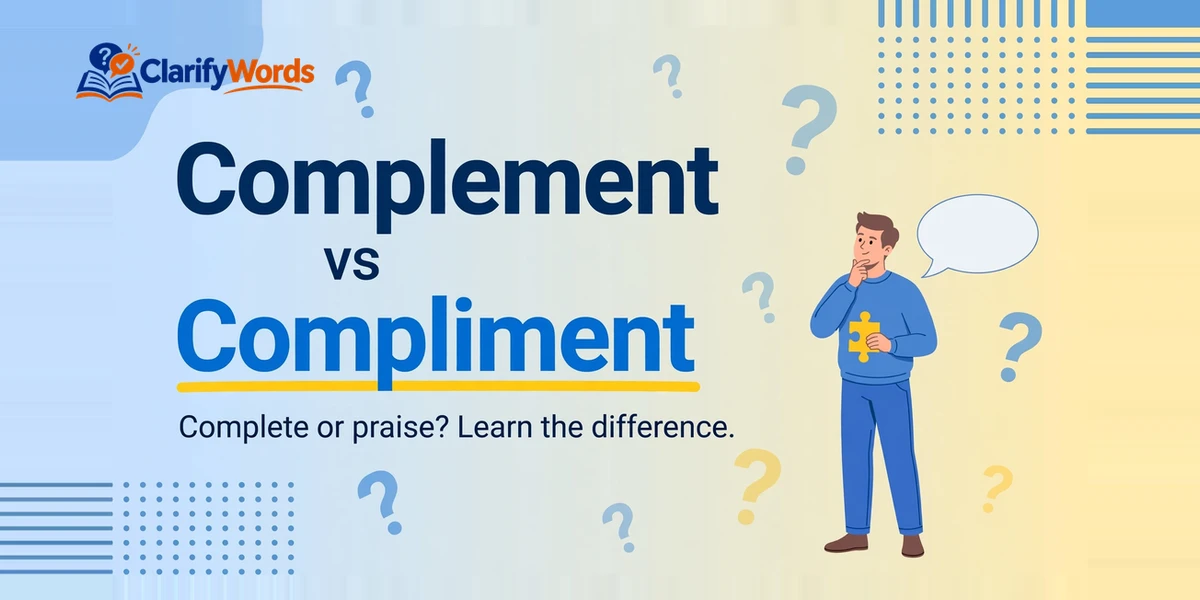
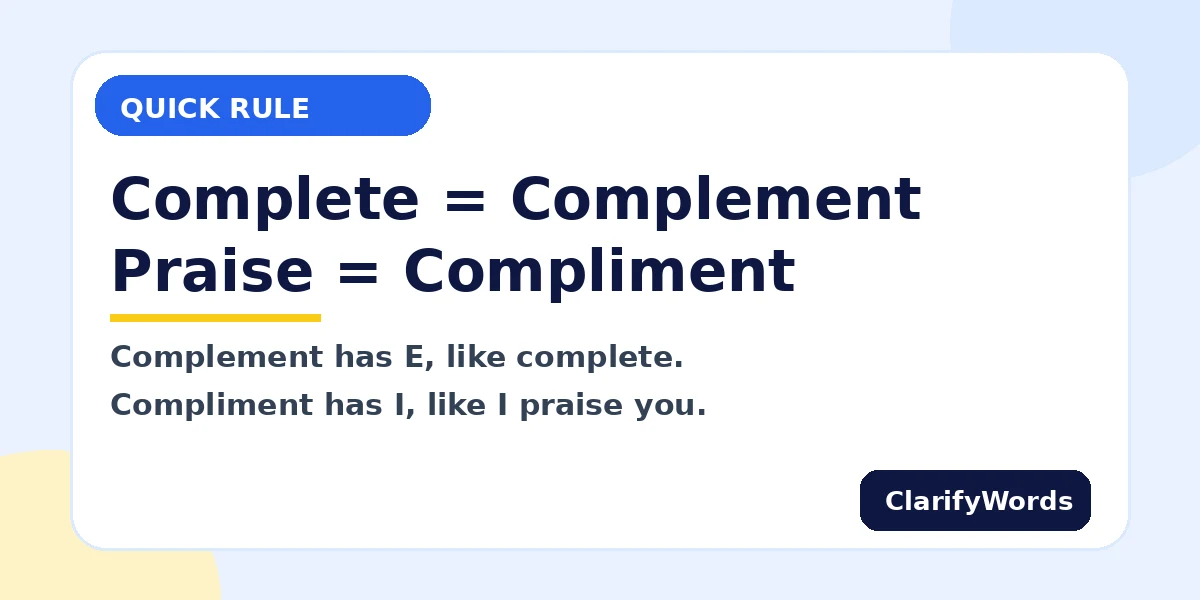
Quick answer: Complement means something that completes, improves, or goes well with something else. Compliment means an expression of praise, admiration, or respect. Both words can be nouns or verbs. Remember that complement contains complete, while compliment contains I, as in “I praise you.”
Table of Contents
- Complement vs Compliment: At a Glance
- What Does Complement Mean?
- What Does Compliment Mean?
- Complement vs Compliment: What’s the Difference?
- How to Remember Complement vs Compliment
- Complimentary vs Complementary: What’s the Difference?
- What Is a Complement in Grammar?
- Other Meanings and Expressions of Complement and Compliment
- Complement and Compliment: Verb Forms, Prepositions, and Common Expressions
- Common Complement vs Compliment Mistakes
- How to Fix Your Sentence: Complement or Compliment?
- Complement vs Compliment Examples in Everyday Contexts
- Test Your Knowledge: Complement or Compliment?
- Frequently Asked Questions
- Conclusion
At a Glance
| Complement | Compliment | |
|---|---|---|
| Main meaning | Something that completes or enhances | An expression of praise |
| Part of speech | Noun and verb | Noun and verb |
| As a noun | Something that completes another thing | Words expressing admiration |
| As a verb | To complete or improve something | To praise someone or something |
| Memory clue | Complete | I praise you |
| Example | “The sauce complements the dish.” | “She complimented the chef.” |
Complement describes a relationship between things. Compliment expresses positive feelings or approval. The words sound similar, so spelling is easy to confuse. Context shows the correct choice.
What Does Complement Mean?
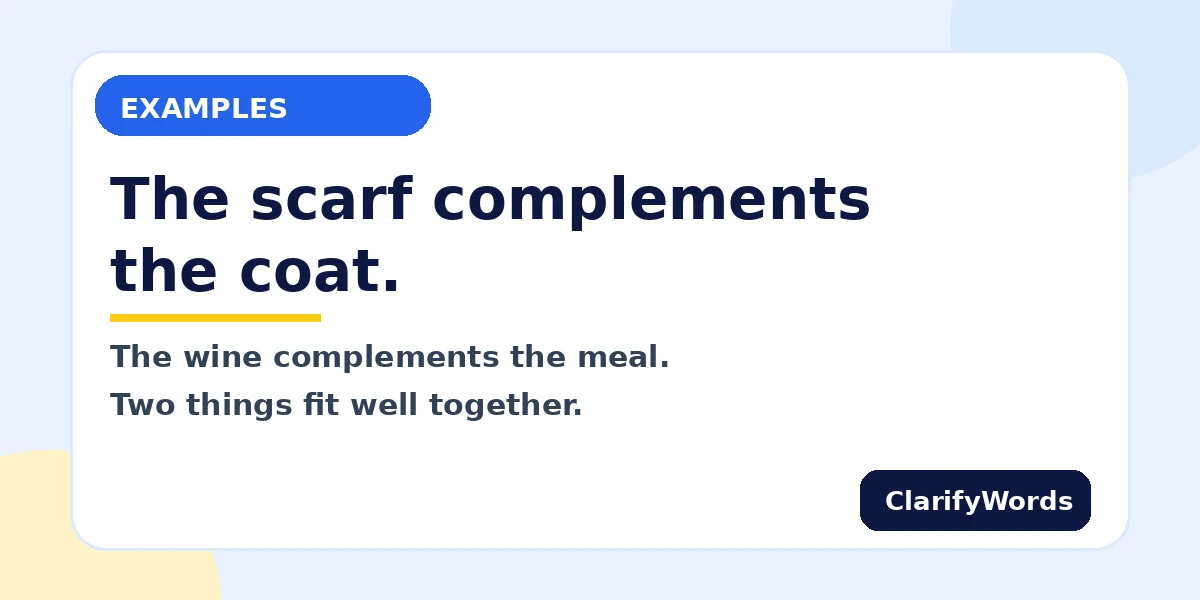
Complement means something that completes, improves, or balances another thing. It can also describe a matching part. The word appears in food, fashion, design, work, and learning.
Complement as a Noun
A complement is something that completes another thing. It may improve appearance, flavor, or performance. It may also serve as a counterpart.
- “The red scarf is a perfect complement to her black coat.”
- “Fresh herbs are a great complement to this soup.”
- “Her experience is a valuable complement to the team’s skills.”
Complement as a Verb
As a verb, complement means to complete or enhance something. The verb follows a regular pattern. It changes form like other regular verbs.
- “The wooden furniture complements the modern design.”
- “His skills complemented those of his business partner.”
- “The new lighting is complementing the room’s warm colors.”
More Examples of Complement in Sentences
- “A light salad complements the rich pasta.”
- “The gray trousers complement her blue blazer.”
- “Soft lighting complements the calm atmosphere.”
- “Her research complements his practical experience.”
- “Group study complements classroom instruction.”
- “A gentle guitar complements the singer’s voice.”
Each example shows completion, balance, or improvement. None of them involves praise.
What Does Compliment Mean?
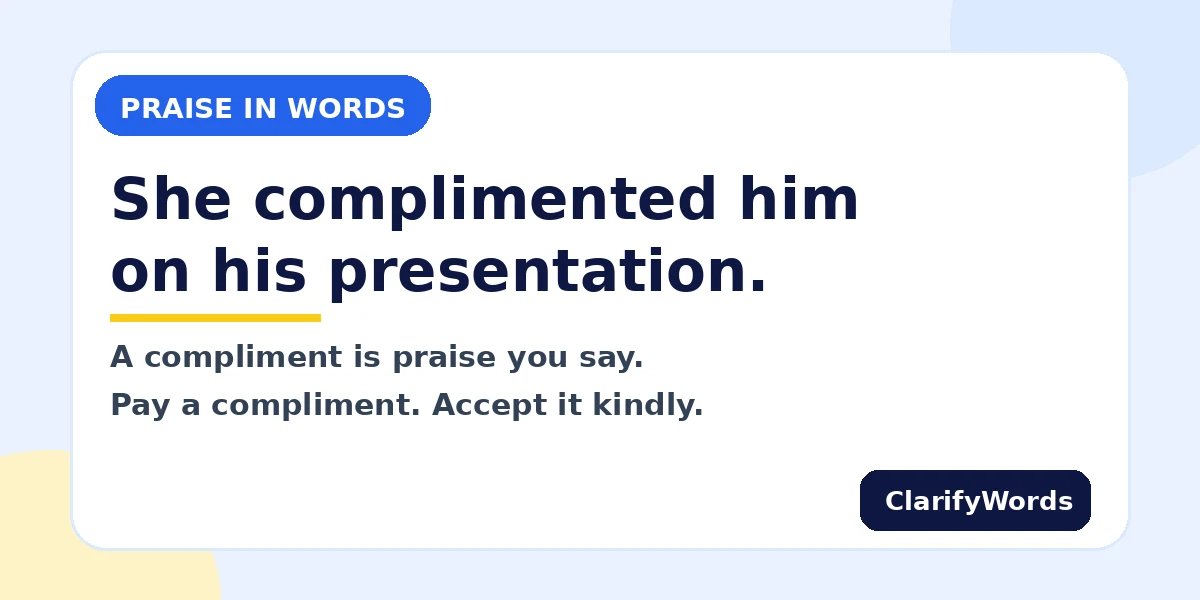
Compliment means praise, admiration, or respect. It focuses on words and feelings. It does not describe how two things fit together.
Compliment as a Noun
A compliment is a statement that expresses admiration, approval, appreciation, or respect. A sincere compliment recognizes effort or quality. Empty flattery sounds less honest. Common expressions include pay someone a compliment and receive a compliment.
- “She gave me a lovely compliment about my writing.”
- “His manager paid him a compliment after the presentation.”
- “That was one of the nicest compliments I have received.”
Compliment as a Verb
As a verb, compliment means to express admiration or praise. The common structure is compliment someone on something. The verb also follows a regular pattern.
- “I complimented her on her excellent presentation.”
- “The teacher complimented the students on their progress.”
- “He often compliments his colleagues on their work.”
More Examples of Compliment in Sentences
- “I complimented my friend on her new haircut.”
- “The principal complimented the class on its behavior.”
- “She complimented him on his clear report.”
- “Customers often compliment the friendly staff.”
- “He complimented her singing after the concert.”
- “The coach complimented the team on its effort.”
Each example involves praise. None involves completion or balance.
What’s the Difference?
| Complement | Compliment | |
|---|---|---|
| Core idea | Completion or enhancement | Praise or admiration |
| Noun meaning | Something that completes another thing | An expression of approval |
| Verb meaning | To complete or improve | To praise |
| Common expression | A complement to something | A compliment on something |
| Example | “The colors complement each other.” | “She complimented the colors.” |
People confuse these words because they sound alike. Their meanings remain different. Context matters more than pronunciation. The same situation can involve both words.
- “The blue frame complements the painting, and visitors often compliment the artist on its beauty.”
The first word shows how two things work together. The second word shows praise. This sentence proves that context controls the choice.
How to Remember Complement vs Compliment
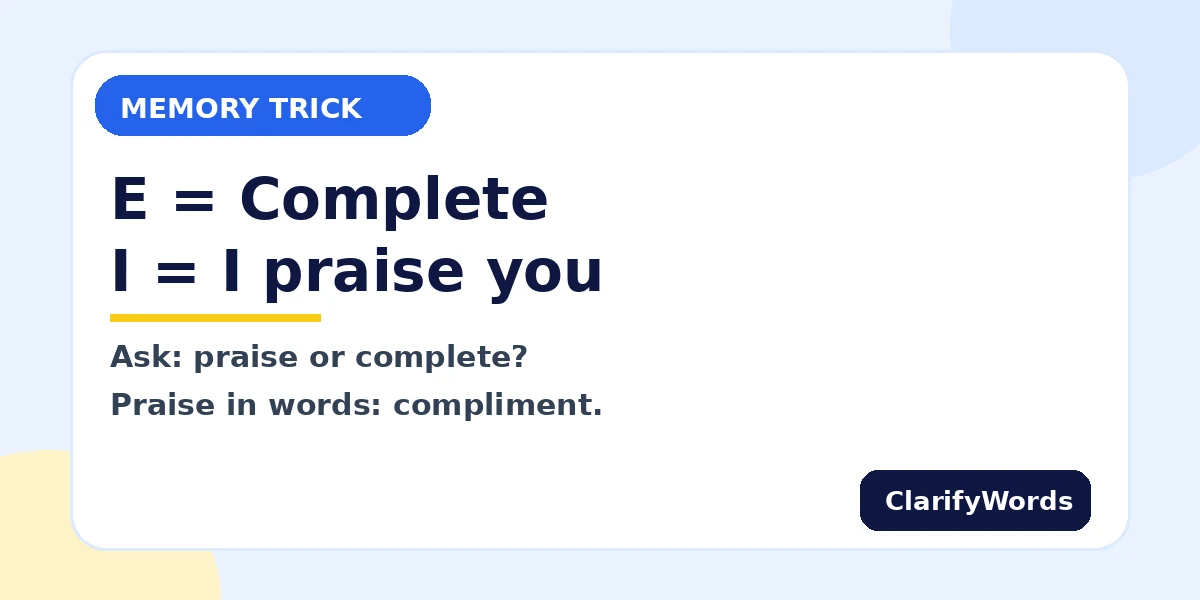
Complement Has an E for Complete
Complement and complete share the same letters at the start. Complement relates to completing, filling, balancing, or enhancing something. Think of complete when you see the E.
- “The sauce complements the meal because it completes the flavor.”
Compliment Has an I for I Praise You
Compliment contains I. Think of the phrase “I praise you.” Compliment involves expressing admiration or approval. This clue helps in most cases.
- “I complimented her on her cooking.”
Use the Substitution Test
Replace the word with a simpler term. If complete, enhance, or improve fits, choose complement. If praise or says something nice fits, choose compliment. This test works in most sentences.
Ask Yourself One Simple Question
Ask: Am I praising someone? Use compliment. Ask: Am I describing something that completes or improves another thing? Use complement. One question often gives the answer.
Complimentary vs Complementary: What’s the Difference?
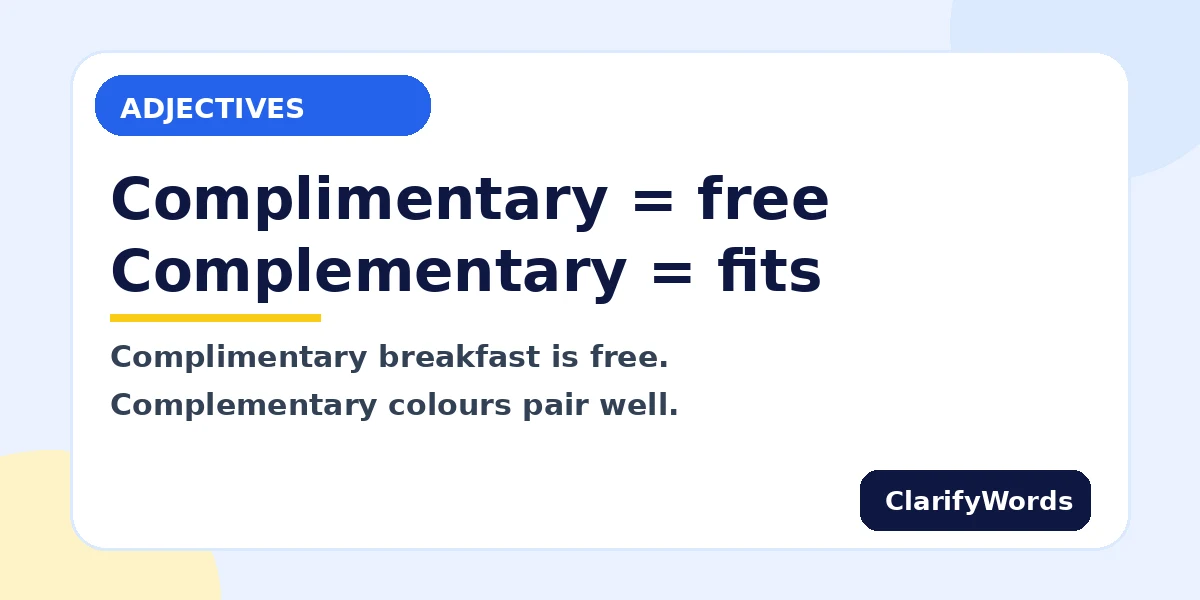
These adjectives cause a similar problem. Their spellings differ by one letter. Their meanings differ in an important way.
What Does Complimentary Mean?
Complimentary has two main meanings. It can mean expressing praise or approval. It can also mean provided free as a courtesy.
- “The hotel offers complimentary breakfast.”
- “The reviewer was complimentary about the restaurant.”
- “We received complimentary tickets to the event.”
What Does Complementary Mean?
Complementary describes things that complete, balance, or enhance each other. It never means free. It describes a working relationship.
- “The two colors are complementary.”
- “Their complementary skills make them an effective team.”
- “The flavors are complementary.”
Complimentary vs Complementary Examples
| Word | Meaning | Example |
|---|---|---|
| Complimentary | Free | “Complimentary parking” |
| Complimentary | Expressing praise | “Complimentary feedback” |
| Complementary | Working well together | “Complementary colors” |
| Complementary | Completing or balancing | “Complementary skills” |
Is Complimentary Free or Complementary?
Complimentary means free when it refers to services, products, or gifts. Complementary means two or more things work well together. The phrase “complimentary free breakfast” is redundant. Complimentary already means free in this context.
What Is a Complement in Grammar?
Grammar uses complement in a technical sense. This meaning differs from the everyday meaning. It still involves completing a sentence.
What Is a Subject Complement?
A subject complement follows a linking verb. It identifies, describes, or gives information about the subject. Common linking verbs include be, seem, and become.
- “She is a teacher.” (teacher is the subject complement)
- “The food smells delicious.” (delicious is the subject complement)
- “He became confident.” (confident is the subject complement)
What Is an Object Complement?
An object complement follows an object. It identifies or describes that object. It completes the meaning of the sentence.
- “They elected Maria president.” (president is the object complement)
- “The news made him happy.” (happy is the object complement)
- “We painted the wall blue.” (blue is the object complement)
This grammar meaning is separate from the everyday meaning. It does not describe praise or enhancement.
Other Meanings and Expressions of Complement and Compliment
What Does Full Complement Mean?
A full complement refers to the complete number or quantity required or included. It often appears in formal or official contexts.
- “The ship sailed with its full complement of crew members.”
- “The school hired its full complement of teachers.”
Complement as a Counterpart
Complement can describe one of two parts that complete or balance each other. The parts work together as a pair.
- “The two departments provide complementary services.”
This use connects to the idea of completing something. It does not involve praise.
What Does Compliments Of Mean?
Compliments of identifies the person, business, or organization providing something. It often appears in restaurants and hotels.
- “The dessert is compliments of the chef.”
- “Your first drink is compliments of the house.”
The expression compliments of the season is a traditional greeting. It wishes someone well during a holiday period.
Complementary Angles
Complementary angles are a math term. Two complementary angles add up to 90 degrees.
- 40 degrees + 50 degrees = 90 degrees
This is a specialized use of complementary. It is not complimentary.
Complement and Compliment: Verb Forms, Prepositions, and Common Expressions
Complement vs Compliment Verb Forms
| Form | Complement | Compliment |
|---|---|---|
| Base form | complement | compliment |
| Third-person singular | complements | compliments |
| Past tense | complemented | complimented |
| Past participle | complemented | complimented |
| Present participle | complementing | complimenting |
Both words follow the same regular verb pattern. Their meanings remain different. Their spelling still controls the choice.
Common Prepositions Used with Compliment
- Compliment someone on something
- Pay someone a compliment
- A compliment about something
- A compliment from someone
Examples:
- “She complimented me on my presentation.”
- “He received a compliment about his writing.”
Common Prepositions and Expressions Used with Complement
- A complement to something
- Complement each other
- A perfect complement to something
- Complemented by something
Examples:
- “This jacket is a perfect complement to your outfit.”
- “The two approaches complement each other.”
Compliment commonly appears with on when it identifies what someone is praised for. Complement commonly appears with to. These patterns help writers choose correctly.
Common Complement vs Compliment Mistakes
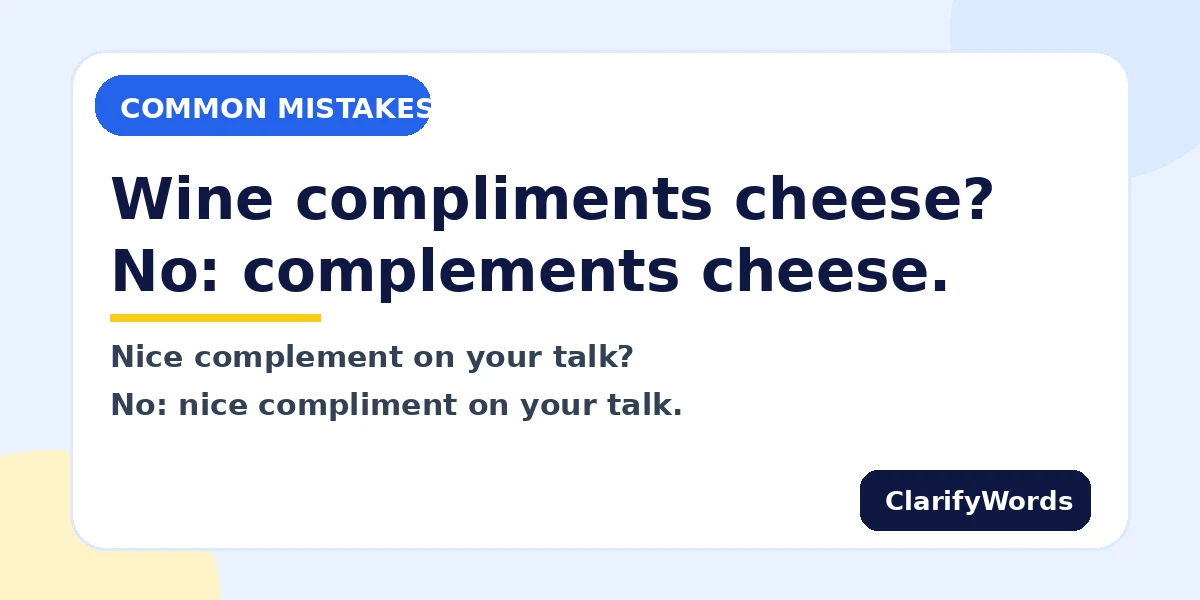
| Incorrect | Correct | Why |
|---|---|---|
| “She gave me a complement.” | “She gave me a compliment.” | She expressed praise. |
| “The sauce compliments the meal.” | “The sauce complements the meal.” | It enhances the meal. |
| “He complemented her on her dress.” | “He complimented her on her dress.” | He praised her dress. |
| “These colors are complimentary.” | “These colors are complementary.” | They work together in color theory. |
| “The hotel provides complementary breakfast.” | “The hotel provides complimentary breakfast.” | The breakfast is free. |
| “Her skills are a nice compliment to his.” | “Her skills are a nice complement to his.” | The skills balance each other. |
| “The teacher gave a complement about my essay.” | “The teacher gave a compliment about my essay.” | The teacher expressed praise. |
| “The furniture compliments the room.” | “The furniture complements the room.” | It improves the room’s appearance. |
Each incorrect sentence is unambiguous. The correct version fits the intended meaning. The wrong version changes the meaning.
How to Fix Your Sentence: Complement or Compliment?
Step 1: Identify What You Want to Say
Decide whether the sentence is about praise. Or decide whether it is about something completing or improving another thing. This choice guides the spelling.
Step 2: Replace the Word With a Simpler Alternative
- Praise to compliment
- Complete or enhance to complement
- Free to complimentary
- Working well together to complementary
Step 3: Check the Sentence Structure
Check common expressions and prepositions:
- Compliment someone on something
- Pay someone a compliment
- A complement to something
- Complement each other
Step 4: Read the Sentence Again
Spellcheck alone may not identify this error. Both spellings are legitimate English words. The intended meaning must be checked.
Editing checklist:
- Does the sentence express praise? Use compliment.
- Does it describe completion or enhancement? Use complement.
- Does it mean free? Use complimentary.
- Does it describe things working well together? Use complementary.
Complement vs Compliment Examples in Everyday Contexts
Food and Restaurants
- “Fresh basil complements the tomato sauce.”
- “The chef complimented the team on its service.”
- “The hotel offers complimentary breakfast.”
- “The dessert was compliments of the chef.”
Clothing and Fashion
- “The belt complements her dress.”
- “She complimented his suit.”
- “The scarf is a perfect complement to the coat.”
- “Her friend complimented her on her style.”
Colors and Design
- “Blue and orange are complementary colors.”
- “The designer complimented the client on her bold choices.”
- “The rug complements the wall color.”
- “Soft tones complement the bright artwork.”
Work and Professional Communication
- “Their skills complement each other.”
- “The manager complimented the team on its results.”
- “Her calm approach complements his fast pace.”
- “A short note can compliment good work.”
School and Education
- “The teacher complimented the students on their reading.”
- “The workbook complements the textbook.”
- “Group projects complement individual study.”
- “The principal paid the class a compliment.”
Casual Conversations
- A: “I love how that necklace complements your dress.”
- B: “Thank you! That’s a lovely compliment.”
The first speaker describes how two things work together. The second speaker recognizes praise. This short exchange shows both meanings clearly.
Test Your Knowledge: Complement or Compliment?
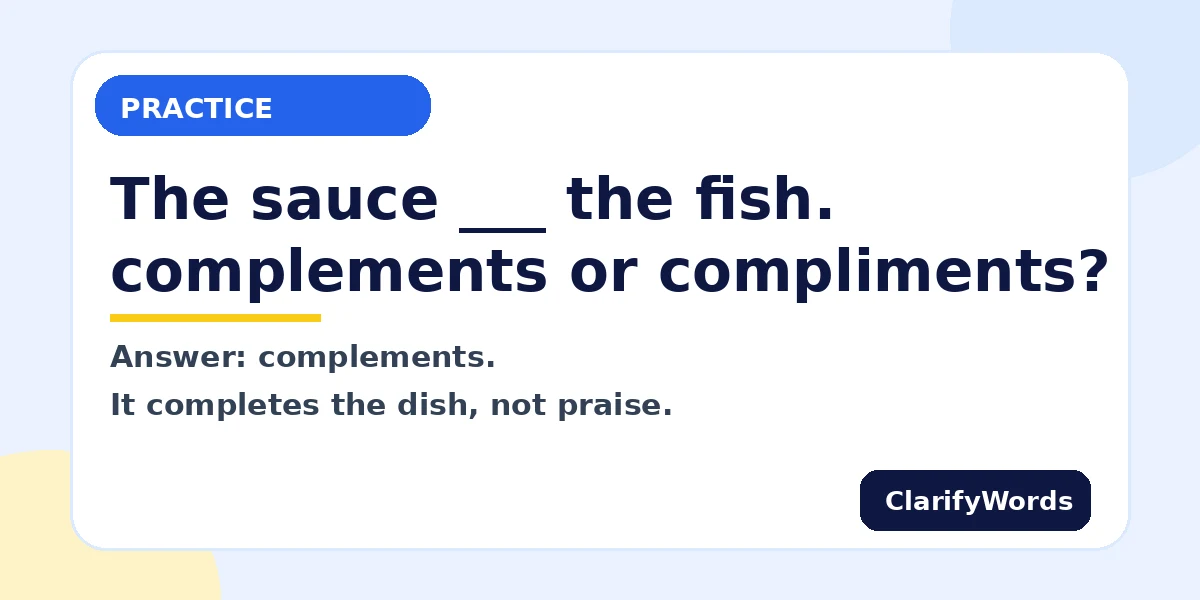
Choose the correct word or form for each sentence.
Practice Questions
- Her necklace is a perfect ______ to her evening dress.
- He gave me a lovely ______ about my presentation.
- The teacher ______ the student on her excellent work.
- The two colors ______ each other beautifully.
- The hotel offers ______ breakfast to all guests.
- Fresh herbs ______ the flavor of the soup.
- The manager paid her a ______ for handling the project well.
- Their different skills ______ each other.
- The restaurant served dessert ______ of the chef.
- In the sentence “They elected her chairperson,” chairperson is an object ______.
Answer Key With Explanations
- Complement: The necklace enhances the dress.
- Compliment: The statement expresses praise.
- Complimented: The teacher praised the student.
- Complement: The colors work well together.
- Complimentary: The breakfast is provided free.
- Complement: The herbs enhance the flavor.
- Compliment: The manager expressed praise.
- Complement: The skills balance each other.
- Compliments: This identifies the source of the gift.
- Complement: It completes the meaning of the object.
Frequently Asked Questions
What Is the Difference Between Complement and Compliment?
Complement means something that completes, improves, or balances another thing. Compliment means praise or admiration. Use complement when two things fit well together, and use compliment for kind words that praise a person.
How Do You Remember Complement vs Compliment?
Remember that complement contains complete. It helps you think of completing or improving something. Compliment contains I, as in “I praise you.” This simple spelling trick helps you choose correctly.
Can Complement and Compliment Both Be Verbs?
Yes. Complement means to complete, balance, or improve something. Compliment means to praise someone or something. For example, colors complement each other, while a teacher compliments a student on good work.
Is It Complimentary or Complementary for Free?
Complimentary can mean free as a courtesy or expressing praise. Complementary means completing, balancing, or enhancing something. A hotel may offer a complimentary breakfast, while two colors in a design may be complementary.
What Is a Complement in Grammar?
A grammatical complement is a word or phrase that completes the meaning of another sentence element. A subject complement describes the subject, while an object complement identifies or describes the direct object.
What Does Compliments of the Chef Mean?
Compliments of the chef means the chef provides something as a gift or courtesy. For example, a restaurant might serve a free dessert and describe it as compliments of the chef.
Why Doesn’t Spellcheck Catch Complement vs Compliment?
Spellcheck may miss this error because both complement and compliment are correctly spelled words. The problem is their meaning in context. Proofread the sentence to make sure the chosen word fits.
Conclusion
Complement means complete or enhance. Compliment means praise or admiration. Complimentary means free or praising. Complementary means working well together. Check the intended meaning before you choose the spelling. This simple habit prevents most errors.
You may also find these guides useful:
Explore more confused words in the Confused Words category.