Then vs Than: Simple Rules and Examples
Quick Answer: Use then for time, sequence, or a result. Use than for a comparison. We ate dinner, then watched a film. This film is better than the last one. This guide explains the rules for then vs than, gives clear examples, and helps you avoid common mistakes.
Then vs Than: Quick Answer
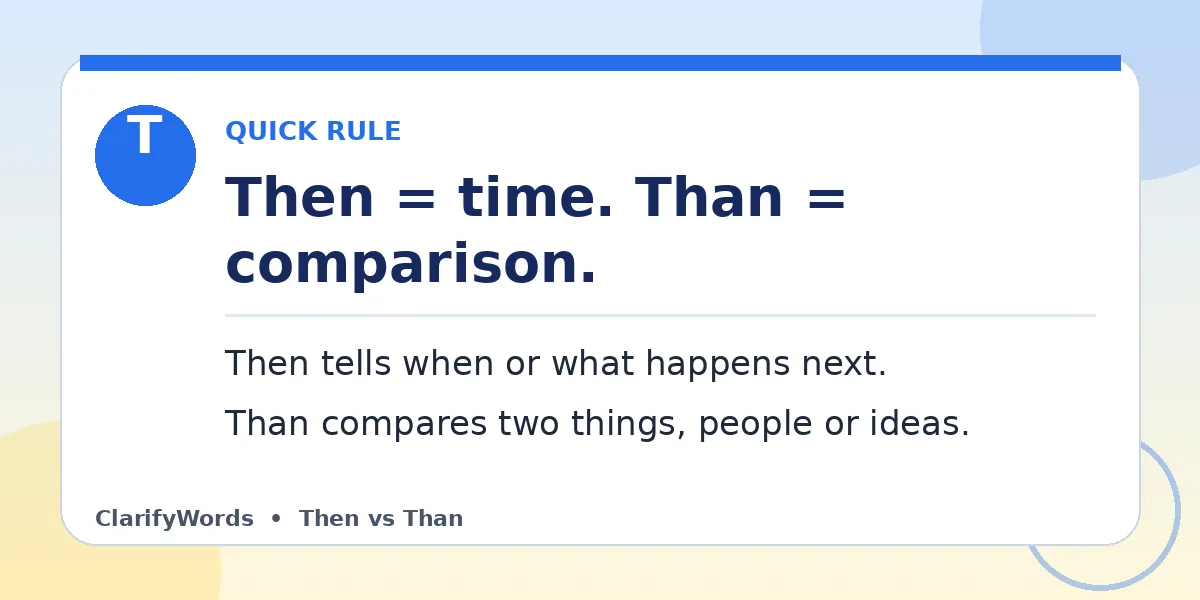
Then usually refers to time, sequence, or a consequence. Than introduces a comparison between two people, things, actions, or amounts. If you can replace the word with at that time, use then. If the sentence compares two things, use than. Many people mix up then vs than because both words sound similar and both are real words. A spellchecker may not catch the error. The meaning of the sentence is the best test.
Then vs Than: At a Glance
| Feature | Then | Than |
|---|---|---|
| Main meaning | Time, sequence, or consequence | Comparison |
| Main roles | Adverb, noun, adjective | Conjunction, preposition |
| Common use | Shows when something happens | Shows how two things differ |
| Common phrases | Back then, just then, then again | More than, less than, rather than |
| Example | We went home then. | She is taller than me. |
| Memory tip | Think of time | Think of comparison |
What Does Then Mean?
Then can mean at that time, after that, or as a result. It can act as an adverb, noun, or adjective. I lived in Chicago then. We can discuss it then. Life was different back then.
What Does Than Mean?
Than introduces the second part of a comparison. It often follows a comparative adjective or adverb, such as better, faster, more, or less. My sister is older than me. This route is shorter than the other one. Reading is more relaxing than watching television.
Then Uses: Time, Sequence, and Consequence
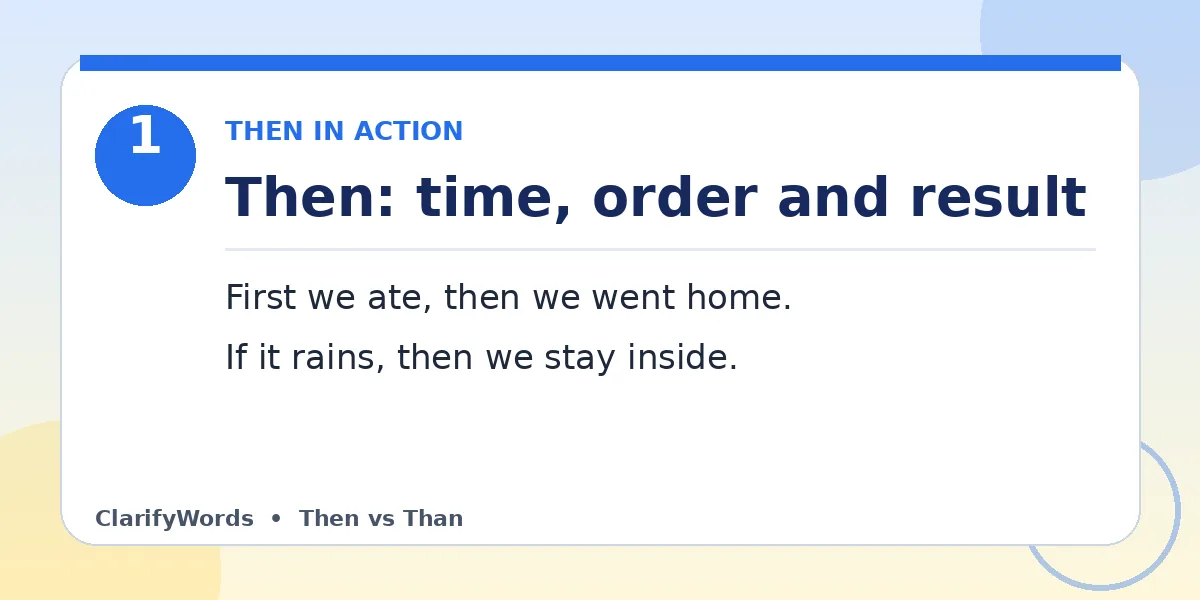
Then for Time
Then points to a time in the past, present, or future. I lived in Chicago then. We can discuss the details then. Life was different back then.
Then for Sequence
Then shows what happens next. Finish your homework, then watch television. First, preheat the oven. Then, prepare the ingredients. She opened the door, then walked inside.
Then for Addition
Then can add another point. The hotel was expensive, and then there were the parking fees. We need to consider the cost, then there is the time involved.
Then for Consequence and If Then Statements
Then can show a result or logical conclusion. If it rains, then we will stay inside. You have finished the assignment, so then you can leave. If that is true, then we need another plan.
Then for Inference
Then can introduce a conclusion from evidence. You knew about the meeting, then? If he has already left, then we have missed him.
Then as a Noun and Adjective
As a noun, then refers to a particular time. Since then, she has changed jobs. As an adjective, then describes a person or thing at a stated time. The then president introduced the policy. Her then boyfriend attended the event.
Common Phrases That Use Then
Just then means at that exact moment. Back then means at an earlier time. Every now and then means occasionally. Then again means on the other hand. Then and there means immediately, at that time and place. And then some means more than the amount mentioned. Well then introduces a conclusion or transition. Okay then shows acceptance or transition. But then again introduces another consideration.
Than Uses: Comparisons and Preferences
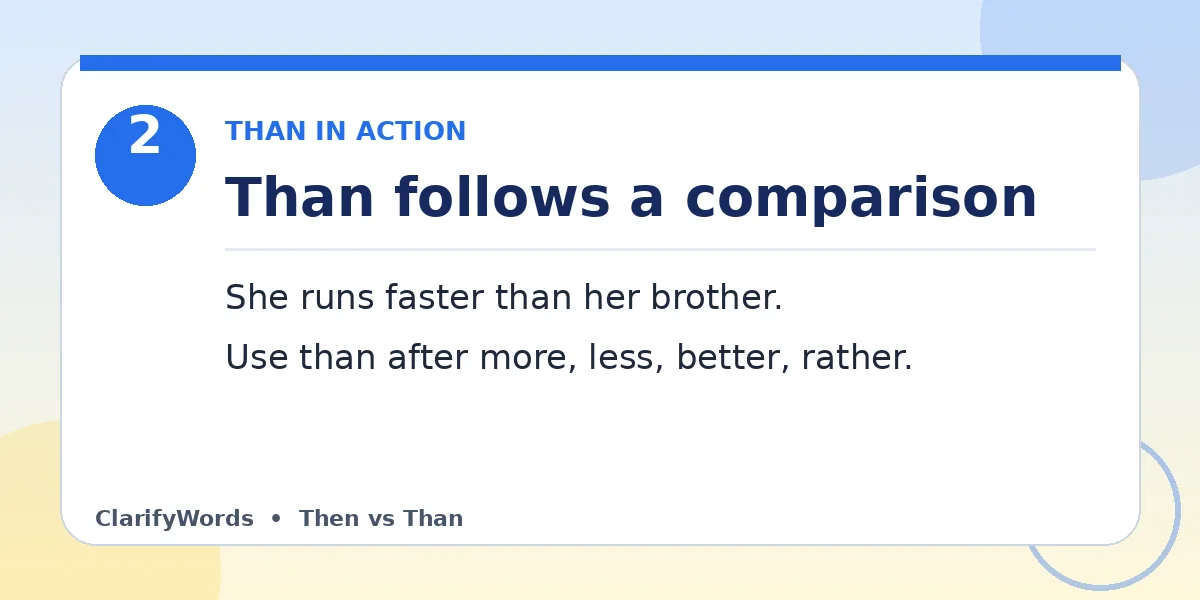
Than for Comparisons
Than introduces the second part of a comparison. My sister is older than me. This route is shorter than the other one. Reading is more relaxing than watching television.
Than After Comparative Adjectives and Adverbs
Comparative forms often take than. Better than, faster than, taller than, smarter than, more carefully than, and less expensive than are common patterns. This phone is better than my old one. She runs faster than her brother. He completed the task more carefully than I did.
Than With More and Less
Than compares quantities, amounts, and degrees. The package weighs more than five pounds. I spent less than 50 dollars. She has more experience than I do. The meeting lasted longer than expected.
Than in Rather Than and Other Than
Rather than shows preference or an alternative. I would walk rather than drive. She chose to read rather than watch television. When you compare parallel actions, use the base verb after rather than, as in rather than pay the fare, he walked home. Other than means except or apart from. Nobody other than Sarah knew the answer. I have no plans other than studying tonight.
Than in Different Than and Different From
Different from is the traditional and safer formal choice. Different than is widely used in American English, especially before a clause. This design is different from the original. The result was different than I expected.
Than in No Sooner Than
No sooner than describes one event happening right after another. No sooner had we arrived than it started raining. No sooner did she finish than the next task began. Note the inversion in formal use: the auxiliary verb comes before the subject.
Than in Time Related Comparisons
Than can compare different times. The weather is warmer than yesterday. The meeting ended earlier than expected. Life is easier now than it was before. A sentence about time still takes than when it compares two periods.
Tricky Phrases: Better Than, More Than, and More
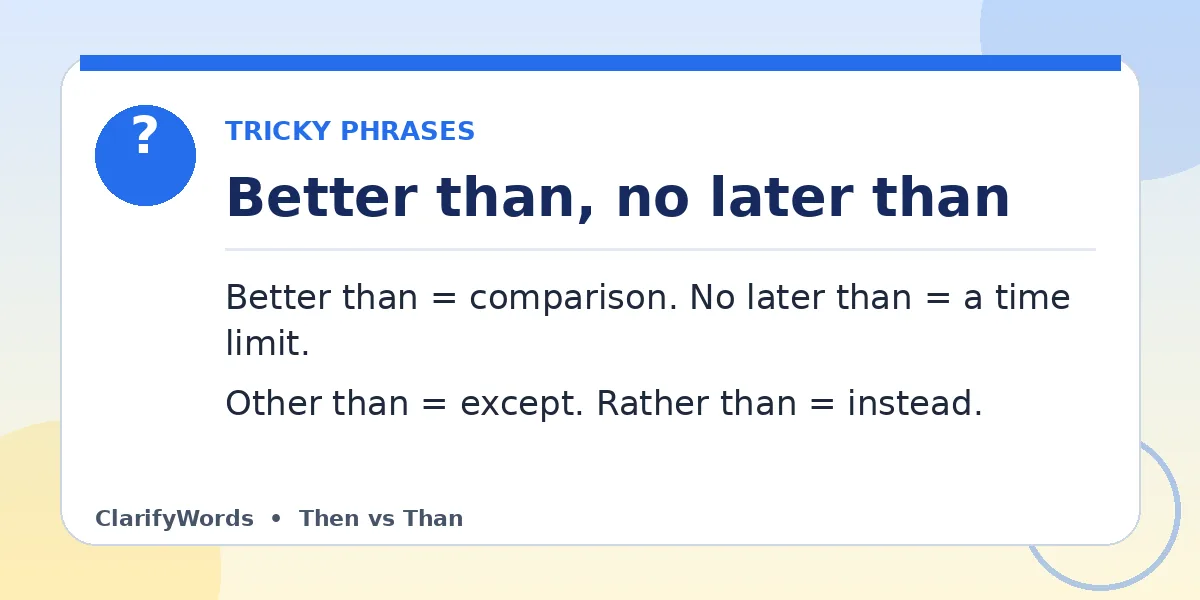
Better Than or Better Then?
Better than is correct when comparing two things. Better then can be correct when then means at that time. This laptop is better than my previous one. Football was better then than it is now. That last sentence is a good test for then vs than, because it uses both words correctly.
More Than or More Then?
More than is correct for a greater amount or degree. The repair cost more than 200 dollars. More then is incorrect for a comparison. Then fits only when it adds a time or sequence meaning of its own.
No Later Than or No Later Then?
No later than is correct for a deadline. Submit your application no later than Friday. The payment must arrive no later than noon. Than introduces the deadline comparison, even though the sentence is about time.
Sooner Than or Sooner Then?
Sooner than is correct for a time comparison. She arrived sooner than expected. We finished sooner than they did. Then fits only when it independently refers to a time or sequence.
Rather Than or Rather Then?
Rather than shows an alternative or preference. I would rather stay home than go out. Then can appear separately as a time or discourse word, but it does not replace than in this fixed construction.
Well Then or Well Than?
Well then is correct as a conversational transition. Well then, let us get started. Well than is incorrect in this expression, because well is not a comparative word.
Would Rather, Then: The Rare Exception
Would rather normally takes than for a preference. I would rather walk than drive. Then can appear separately as an independent adverb meaning in that case or next, but would rather, then is not a standard alternative to would rather than.
Then and Than in the Same Sentence
Both words can appear correctly in one sentence because they do different jobs. We were happier then than now. In that sentence, then identifies the earlier time, and than introduces the comparison with now. More examples: I was more confident then than I am today. The town was smaller then than it is now. She earned more money then than she does today.
Than I or Than Me?
Than I
In formal use, than can act as a conjunction with an implied verb. She is taller than I am. He works harder than I do. She is more experienced than I, with am implied.
Than Me
In informal use, than is often treated as a preposition. She is taller than me. He knows more than me. This use is widely accepted in everyday American English.
How Pronoun Case Can Change Meaning
An omitted verb can make a comparison unclear. He likes her more than me can mean he likes her more than he likes me. He likes her more than I do means I like her less than he does. Restore the missing verb when meaning could be misunderstood.
Than Clauses Can Drop Words
A than clause often drops words that the reader can fill in. The house was bigger than we had imagined means bigger than we had imagined it was. He finished the second part more quickly than he did the first part. When you are unsure, restore the missing words and check whether the comparison still makes sense. Do not use that or as after a comparative adjective or adverb. Write quicker than we expected, not quicker that we expected.
Hardly and Scarcely Take When, Not Than
No sooner takes than, but hardly and scarcely take when. No sooner had I arrived than it rained. Hardly had I arrived when it rained. Scarcely had she started when the phone rang. Mixing these pairs up is a common error in then vs than practice, because all three constructions describe events close together in time.
Why Then and Than Are Confused
Pronunciation
In stressed American English, then has a short e sound, like hen. Than has a short a sound in its strong form, like man. In unstressed speech, than often sounds reduced, which can make the two words sound very similar. This can vary by speaker, accent, and sentence context. Do not assume every speaker merges them completely.
Why Spellcheck Does Not Always Catch the Mistake
Both words are real dictionary words. Spellcheck may not flag a correctly spelled word used in the wrong grammatical role. That is why then vs than errors survive even careful proofreading by ear. This option is cheaper then the other is incorrect. This option is cheaper than the other is correct. Check meaning and sentence structure, not spelling alone.
Easy Memory Tricks
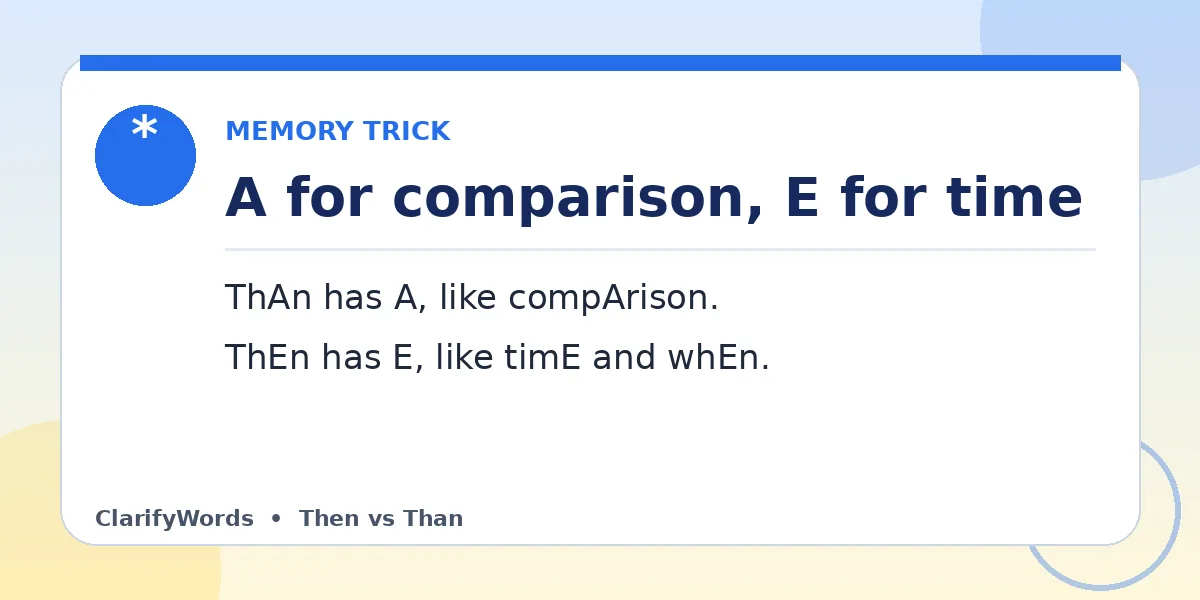
Remember Then With Time
Link then with when. Try replacing then with at that time. If the sentence still makes sense, then is likely correct. I was happier then becomes I was happier at that time.
Remember Than With Comparison
Link than with comparison. Try replacing than with in comparison to. If the sentence still makes sense, than is likely correct. She is taller than me becomes She is taller in comparison to me.
Use the Subsequently Test for Then
For sequence, try subsequently. We finished dinner, then left becomes We finished dinner and subsequently left. This test helps with sequence, not every use of then.
Check for Comparative Words
Words such as better, worse, more, less, taller, faster, older, and earlier often signal that than is needed. Check the whole sentence, not one word alone.
Restore the Missing Verb
Complete an omitted than clause to check meaning. She likes him more than me is unclear. She likes him more than I do, or She likes him more than she likes me, are both clear.
The Letter Trick
Than has an a, like comparison. Then has an e, like time and when. This small letter check solves many then vs than doubts in seconds.
Common Mistakes
| Incorrect | Correct | Explanation |
|---|---|---|
| She is taller then me. | She is taller than me. | Than introduces a comparison. |
| I finished my work, than went home. | I finished my work, then went home. | Then shows sequence. |
| This is more then I expected. | This is more than I expected. | Than compares an amount or degree. |
| Submit it no later then Friday. | Submit it no later than Friday. | Than introduces a deadline. |
| I would rather walk then drive. | I would rather walk than drive. | Than introduces the alternative. |
| Well than, let us begin. | Well then, let us begin. | Then introduces a conversational transition. |
| No sooner had I arrived when it rained. | No sooner had I arrived than it rained. | No sooner takes than. |
| Hardly had I arrived than it rained. | Hardly had I arrived when it rained. | Hardly takes when. |
| The result was different then I expected. | The result was different than I expected. | Than introduces the expected comparison. |
| Life was better than. | Life was better then. | Then refers to an earlier time when no comparison follows. |
Some mistakes involve more than spelling. Incomplete comparisons, misplaced conjunctions, and unclear omitted verbs can also affect meaning. A comparison must name both sides. My car is faster is incomplete. My car is faster than my cousin’s car is complete.
Practice Questions
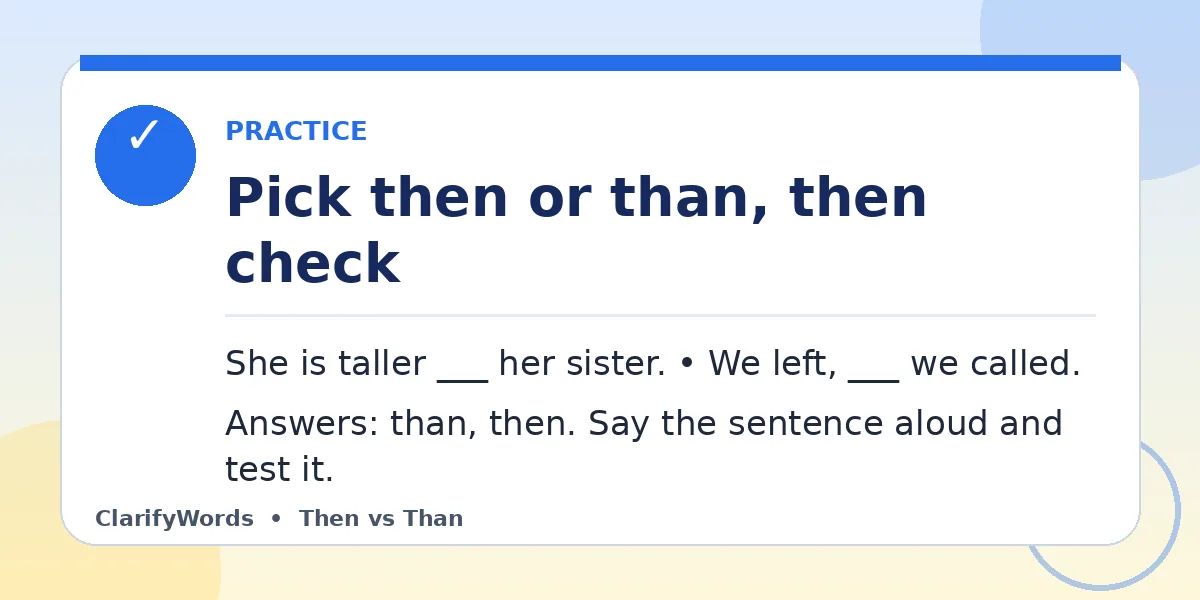
Fill in each blank with either then or than.
- My new laptop is faster _____ my old one.
- We finished dinner and _____ watched a movie.
- She was much happier _____ than she is today.
- The assignment took longer _____ expected.
- If you finish early, _____ you can leave.
- I would rather read a book _____ watch television.
- Please submit your application no later _____ Friday.
- The weather was warmer _____ than it is now.
- He earns more money _____ his brother.
- _____ again, we could always try another approach.
Answer Key With Explanations
- Than. Introduces a comparison between laptops.
- Then. Shows the next action in a sequence.
- Then. Both words appear: then for the earlier time and than for the comparison.
- Than. Completes a comparison with expected duration.
- Then. Introduces the consequence of finishing early.
- Than. Introduces the alternative in a preference.
- Than. Introduces a deadline.
- Then. Both words appear: then refers to an earlier time and than compares that time with now.
- Than. Compares the amounts of money earned.
- Then. Forms the expression then again.
Frequently Asked Questions
1. What is the difference between then and than?
Then usually refers to time, order, or consequence. Than introduces a comparison between people, things, actions, or amounts. For example, you finish a task, then rest, or choose one option over another.
2. Is it better then or better than?
Both forms can be correct, depending on meaning. Use better than to compare two things. Use better then when describing how something was at an earlier time, as in “It was better then than now.”
3. Is it more then or more than?
The correct phrase for comparisons and amounts is more than. For example, “She has more than ten books.” Use then only when referring to a time or the next event. It is the standard choice in comparisons.
4. Is it no later then or no later than?
Use no later than for deadlines and time limits. It sets the latest possible time for an action, so it must be clear to the reader. For example, submit your application no later than Friday.
5. Can then and than be used interchangeably?
No, the words cannot be used interchangeably in standard English. Then refers to time, sequence, or consequence, while than introduces a comparison. Swapping them changes the meaning or makes the sentence incorrect.
6. When do I use then and when do I use than?
Use then when at that time or subsequently fits the sentence, for time, sequence, or a result. Use than when the sentence compares, prefers, or measures one thing against another, especially after a comparative word.
7. Is different than correct in American English?
Yes. Different than is common in American English, especially before a clause, as in “The result was different than expected.” Different from is also correct and is often preferred in formal writing.
With these rules, then vs than becomes a quick check, not a guess. Ask whether the sentence compares or tells time, and choose accordingly.