

Either vs Neither: Meanings, Rules, and Examples

Either means one of two options. Neither means not one and not the other. Use either with or. Use neither with nor. Either is positive. Neither is negative. This either vs neither guide gives you the full rules, clear examples, and practice questions so you can choose the right word every time.
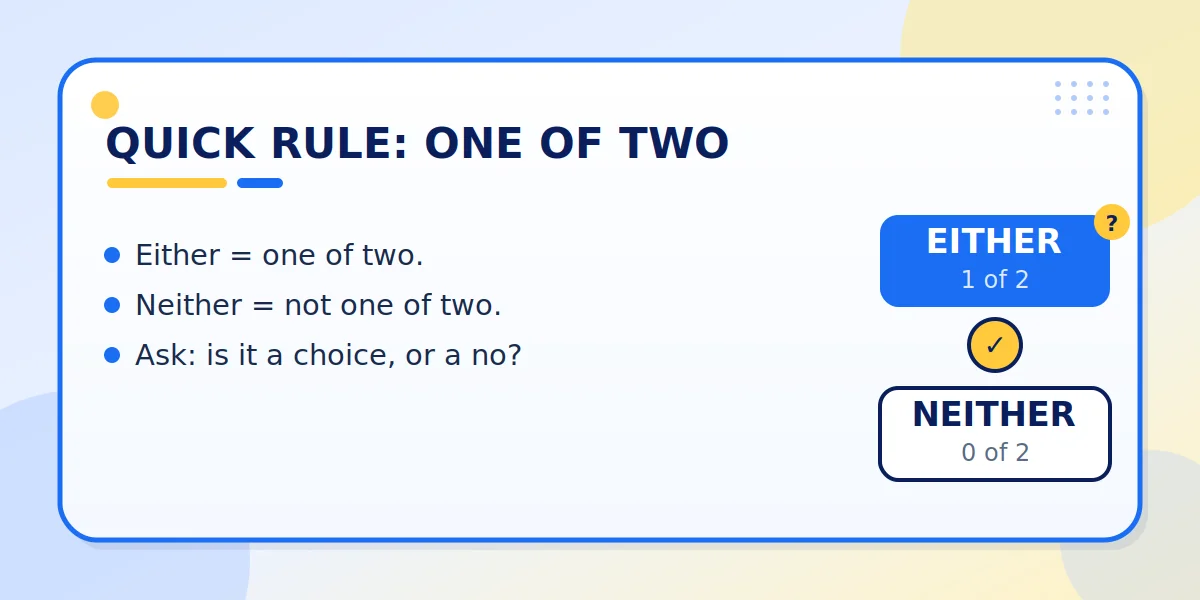
Table of Contents
- What Is the Main Difference?
- What Does Either Mean?
- What Does Neither Mean?
- Comparison Table
- How to Use Either…Or
- How to Use Neither…Nor
- Four Parts of Speech
- Either/Neither Of + Plural Noun
- Verb Agreement and the Proximity Rule
- How to Agree With a Negative
- Neither vs None
- Either/Neither vs Both and the Any/None/All Map
- Formal vs Informal
- How Do You Pronounce Either and Neither?
- Common Mistakes
- Memory Trick
- Practice Questions
- Frequently Asked Questions
What Is the Main Difference Between Either and Neither?
Either gives you a choice between two options. Neither removes both options. The either vs neither choice is simple once you know the rules. You can take either the bus or the train. That sentence offers two options. Pick one. Neither the bus nor the train is running today. That sentence removes both options. Nothing is left to pick. Either is positive. It points to one thing out of two. Neither is negative. It points to zero things out of two. Either pairs with or. Neither pairs with nor. Never pair neither with or. Never pair either with nor. Think of two doors. Either opens one door. Neither closes both doors. That picture covers the whole difference. The rest of this guide covers the grammar that follows from it.
What Does Either Mean?
Either means one of two. It can also mean each of two. Either is the positive half of the either vs neither pair. You can choose either option. Trees stood on either side of the road. In the first sentence, either means one of two options. In the second, it means both sides. Context tells you which sense applies.
Either as a Conjunction
Either…or joins two equal parts. You can either call or text me. Either word can start the pair. The two parts must match in form. Call and text are both verbs here. That match keeps the sentence smooth.
Either as a Pronoun
Either can stand alone for one of two things. Either of the shirts will work. The pronoun replaces a noun. It still points to one of two items. Either of the two answers is correct. Either one is fine.
Either as a Determiner
Either comes before a noun. Either road leads to the town. Either book will help you. The determiner limits the noun to one of two. It always sits before a singular noun. Do not write either books. Write either book.
Either as an Adverb
Either can mean also after a negative. I do not like it either. The adverb adds your feeling to a negative statement. Someone else dislikes it. You dislike it too. Either can also add extra information. The house was beautiful, and it was not too big either.
Either as “Each of Two”
Either can mean both sides or both parts. There were houses on either side of the street. The offices on either end were empty. This sense is easy to miss. Most guides skip it. Keep it in mind when you read. Either side means each side, not one side.
What Does Neither Mean?
Neither means not one and not the other. It is the negative form of either. Neither is the negative half of the either vs neither pair. Neither answer is correct. Both answers fail. Neither book is mine. Both books belong to someone else.
Neither as a Conjunction
Neither…nor joins two negative parts. Neither the cat nor the dog came inside. Both animals stayed out. Neither the manager nor the team was available. Nobody was available.
Neither as a Pronoun
Neither can stand alone for none of two things. Neither of the plans worked. Both plans failed. Neither of the two candidates passed. The pronoun replaces a noun. It still points to zero of two items.
Neither as a Determiner
Neither comes before a noun. Neither book is mine. Neither dress fitted her. The determiner limits the noun to zero of two. It always sits before a singular noun. Do not write neither books. Write neither book.
Neither as an Adverb
Neither can mean also not. Neither did I. The adverb agrees with a negative statement. Someone did not go. You did not go either. The word order changes here. Neither comes first. The verb follows. Then comes the subject.
Either vs Neither: Comparison Table
| Feature | Either | Neither |
|---|---|---|
| Meaning | One of two | Not one and not the other |
| Tone | Positive | Negative |
| Pairs with | Or | Nor |
| Verb | Singular | Singular |
| Use for | Choice | Rejection |
| Example | Either option works. | Neither option works. |
Read the table from left to right. Each row shows one contrast. The pair is a mirror image. Either opens a choice. Neither closes it.
How to Use Either…Or
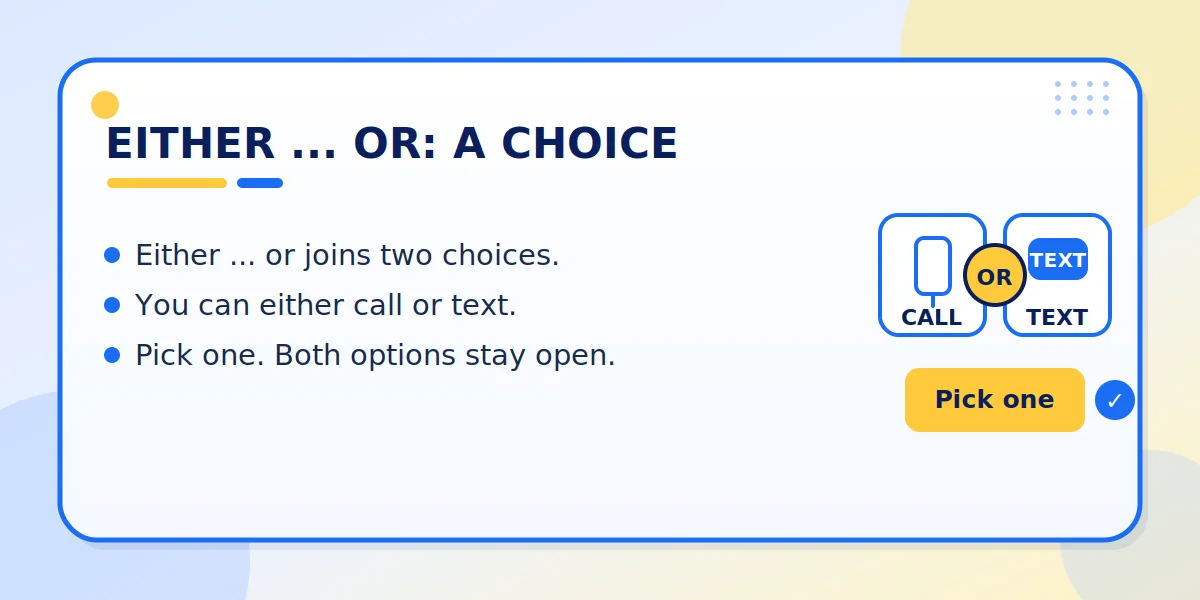
Either…or is a correlative conjunction. The either vs neither pair is clearest in these two patterns. It joins two equal parts. The parts must match in form. Nouns pair with nouns. Verbs pair with verbs. Clauses pair with clauses. You can stay either with me or with Janet. Both parts are phrases. Either I drive to the airport or I get a taxi. Both parts are clauses. Keep the parts parallel. Wrong: She planned to collect data by either using an online survey or phone interviews. Right: She planned to collect data by either using an online survey or conducting phone interviews. The fix makes both parts verbs. Parallel form keeps the sentence clear. Placement matters. Put either right before the first choice. He wanted to go to either Hawaii or Europe. Both places are wanted. The choice is between places. She will either spend her bonus on a vacation or pay off her car. The choice is between actions. Either sits before the verb here. Move it and the meaning moves too. Do not use a comma between the pair. Wrong: You can have either a chocolate cake, or a vanilla cake. Right: You can have either a chocolate cake or a vanilla cake. The pair needs no comma. Either also works in questions and conditionals. Either you apologise, or I will never speak to you again. The sentence gives a clear choice. The tone is firm. Either can open a question too. Either we leave now or we miss the train. Both options stay open.
How to Use Neither…Nor
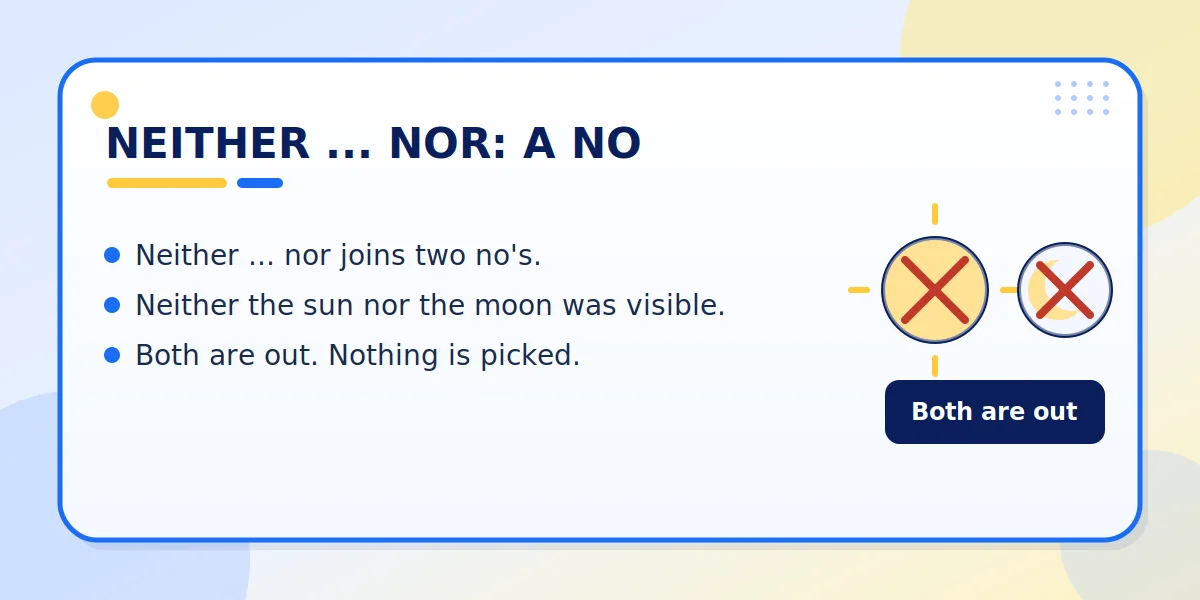
Neither…nor is also a correlative conjunction. It joins two negative parts. Use an affirmative verb. Do not add not. Neither the manager nor the team was available. Was is positive. The negative lives in neither and nor. Adding not would double the negative. Neither…nor is formal. It sounds neat in writing. In everyday speech, use not…either. I do not like tea or coffee. That sentence says the same thing in a simpler way. Italy did not get to the quarter finals last year and France did not either. That version is natural and clear. Keep the parts parallel here too. Neither Brian nor his wife mentioned anything about moving house. Both parts are nouns. Neither Italy nor France got to the quarter finals last year. Both parts are country names. Parallel form keeps the sentence smooth. Neither…nor can join more than two parts. Neither the sun nor the moon nor the stars was visible. The rule stays the same. Each part takes nor. The verb stays affirmative.
Either and Neither as Four Parts of Speech
The either vs neither pair shares four jobs. Both words can work as a conjunction, a pronoun, a determiner, and an adverb. Learn the four jobs and you can use both words anywhere.
Conjunction
Either…or joins choices. Neither…nor joins rejections. You can either call or text. Neither the cat nor the dog came inside. The conjunction always works in a pair. One word never works alone here.
Pronoun
Either stands for one of two. Neither stands for none of two. Either of the two roads will lead you to the town. Neither of the two answers is correct. The pronoun replaces a noun. It still points to two items.
Determiner
Either book. Neither book. The determiner sits before a singular noun. Either road leads to the town. Neither dress fitted her. The determiner limits the noun. It tells the reader how many items count.
Adverb
Either means also after a negative. I do not like it either. Neither means also not. Neither did I. The adverb agrees with a negative statement. It adds your voice to the first speaker. The two adverbs look alike. Their word order differs. Either sits at the end. Neither starts the sentence.
Either/Neither Of + Plural Noun
Use of before pronouns and plural nouns with a determiner. Neither of us went to the concert. Neither of the birthday cards was suitable. Either of these approaches will help you. The pattern is fixed. Either of and neither of always take of before a pronoun or a plural noun. The formal rule uses a singular verb. Neither of them is here. Either of them is ready. Both sentences follow the formal rule. Cambridge and Oxford agree on this point. Singular is the safe choice in writing. Informal speech often uses a plural verb. Neither of them are here. You will hear this form often. Cambridge and Oxford allow both forms. Singular is formal. Plural is informal. Choose singular in an exam or a formal letter. Choose plural only in casual talk if it sounds natural to you. Neither of which and either of which work the same way. They use a relative pronoun. They produced two reports, neither of which contained any useful suggestions. Either of which would suit me. The pattern adds polish to a sentence. It fits well in formal writing.
Verb Agreement and the Proximity Rule
The either vs neither pair follows one clear verb rule in formal use. Either and neither take a singular verb when they stand alone as the subject. Either is correct. Neither is ready. Purdue OWL lists both words as singular. That rule is simple.
Either/Neither as Subjects Are Singular
Either is correct. Neither was selected. Neither candidate was selected for the job. Each sentence uses a singular verb. The subject is one thing or zero things. A singular verb matches that sense.
The Proximity Rule
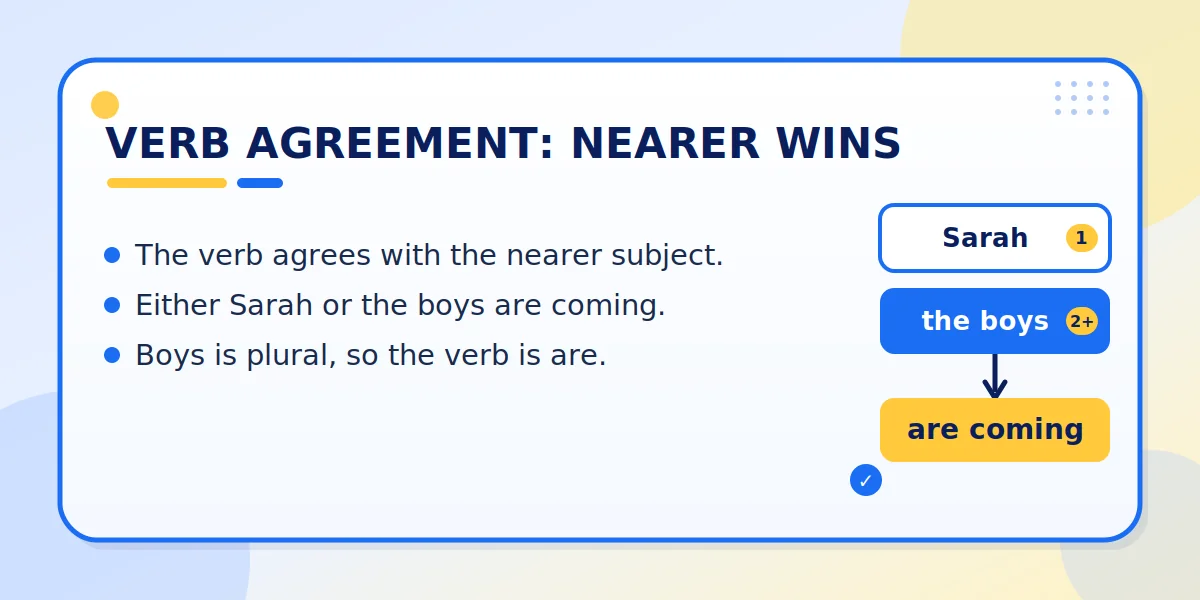
Mixed subjects follow a different rule. The verb agrees with the nearer subject. Either Sarah or the boys are coming. Boys is plural and near the verb. Are is plural. Neither the boys nor Sarah is coming. Sarah is singular and near the verb. Is is singular. Flip the order and the verb flips too. Either the boys or Sarah is coming. Neither Sarah nor the boys are coming. The nearest noun controls the verb. That is the proximity rule. It applies to both either…or and neither…nor. Oxford adds one note. With two singular nouns, either…or and neither…nor can take a singular or a plural verb. A plural verb is more informal. Neither the man nor his dog was injured. Either a passport or a driving licence is required. Both examples use singular verbs. That is the formal choice.
How to Agree With a Negative
English has three ways to agree with a negative statement. Each way fits a different tone. Learn all three and pick the one that fits the moment. I don’t either keeps normal word order. I do not like tea. I do not like it either. The word either sits at the end. Nothing moves. This form is the most common in everyday speech. Neither do I uses inversion. It is more formal. I do not like tea. Neither do I. Neither comes first. The verb follows. Then comes the subject. Nor do I works the same way. Both forms sound polished. Use them in writing and formal talk. Me neither is informal. I cannot smell anything. Me neither. It is common in speech. It is short and friendly. Do not use it in formal writing. Use Neither do I or I do not either instead. LanguageTool adds one useful note. After I do not, me either is the safer casual choice. Me neither after a negative creates a double negative. I do not like pineapples on my pizza. Me neither. The two negatives clash. Me either avoids that clash. Most speakers still say me neither. Both forms appear in casual talk. In formal writing, use neither do I. Inversion also works after a negative clause. He had not done any homework, neither had he brought any of his books to class. We did not get to see the castle, nor did we see the cathedral. Neither and nor open the second clause. The verb follows. Then comes the subject. Nor can stand alone too. I do not speak French. Nor do I know Greek. Nor means and not here. It continues a negative thought. It adds a second negative idea without repeating not.
Neither vs None
Neither is for two only. None is for three or more or uncountable nouns. The either vs neither pair is not the same as neither vs none. Neither of the two books is mine. None of the books are mine. The first sentence covers two books. The second covers a larger set. Use neither, not none, for two people or things. Neither of them should replace the other. None of them should replace the other is wrong for two people. Save none for three or more. None of the three colours matched. None of the milk was left. Merriam-Webster adds a nuance. Neither for more than two has been common for several hundred years. Some writers still use it that way. Standard teaching stays simple. Use neither for two. Use none for three or more. That rule keeps your writing safe in exams and formal work. Both and none follow the same two versus many pattern. Both is for two. All is for more than two. Either is for two. Any is for more than two. Neither is for two. None is for more than two. Learn the pattern once and it covers the whole set.
Either/Neither vs Both and the Any/None/All Map
Either/Neither vs Both
Both means two together. It takes a plural verb. Both are ready. Both of the cars are new. Either and neither take a singular verb. Either is ready. Neither is ready. Both includes two items. Either picks one. Neither picks zero. Do not use either when you mean both. Either of them are correct is wrong for the both sense. Both of them are correct is right. Either points to one item. Both points to two items together.
The Any/None/All Map
Two items use both, either, and neither. More than two items use all, any, and none. The map is simple.
| Two items | More than two |
|---|---|
| Both | All |
| Either | Any |
| Neither | None |
Both of the cars are new. All of the cars are new. Either of the two roads will work. Any of the roads will work. Neither of the two books is mine. None of the books are mine. The map helps you pick the right word fast. Count the items first. Then pick the row.
Formal vs Informal: Which Form Should You Use?
The either vs neither choice also changes with tone. The same idea has three forms. Pick the form that fits the setting.
| Register | Form | Example |
|---|---|---|
| Formal | Neither…nor | Neither the manager nor the team was available. |
| Everyday | Not…either | I do not like tea or coffee. |
| Casual | Me neither | I cannot smell anything. Me neither. |
Neither…nor is formal. Use it in essays, reports, and formal letters. Not…either is everyday. Use it in normal speech and plain writing. Me neither is casual. Use it only in relaxed talk with friends. Neither of plus a plural verb follows the same split. Singular is formal. Plural is informal. Neither of my best friends was around. That is formal. Neither of them were interested. That is informal speech. Choose the verb that fits the setting. Is neither always more formal than not either? In general, yes. Neither…nor sounds more formal than not…either. Both forms are correct. Tone is the only real difference.
How Do You Pronounce Either and Neither?
US speakers say ee-ther and nee-ther. UK speakers often say i-ther and ni-ther. The either vs neither pair sounds simple once you hear both forms. Both pronunciations are correct in both places. No version is wrong. Pick the one that sounds natural where you live. Writing Explained notes one point. In US English, i-ther can sound pretentious to some listeners. Ee-ther is the common US form. The same applies to ni-ther. Nee-ther is the common US form. The difference is small. No listener will mark you wrong for either form. Etymology adds a nice detail. Either comes from Old English aeghwaether. It means both or each. Neither comes from Old English nahwaether. Na means not. Hwaether means which of two. Neither is literally not either. The history matches the meaning. Spelling trap: write neither, not niether or neighter. The letters i and e swap easily. Remember the word starts with n. Then comes ei. Then ther. Neither. Say it slowly while you write it.
Common Mistakes With Either and Neither
Most either vs neither errors fall into six groups. Learn them once and you will avoid them all.
1. Neither + Or
Wrong: Neither tea or coffee. Right: Neither tea nor coffee. Neither always pairs with nor. Or belongs to either. Keep the pairs locked.
2. Neither + Not (Double Negative)
Wrong: Neither of them is not here. Right: Neither of them is here. Neither already carries the negative. Adding not doubles it. Use either with not instead. I do not like either of them. That sentence is correct.
3. Either/Neither With More Than Two
Wrong: Neither of the three colours matched. Right: None of the three colours matched. Either and neither cover two items only. Use any and none for three or more. This error shows up in tests often.
4. Wrong Verb Agreement
Wrong: Neither of the boys are going, in formal writing. Right: Neither of the boys is going. Formal use takes a singular verb. Plural is common in speech. In an exam, use singular. With mixed subjects, use the proximity rule. Either Sarah or the boys are coming. The nearest noun controls the verb.
5. Wrong Placement of Either
Wrong: He either wanted to go to Hawaii or Europe. Right: He wanted to go to either Hawaii or Europe. Either must sit before the first choice. Both places are wanted here. The choice is between places. Put either before the verb only when the actions differ. She will either spend her bonus on a vacation or pay off her car.
6. Me Neither in Formal Writing
Wrong in a formal letter: I cannot attend. Me neither. Right: I cannot attend. Neither can I. Me neither is casual speech. Formal writing needs neither do I or I cannot either. Keep the casual form for casual talk.
Memory Trick: How to Remember Either vs Neither
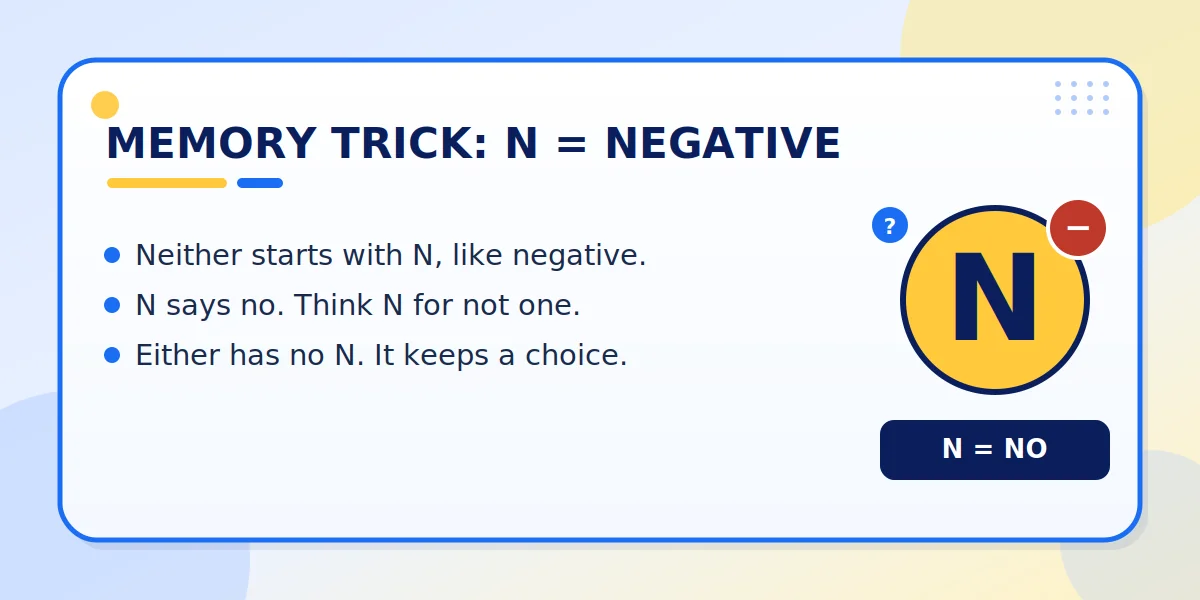
The either vs neither trick takes five seconds. N means negative. Neither starts with N. Neither means none. Either has no N. Either means one. Choice or cross out. Either opens one door. Neither crosses out both doors. Say it once: either is one, neither is none. One starts with o. None starts with n. Neither starts with n too. The letters line up. Either equals one. Neither equals none. That is the whole trick. Picture two boxes. Either ticks one box. Neither ticks no box. The picture stays in your mind. Use it whenever you pause over the two words.
Practice Questions: Either vs Neither
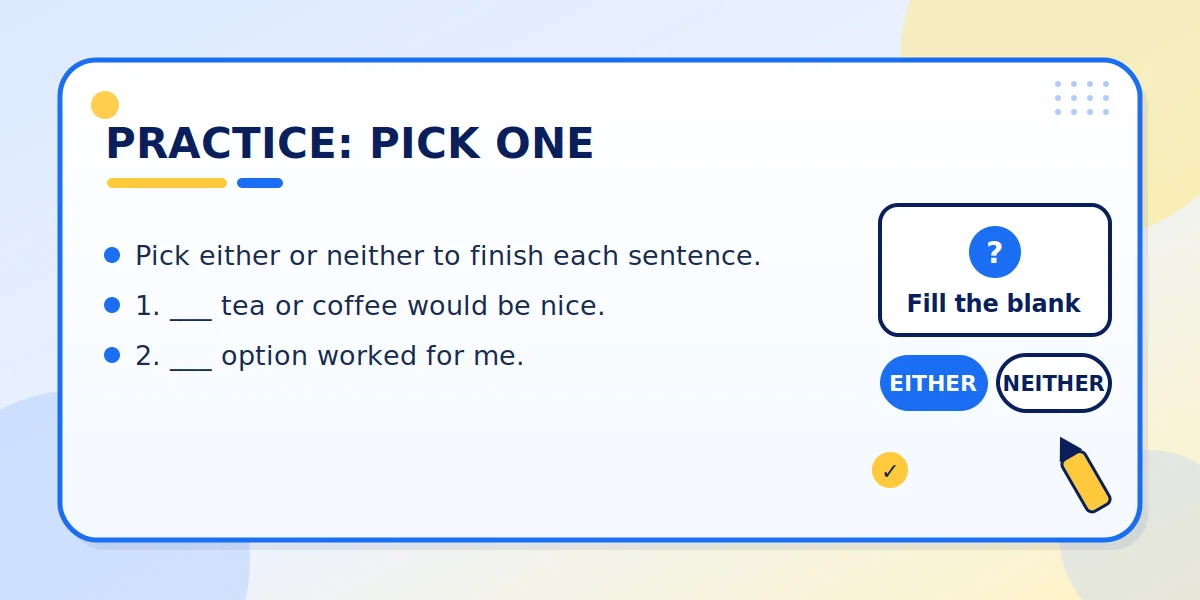
Fill each blank with either or neither. Choose the word that fits the sentence.
- You can take ___ the bus or the train.
- ___ of the two answers is correct.
- ___ Sarah or the boys are coming.
- ___ the boys nor Sarah is coming.
- I do not like tea. ___ do I.
- ___ of them is here.
- ___ the manager nor the team was available.
- I do not like it ___.
- ___ of the two books is mine.
- You can choose ___ option.
Answer Key
1. either 2. Neither 3. Either 4. Neither 5. Neither 6. Neither 7. Neither 8. either 9. Neither 10. either
Check your score. Ten out of ten means the rules are clear. Below seven means you should reread the agreement and negative sections. The proximity rule and the me neither rule cause most errors.
Frequently Asked Questions About Either vs Neither
What is the difference between either and neither?
Either means one of two options. Neither means not one and not the other. Either is positive and pairs with or. Neither is negative and pairs with nor. Use either for a choice. Use neither to reject both options.
How do I use either…or and neither…nor correctly?
Use either…or to offer a choice between two equal parts. Use neither…nor to reject two parts at once. Keep both parts parallel in form. Place either or neither before the first part. Use an affirmative verb with neither…nor always.
What is the verb agreement rule for either and neither?
Either and neither take a singular verb as the subject in formal English. With mixed subjects joined by or or nor, the verb agrees with the nearer subject. Either of and neither of take a singular verb in formal use.
Can I say “I don’t like it either” and “Neither do I”?
Yes, both forms are correct and they mean the same thing here. I don’t like it either keeps normal word order and sounds everyday. Neither do I uses inversion and sounds more formal in writing.
Is “me neither” grammatically correct?
Me neither is informal but very common in everyday speech. In formal writing, use Neither do I or I don’t either instead. Save me neither for relaxed talk with friends and family.
Is it “neither of them is” or “neither of them are”?
Formal English uses “neither of them is” because neither takes a singular verb. Informal speech often uses “neither of them are” instead. Both Cambridge and Oxford note this plural form in their grammar notes.
What is the difference between neither and none?
Neither refers to two people or things only. None refers to three or more people or things, or to an uncountable noun. Use neither of the two books for two books. Use none of the books for a larger set.
Final Takeaway
The either vs neither rule is short. Either means one of two. Neither means none of two. Either pairs with or. Neither pairs with nor. Use singular verbs in formal writing. Use the proximity rule for mixed subjects. Use not…either in everyday speech. Use neither do I in formal writing. Keep the pairs locked and the verbs close to their subjects. The rest is practice.