Now or Later: Meaning, Difference, and Examples
Quick Answer
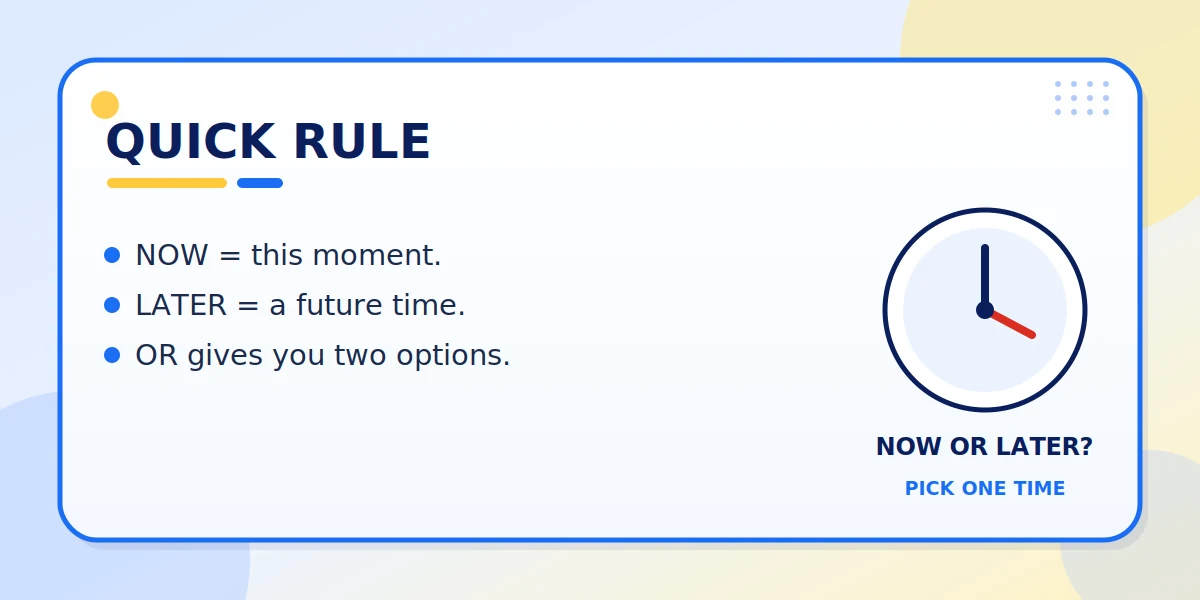
Now or later usually means at the present time or at a future time. It gives someone a choice between doing something now and waiting until later.
For example:
Would you like to discuss the project now or later?
The speaker is asking the other person to choose a time.
The phrase also has a dated meaning: "eventually but not immediately." This meaning is close to sooner or later, but it is less common in everyday conversation.
Remember the difference:
- Now or later usually presents a choice.
- Sooner or later means something will happen at an uncertain future time.
- Now or never means there may not be another chance.
Table of Contents
- What Does Now or Later Mean?
- Understanding Now, Or, and Later
- How to Use Now or Later in a Sentence
- Now or Later Examples
- Now or Later vs. Sooner or Later
- Now or Later vs. Now or Never
- Now or Later vs. Now and Then vs. Now and Later
- Common Mistakes to Avoid
- Synonyms and Alternatives
- An Easy Memory Trick
- Practice Questions
- Now and Later Candy and Songs
- Frequently Asked Questions
What Does Now or Later Mean?
The phrase now or later usually describes two possible times for an action. One option is the present. The other is a future time.
For example:
You can finish your homework now or later.
This sentence gives someone two choices. They can finish the homework immediately or wait.
The phrase does not usually tell us exactly when the later action will happen. The person may choose an hour from now, tomorrow, or another suitable time. The surrounding conversation provides more details.
1. The Everyday Meaning: A Choice Between Two Times
The most useful meaning is a choice between doing something at the present time and doing it in the future.
People use this expression when discussing plans, tasks, appointments, and everyday decisions.
Consider these examples:
- Should we order dinner now or later?
- You can call me now or later.
- Would you like to start the lesson now or later?
- I can help you with the report now or later.
Each sentence presents two possible times. The speaker does not necessarily prefer one option.
The phrase can also make an offer sound flexible. It lets the other person decide when they need help.
For example:
I have some free time. We can review your application now or later.
The speaker is available at either time. The listener can choose what works best.
2. The Dated Meaning: Eventually, but Not Immediately
There is also a less common, dated meaning. Reverso records the expression as meaning "eventually but not immediately."
This meaning is close to sooner or later. It describes something expected to happen at an uncertain future time.
For example:
- The truth will come out now or later.
- You will have to make a decision now or later.
In these examples, the speaker suggests that an event will happen eventually. The exact time is uncertain.
This sense needs a little care. The dated label applies to this recorded meaning. It does not mean that every modern use of the phrase is dated.
In everyday English, people still use it naturally to offer a choice between the present and a future time.
Is Now or Later an Idiom?
It is better to describe the expression as a common phrase or time expression. It combines three familiar words to present two possible times.
No standalone entry for "now or later" was found in Merriam-Webster, Cambridge, or Oxford Learner's in our research.
By contrast, sooner or later is an established idiom. Longman describes it as something certain to happen at some time in the future, though you cannot be sure exactly when.
This distinction helps you choose the right expression. Use the first phrase for a choice. Use the second when you mean something will eventually happen.
Understanding Now, Or, and Later
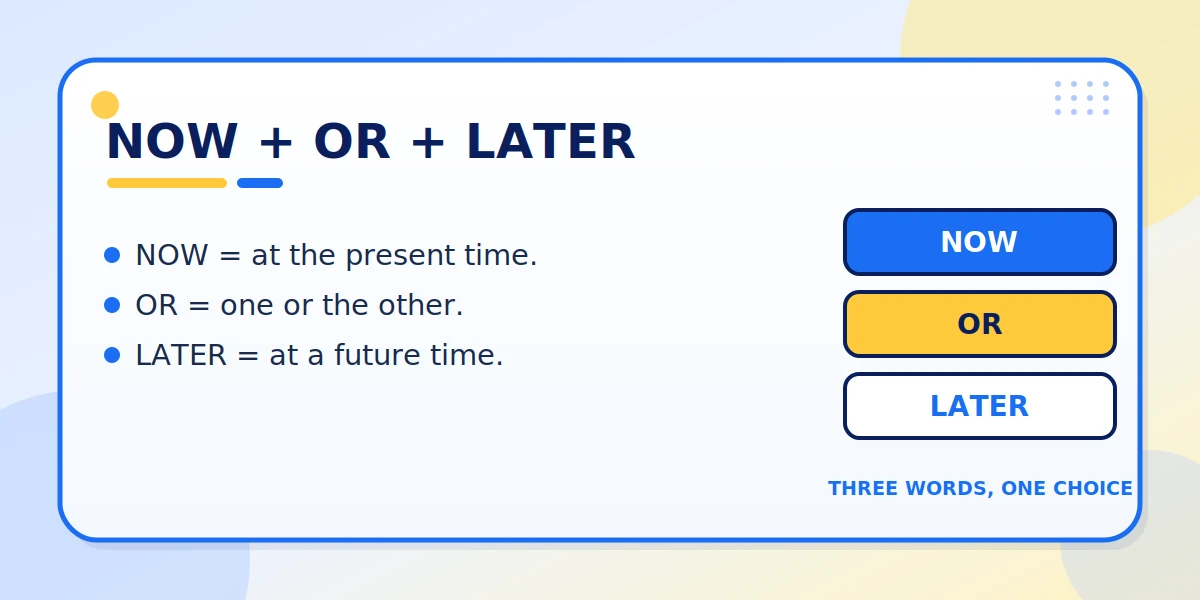
You can understand the full expression by looking at each word. All three words have clear jobs.
What Does Now Mean?
Now means at the present time or moment. It can also mean immediately, depending on the sentence.
It is an adverb of time.
Examples:
- I need your answer now.
- We are ready now.
- She wants to leave now.
Merriam-Webster defines now as "at the present time or moment." Cambridge also gives the present time as a central meaning.
In "now or later," now represents the first possible time.
What Does Or Mean?
Or is a coordinating conjunction. It connects alternatives and presents a choice between them.
Examples:
- Would you like tea or coffee?
- Should we walk or drive?
- Can you meet today or tomorrow?
In "now or later," or connects two time options.
It tells the reader that the action can happen at one time or the other. The speaker is not necessarily asking for both.
What Does Later Mean?
Later means at a time after the present or after another time being discussed.
It is an adverb of time.
Examples:
- I will finish the book later.
- We can discuss the details later.
- She arrived later than expected.
Merriam-Webster defines later as a time subsequent to a given time. Oxford Learner's Dictionaries also explains its use for a future time.
In "now or later," later represents the second possible time.
What Does the Whole Phrase Mean?
Put the three words together:
| Word | Meaning | Function |
|---|---|---|
| Now | At the present time | Gives the first time option |
| Or | One alternative or another | Connects the options |
| Later | At a future time | Gives the second time option |
The whole phrase functions as a time expression. It can tell readers when an action may happen.
For example:
We can discuss the schedule now or later.
The phrase explains when the discussion can take place. It does not change the main action, which is discussing the schedule.
How to Use Now or Later in a Sentence
You can use the expression in questions, offers, and statements. It works in casual conversation and many everyday workplace situations.
Use It in Questions
Questions often use the phrase to ask someone to choose a time.
Examples:
- Do you want to leave now or later?
- Should I send the email now or later?
- Would you like your appointment now or later?
- Are we meeting now or later?
- Can we talk about this now or later?
These questions are direct and easy to understand.
They are useful when the speaker has some flexibility. The listener can select the time that suits them.
Use It When Making an Offer
The expression can also make an offer sound flexible. It shows that help or another action is available at different times.
Examples:
- I can help you now or later.
- Would you like me to explain the lesson now or later?
- We can order lunch now or later.
- I can check your answers now or later.
This pattern works well in friendly conversations. It can also suit polite workplace communication.
Use It in Statements
Statements can describe a plan, decision, or possible action.
Examples:
- You can complete the form now or later.
- We can review the report now or later.
- The manager can speak with you now or later.
- I will answer your questions now or later.
The expression does not always mean the speaker has made a final decision. It can leave the timing open.
Use It After Either
You can add either to emphasize the two available options.
The common pattern is:
Either + first option + or + second option
Examples:
- You can either pay now or later.
- We can either leave now or later.
- She can either call now or later.
The word either is optional in many sentences. The meaning remains clear without it.
Where Does It Go in a Sentence?
The expression often appears near the end of a sentence. However, its position can change with the sentence structure.
| Position | Example |
|---|---|
| At the end | We can discuss it now or later. |
| After the main verb | You can submit the form now or later. |
| In a question | Should we start now or later? |
| After either | You can either call now or later. |
End position is common and natural. It keeps the timing information close to the end of the sentence.
You can also place the time options near the verb. The best position depends on what sounds clear and natural.
Now or Later Examples
Examples from everyday situations can help you understand the expression. The following sentences show how people use it in different settings.
Everyday Life Examples
- Do you want to go shopping now or later?
- I can clean the kitchen now or later.
- We can watch the movie now or later.
- Would you like to eat now or later?
- You can take a walk now or later.
- Should we visit Grandma now or later?
- I can pick up the groceries now or later.
In each example, the speaker offers two possible times. The listener can choose based on their plans.
Work and School Examples
- I can review your assignment now or later.
- Would you like to discuss the project now or later?
- You can submit your application now or later.
- The manager can speak with you now or later.
- We can prepare for the meeting now or later.
- I can explain the instructions now or later.
- Should we check the final report now or later?
The expression can make workplace communication sound less demanding. It gives the other person some control over the timing.
However, context matters. If a deadline is close, waiting may not be a good option. You can add a specific time to avoid confusion.
For example:
You can send me the report now or by 3 p.m.
Shopping, Payments, and Decisions
People often use this expression when discussing purchases and plans.
- Should I buy the laptop now or later?
- You can place your order now or later.
- Do you want to pay now or later?
- We can book the tickets now or later.
- I am not sure whether to make the purchase now or later.
- Would you like to choose your seats now or later?
These examples describe a choice about timing. They do not promise that prices, availability, or other conditions will stay the same.
Now or Later in Text Messages
The phrase has the same ordinary meaning in texting as it does in spoken English. It is not a special texting abbreviation.
People use it to ask about plans or offer a flexible time.
Examples:
- Want to talk now or later?
- I can call you now or later.
- We can finish this later if you're busy now.
- Do you want the details now or later?
- Should I send the pictures now or later?
Short messages often leave out words such as would or do. That does not change the basic meaning.
The surrounding conversation helps explain the sender's intention. They may be offering a choice, arranging a call, or deciding when to share something.
Now or Later vs. Sooner or Later
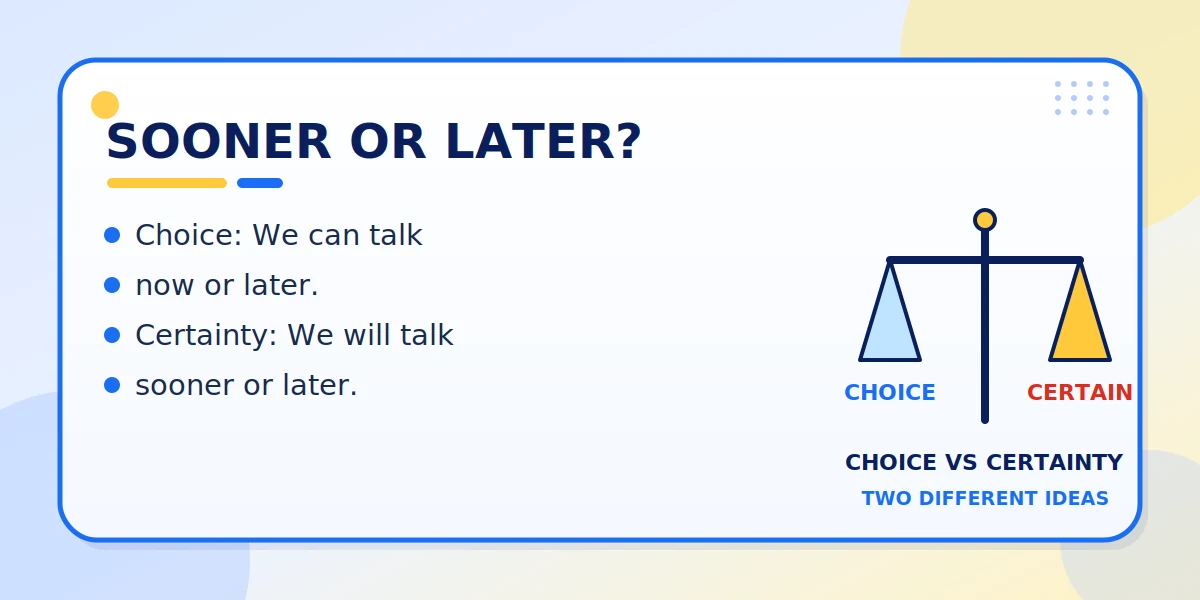
These expressions look similar, but they do not usually mean the same thing.
Now or later usually offers a choice between the present and a future time. Sooner or later means something will happen at an uncertain time in the future.
| Point | Now or later | Sooner or later |
|---|---|---|
| Main meaning | At the present time or a future time | At some uncertain future time |
| Main purpose | Presents a choice | Describes an expected future event |
| Exact timing | Now is one available option | The exact time is unknown |
| Common use | Questions, offers, and plans | Predictions and statements about the future |
| Example | We can talk now or later. | We will have to talk sooner or later. |
When Should You Use Now or Later?
Use it when someone can choose between acting now and waiting.
Examples:
- You can complete the task now or later.
- Should we make the reservation now or later?
- I can explain the problem now or later.
The speaker is discussing two possible times. The action may happen immediately or at another time.
When Should You Use Sooner or Later?
Use sooner or later when you mean something will eventually happen.
Examples:
- Sooner or later, everyone makes mistakes.
- You will need to make a decision sooner or later.
- The truth usually comes out sooner or later.
Longman describes this idiom as something certain to happen at some time in the future, though you cannot be sure exactly when.
Merriam-Webster records 1577 as the first known use of sooner or later. That date belongs to this expression, not to now or later.
For more examples of expressions that present alternatives, see our guide to yes or no: https://clarifywords.com/yes-or-no/
Now or Later vs. Now or Never
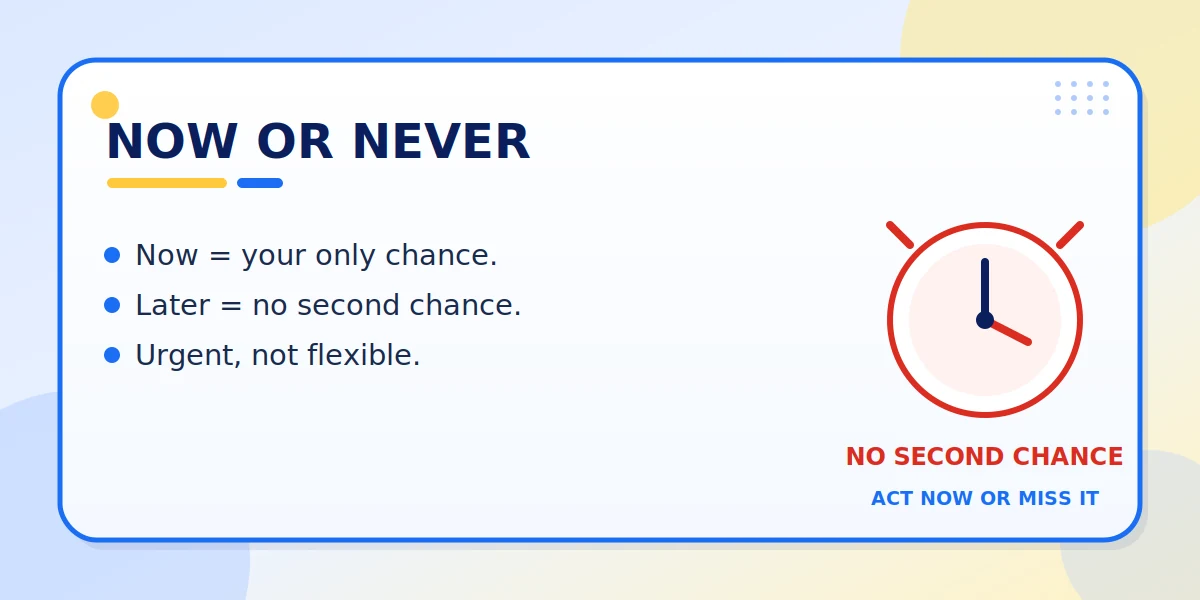
These expressions differ in urgency.
Now or later allows someone to wait. Now or never suggests that the present may be the only chance to act.
| Point | Now or later | Now or never |
|---|---|---|
| Main meaning | Now or at a future time | Now is the only chance |
| Choice | Allows a later option | Suggests there may be no second chance |
| Tone | Usually neutral or flexible | Urgent and forceful |
| Example | You can apply now or later. | Apply now or never get this opportunity again. |
Use Now or Later for a Flexible Choice
Examples:
- We can make the decision now or later.
- You can start the course now or later.
- I can speak with you now or later.
These sentences do not suggest that waiting will remove the opportunity.
Use Now or Never for Urgency
Examples:
- If you want to enter the competition, it's now or never.
- This may be your last chance. It's now or never.
- We must act now or never solve this problem.
Cambridge explains it's now or never as a situation that requires immediate action, especially when there may be no other chance.
Do not use it when you simply want to offer someone more time.
You can also explore the related expression all or nothing, which presents a different kind of choice: https://clarifywords.com/all-or-nothing/
Now or Later vs. Now and Then vs. Now and Later
These phrases may look similar, but their conjunctions change their meanings.
| Phrase | Meaning | Example |
|---|---|---|
| Now or later | At the present time or a future time | We can talk now or later. |
| Now and then | Sometimes or occasionally | I visit my old school now and then. |
| Now and later | Both at the present time and at a future time | We need support now and later. |
What Does Now and Then Mean?
Now and then means sometimes, but not very often. It describes something that happens occasionally.
Examples:
- I go to the beach now and then.
- We still meet for lunch now and then.
- She listens to that old song now and then.
Now and then is a common expression meaning occasionally, or sometimes but not very often.
It does not offer a choice between two times. Instead, it describes how often something happens.
What Does Now and Later Mean?
Now and later uses and to include both time periods.
Examples:
- We need to plan for now and later.
- The new policy will affect employees now and later.
- I need your support now and later.
The phrase does not offer the same either-or choice. It includes both the present and a future time.
Why Do Or and And Change the Meaning?
The difference comes from the conjunctions.
Or presents alternatives.
And joins things or ideas together.
Compare these sentences:
You can pay now or later.
This sentence gives the customer two payment options.
We need to prepare for now and later.
This sentence includes both time periods.
For another guide to choosing between two alternatives, read true or false: https://clarifywords.com/true-or-false/
Common Mistakes to Avoid
The following mistakes can make your meaning unclear. Understanding them will help you choose the right expression.
Mistake 1: Using Now or Later When You Mean Sooner or Later
These phrases serve different purposes.
Less suitable for an eventual event:
I will finish the project now or later.
Clearer when you mean the project will eventually be finished:
I will finish the project sooner or later.
The first sentence can sound like a choice about timing. The second focuses on an expected future result.
Mistake 2: Confusing Now or Later With Now or Never
These expressions do not communicate the same level of urgency.
Use now or later when waiting is possible.
You can register now or later.
Use now or never when the opportunity may disappear.
Register today. It's now or never.
Mistake 3: Writing Now and Later When You Mean Now or Later
Changing or to and changes the meaning.
Compare:
You can pay now or later. This gives two choices.
We need support now and later. This includes both times.
Check the intended meaning before choosing the conjunction.
Mistake 4: Treating It as a Texting Abbreviation
The phrase is not an abbreviation or internet slang term. It keeps its ordinary meaning in messages.
For example:
Can we talk now or later?
The sender is asking about a suitable time. There is no hidden texting meaning.
Mistake 5: Assuming Later Gives an Exact Time
Later does not identify a specific hour or date by itself.
For example:
I will call you later.
This tells the listener that the call will happen in the future. It does not say when.
If timing matters, add more information:
I will call you later, around 6 p.m.
Mistake 6: Calling Every Use Dated
The dated label belongs to the recorded "eventually but not immediately" sense.
The everyday choice meaning remains natural in modern English.
For example:
Would you like to start now or later?
This is a normal question about timing. It should not be treated as an outdated expression.
Synonyms and Alternatives
The best alternative depends on what you want to say. Some expressions offer a choice. Others describe an event expected in the future.
Alternatives for Offering a Choice
| Alternative | Meaning | Example |
|---|---|---|
| Right now or at another time | Immediately or in the future | We can meet right now or at another time. |
| Today or another day | Today or on a different date | You can submit the form today or another day. |
| Now or at a later time | Present time or future time | We can discuss the issue now or at a later time. |
| Immediately or afterward | Without delay or after something else | You can pay immediately or afterward. |
| At present or sometime later | Currently or at an uncertain future time | We can review the plan at present or sometime later. |
These alternatives can make your meaning more specific. Choose one that fits the situation and tone.
Alternatives for the Eventually Meaning
If you mean that something will happen at an uncertain future time, consider these expressions:
| Alternative | Meaning | Example |
|---|---|---|
| Sooner or later | At some unknown future time | Sooner or later, she will understand. |
| Eventually | At some point in the future | Eventually, the problem will be solved. |
| At some point | At an unspecified time | We will discuss the issue at some point. |
| In time | Before it is too late or after some time | You will understand in time. |
| At some time in the future | At an unspecified future time | We may revisit the idea at some time in the future. |
These expressions do not always preserve the choice between acting now and waiting.
Which Alternative Should You Choose?
Use now or later when someone can choose between two times.
Use sooner or later when you expect something to happen eventually.
Use eventually when you want a short alternative for an uncertain future result.
Use at some point when the exact time does not matter or is unknown.
For more examples of words that express different choices, explore good or bad (https://clarifywords.com/good-or-bad/), hot or cold (https://clarifywords.com/hot-or-cold/), and more or less (https://clarifywords.com/more-or-less/).
An Easy Memory Trick
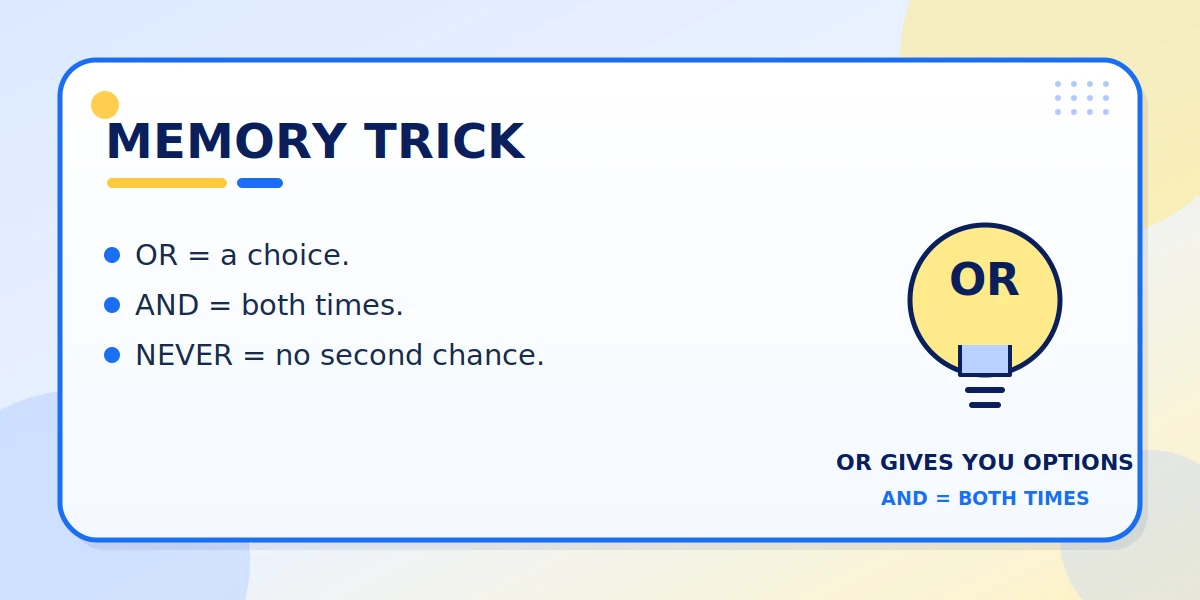
Remember the job of each word:
Now means the present.
Or means a choice.
Later means a future time.
The memory line is simple:
Or gives you options: now OR later.
You can also remember the differences between the similar expressions:
- Now or later: Choose one time.
- Now and later: Include both times.
- Now and then: Something happens occasionally.
- Now or never: There may be no second chance.
- Sooner or later: Something will eventually happen.
Think about the conjunction before choosing the phrase. It often tells you what the sentence means.
Practice Questions
Test your understanding with these 10 questions. Choose the best answer or complete each sentence.
Questions
- Which meaning is most common for "now or later"?
A. A choice between now and a future time
B. A type of food
C. A type of music
D. A special code - What does the word or do in the phrase?
A. It adds two times together
B. It joins two time options and presents a choice
C. It means the same as and
D. It means never - Choose the correct sentence for asking about a meeting time.
A. Do you want to meet now or later?
B. Do you want to meet now or never?
C. Do you want to meet now and never?
D. Do you want to meet now and later or never? - What does sooner or later usually mean?
A. At the present time
B. Something will happen at some uncertain future time
C. The speaker wants an immediate answer
D. The event already happened - Which expression means there may not be another chance?
A. Now or later
B. Now and then
C. Now or never
D. Now and later - What does now and then usually mean?
A. Occasionally or sometimes
B. At the present time or a future time
C. Immediately
D. Never - Which phrase means both the present and a future time?
A. Now or later
B. Now and then
C. Now and later
D. Now or never - Choose the correct sentence for offering help.
A. I can help you now or never.
B. I can help you now or later.
C. I can help you now and never.
D. I can help you sooner or never. - Which expression means something will eventually happen?
A. Now or later
B. Now and then
C. Sooner or later
D. Now or never - Which sentence uses now or later correctly for a choice between two times?
A. We can start the lesson now or later.
B. We can start the lesson now or never.
C. We can start the lesson now and never.
D. We can start the lesson sooner or never.
Answer Key
- A. A choice between now and a future time
Now or later usually presents two possible times. - B. It joins two time options and presents a choice
Or connects alternatives. - A. Do you want to meet now or later?
This sentence asks about two possible meeting times. - B. Something will happen at some uncertain future time
Sooner or later describes an expected future event. - C. Now or never
Now or never suggests the present may be the only chance. - A. Occasionally or sometimes
Now and then means sometimes, but not very often. - C. Now and later
And includes both the present and a future time. - B. I can help you now or later.
The phrase offers help at either time. - C. Sooner or later
Sooner or later means something will happen eventually. - A. We can start the lesson now or later.
The sentence offers two possible times for the lesson.
Now and Later Candy and Songs
The words now and later also appear in popular culture. Two examples are a candy brand and song titles.
Now and Later Candy
Now and Later is a taffy-like candy.
The candy was created in 1962 by the Phoenix Candy Company. Its name suggests eating some now and saving some for later.
The product still uses the now and later idea in its name and packaging.
Songs With Now and Later
Sage the Gemini released a song called Now and Later in 2016. The track appeared on the Billboard Hot 100 and peaked at No. 93.
Chief Keef released a song called Now & Later with Tyga.
These examples use and rather than or. That small word changes the meaning and the tone.
You can also explore our guide to hot or cold for another expression about opposite ideas: https://clarifywords.com/hot-or-cold/
Frequently Asked Questions
What does now or later mean?
It usually means at the present time or at a future time. It gives someone a choice between doing something now or waiting until a later time.
Is now or later the same as sooner or later?
No. Now or later usually presents a choice between two times. Sooner or later means something will happen at an uncertain future time.
What is the difference between now or later and now or never?
Now or later allows someone to wait for a better time. Now or never suggests the present may be the only chance to act.
Is now or later correct grammar?
Yes. The expression combines an adverb, a coordinating conjunction, and another adverb. It follows normal English patterns for offering two alternatives.
Can I use now or later in formal writing?
You can use it in many formal settings, but be specific when timing matters. Replace it with an exact time if the reader needs a deadline.
What is now or later in texting?
It has the same ordinary meaning in text messages. People use it to ask about plans or offer a flexible time to talk, meet, or send information.
Is now or later an idiom?
It is best described as a common phrase or time expression. It combines familiar words to present two possible times, unlike established idioms such as sooner or later.
Now or later is a flexible expression. Use it when you want to offer a choice between acting now and waiting for a future time. Choose the related phrase sooner or later when you mean that something will eventually happen. You can also explore one or two (https://clarifywords.com/one-or-two/), left or right (https://clarifywords.com/left-or-right/), and rain or shine (https://clarifywords.com/rain-or-shine/) for more everyday expressions.