

Exempt vs Non-Exempt: Meaning, Differences, and Examples
Quick Answer: What Is the Difference Between Exempt and Non-Exempt?
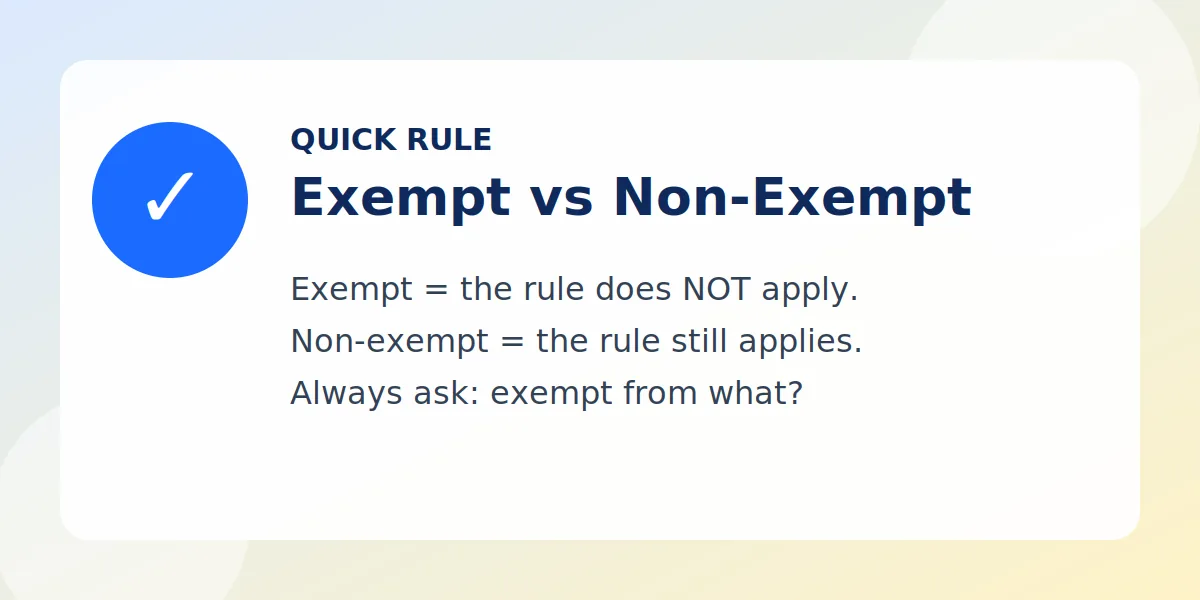
Exempt means someone or something is free from a specific rule, duty, payment, or requirement. Non-exempt means that the rule still applies. At work, the terms usually describe overtime eligibility under the Fair Labor Standards Act (FLSA). Exempt employees generally do not qualify for federal minimum wage and overtime protections under the FLSA exemption that applies to them. Non-exempt employees remain covered by those protections. They generally receive overtime pay after working more than 40 hours in a workweek. A job title or salary alone does not decide a worker’s status. The employee’s pay method, salary level, and actual job duties matter. The key point in exempt vs non-exempt is the rule involved. Someone may be exempt from one requirement but still covered by other laws and obligations.
Table of Contents
- What Does Exempt Mean?
- What Does Non-Exempt Mean?
- Non-Exempt or Nonexempt: Which Spelling Is Correct?
- Is It Exempt From or Exempt Of?
- Exempt vs Non-Exempt Employees Under the FLSA
- The Three Tests for Exempt Employee Status
- Current Federal Salary Thresholds
- What Rules Apply to Exempt and Non-Exempt Employees?
- Exempt vs Non-Exempt Examples
- What Is Employee Misclassification?
- What Does Tax-Exempt Mean?
- Other Uses of Exempt and Non-Exempt
- Common Mistakes to Avoid
- A Simple Memory Trick
- Practice Questions
- Frequently Asked Questions
What Does Exempt Mean?
Exempt means free from a rule, duty, payment, or obligation that applies to others. The word often appears in legal, financial, educational, and workplace contexts. Its exact meaning depends on what someone is exempt from. For example: A tax-exempt organization qualifies for certain tax benefits. An exempt employee meets the requirements for a specific FLSA exemption. A student may be exempt from a school fee. A person may be exempt from jury duty under certain rules. Merriam-Webster and Cambridge define the word around freedom from an obligation or requirement. The same basic meaning applies across these situations. In exempt vs non-exempt terms, the question is always which side of the rule a person or item falls on.
What Does Non-Exempt Mean?
Non-exempt means not free from a particular rule or requirement. The person, organization, or item remains subject to that rule. For example, a non-exempt employee is generally entitled to FLSA minimum wage and overtime protections. A non-exempt asset in bankruptcy is not protected by an applicable exemption. The word does not automatically mean someone is disadvantaged. It simply describes whether a specific exemption applies.
Non-Exempt or Nonexempt: Which Spelling Is Correct?
Both non-exempt and nonexempt are standard spellings. The hyphenated form is common in workplace writing. The closed form also appears in dictionaries and professional materials.
| Spelling | Correct? | Example |
|---|---|---|
| Non-exempt | Yes | She is a non-exempt employee. |
| Nonexempt | Yes | The position is classified as nonexempt. |
| Non exempt | Usually avoid | He has a non exempt position. |
Choose one spelling and use it consistently throughout your writing. If an employer, publication, or style guide has a preference, follow it. Either spelling works in an exempt vs non-exempt discussion, as long as you stay consistent.
Is It Exempt From or Exempt Of?
The correct expression is exempt from. Use from when explaining the rule, payment, duty, or requirement that does not apply. Correct examples: The employee is exempt from overtime pay. The nonprofit is exempt from certain federal taxes. Some students are exempt from the application fee. Incorrect example: The employee is exempt of overtime pay. Remember this simple grammar rule: someone is exempt from something.
Exempt vs Except
These words look similar, but they have different meanings.
| Word | Meaning | Example |
|---|---|---|
| Exempt | Free from a rule or requirement | The worker is exempt from overtime. |
| Except | Not including someone or something | Everyone attended except Mia. |
Use exempt when a rule does not apply. Use except when leaving something or someone out. That distinction also helps in exempt vs non-exempt writing, where the rule itself must stay clear.
Exempt vs Non-Exempt Employees Under the FLSA
In employment, exempt vs non-exempt usually refers to overtime and minimum wage protections. The Fair Labor Standards Act is a federal law. It sets rules for minimum wage, overtime pay, and recordkeeping for covered employees. The federal minimum wage for covered non-exempt workers is $7.25 per hour. Most employees covered by the FLSA qualify for minimum wage and overtime protections. Certain employees may meet an exemption. An exempt employee generally does not receive FLSA overtime pay. A non-exempt employee generally receives overtime after 40 hours in a workweek. The U.S. Department of Labor (DOL) explains that job titles do not determine exemption status. The employee’s actual duties and pay must meet the legal requirements.
Exempt vs Non-Exempt Employee Comparison
| Feature | Exempt employee | Non-exempt employee |
|---|---|---|
| Overtime pay | Generally not required under the applicable FLSA exemption | Generally required after 40 hours in a workweek |
| Minimum wage protection | Exempt from FLSA minimum wage provisions under the exemption | Covered by applicable minimum wage rules |
| Pay method | Usually salary or fee basis, with exceptions | Hourly or salaried |
| Time records | Federal FLSA rules may not require the same hours records | Employer must keep accurate hours records |
| Job duties | Must meet a recognized exemption test | Does not meet an applicable exemption |
| Extra hours | Usually no extra FLSA overtime pay | Generally paid at least 1.5 times the regular rate |
These are general federal rules. Other federal laws and state requirements may also apply. The exempt vs non-exempt table above is a starting point, not a final classification for any one worker.
Does Exempt Mean Salaried?
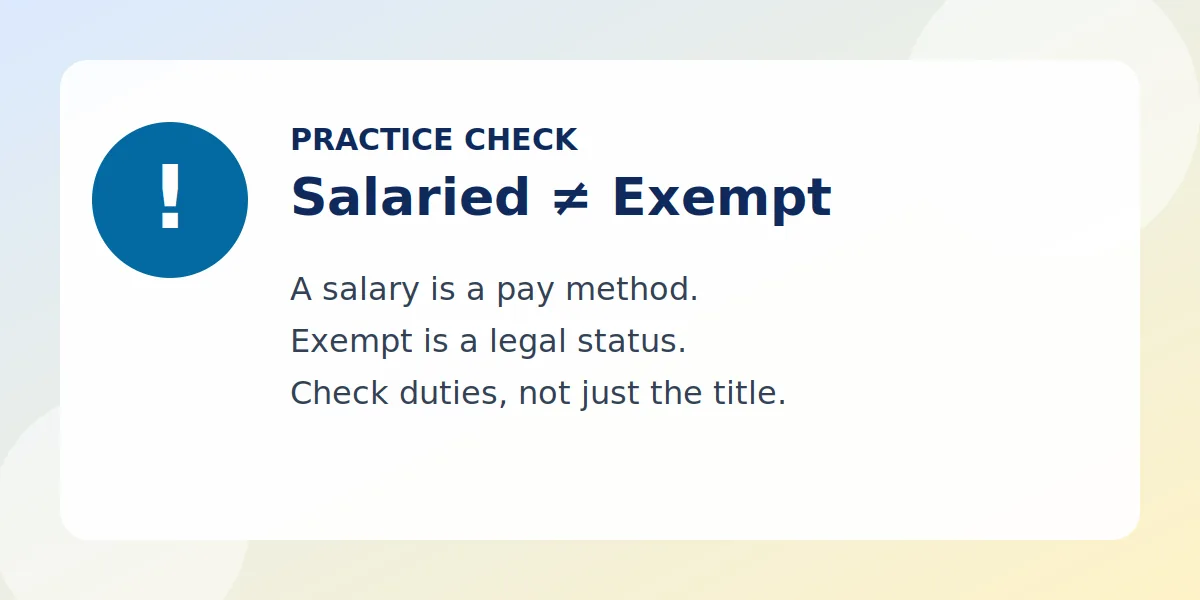
No. Exempt and salaried do not mean the same thing. Many exempt employees receive a salary. However, some non-exempt employees also receive salaries. A salary describes how an employee receives pay. Exempt status describes whether a specific legal exemption applies.
Can a Salaried Employee Be Non-Exempt?
Yes. An employer can pay a non-exempt employee a fixed salary. That employee must still receive the required minimum wage and overtime pay. The employer must track all hours worked and calculate overtime under the applicable rules. For example, a salaried employee may receive a fixed weekly amount. If the employee works more than 40 hours, the employer must calculate any overtime owed. A salary does not remove overtime rights. This is one of the most useful points in the exempt vs non-exempt distinction for workers who are paid a salary.
The Three Tests for Exempt Employee Status

For most executive, administrative, and professional exemptions, an employee must meet three tests. These are the salary basis test, salary level test, and duties test. All applicable requirements must be satisfied.
1. Salary Basis Test
The employee must receive a predetermined salary. The employer generally cannot reduce that salary because of changes in work quality or quantity. For example, an exempt employee who works fewer hours during a week usually receives the full weekly salary if they perform any work that week. Specific deductions are allowed under limited circumstances. These may include certain full-day personal absences or qualifying disciplinary suspensions. The rules contain exceptions. Employers should review the DOL salary basis guidance before making deductions.
2. Salary Level Test
The employee must meet the applicable federal salary threshold. For most standard executive, administrative, and professional exemptions, the current federal threshold is $684 per week. That equals $35,568 per year. Some exemptions have different pay rules. The computer employee exemption, for example, allows a qualifying hourly rate.
3. Duties Test
The employee’s main job duties must meet the requirements of a recognized exemption. A high salary does not automatically make someone exempt. A manager title does not prove exemption either. The employer must look at the work the employee actually performs. In an exempt vs non-exempt review, actual duties carry more weight than a job title.
Common FLSA Exemption Categories
The DOL recognizes several categories under the FLSA regulations.
Executive Employees
An executive employee may qualify if their main duty involves managing a business or a recognized department. The employee must also regularly direct the work of at least two full-time employees or their equivalent. They must have authority over hiring or firing decisions, or their recommendations must carry particular weight.
Administrative Employees
An administrative employee performs office or nonmanual work related to business operations or management. Their primary duty must involve discretion and independent judgment on important matters. Routine clerical work alone does not meet this test.
Learned and Creative Professionals
A learned professional performs work requiring advanced knowledge in a recognized field of science or learning. The knowledge usually comes from specialized academic instruction. Certain licensed professionals may qualify. A creative professional performs work requiring invention, imagination, originality, or talent in a recognized artistic field.
Computer Employees
Certain computer systems analysts, programmers, software engineers, and similarly skilled workers may qualify. Their primary duties must involve specific systems analysis, programming, or related computer work. General computer use and basic technical support do not automatically qualify. A qualifying computer employee may meet the salary requirement or the special hourly rate.
Outside Sales Employees
An outside sales employee may qualify if their main duty involves making sales or obtaining contracts. They must also regularly work away from the employer’s place of business. Inside sales work does not automatically qualify.
Highly Compensated Employees
Some highly compensated employees may qualify under a separate, less demanding duties test. They must perform office or nonmanual work. They must also regularly perform at least one exempt duty from the executive, administrative, or professional categories.
Who Usually Cannot Qualify for These Exemptions?
Many manual laborers and blue-collar workers do not qualify for the standard executive, administrative, or professional exemptions. This includes many construction workers, mechanics, electricians, plumbers, and similar workers. Certain first responders also remain protected by overtime rules. This can include police officers, firefighters, paramedics, and emergency medical technicians. Pay level alone does not change these rules. That limit is a key part of exempt vs non-exempt law for manual and first responder roles.
Are Teachers, Doctors, Lawyers, and Outside Sales Employees Exempt?
Some employees are not subject to the standard salary basis and salary level tests. This includes certain teachers, employees practicing law or medicine, and outside sales employees. However, the relevant duties and occupation requirements still matter. Do not assume every person in one of these fields qualifies for every exemption.
Current Federal Salary Thresholds
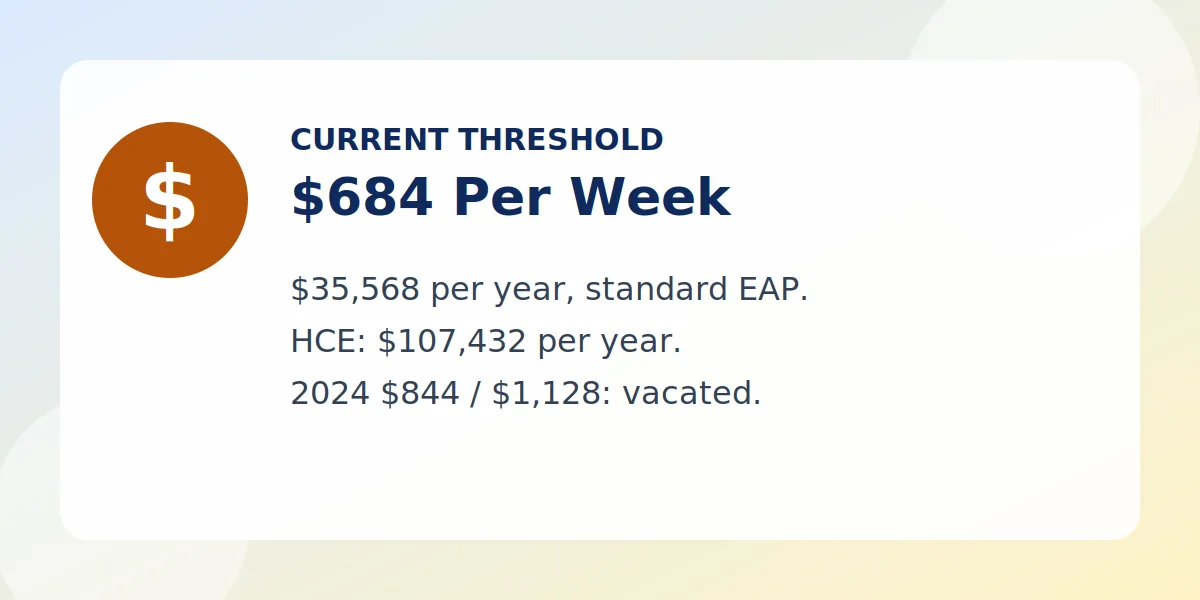
The federal salary figures matter when checking many executive, administrative, and professional exemptions. The current federal standards applied by the DOL are:
| Exemption rule | Current federal amount |
|---|---|
| Standard salary level | $684 per week |
| Annual equivalent | $35,568 per year |
| Highly compensated employee threshold | $107,432 per year |
| Minimum weekly salary component for highly compensated employees | $684 per week |
| Computer employee hourly alternative | $27.63 per hour |
For the highly compensated employee exemption, total annual compensation must include at least $684 per week paid on a salary or fee basis. Certain nondiscretionary bonuses and incentive payments may count toward up to 10% of the standard salary level. Special rules apply.
What Happened to the 2024 Overtime Rule?
The DOL published a final overtime rule in April 2024. It planned to raise the standard salary threshold in stages. The proposed figures included $844 per week, or $43,888 per year, starting July 1, 2024, and $1,128 per week, or $58,656 per year, starting January 1, 2025. On November 15, 2024, a federal district court vacated the 2024 rule in full. The DOL therefore applies the earlier $684 weekly salary level and $107,432 highly compensated employee threshold for enforcement. Do not use the $844 or $1,128 figures as the current federal standard.
Do State Laws Have Different Overtime Rules?
Yes. State laws may provide stronger protections than federal law. A state may set a higher minimum wage, stricter overtime rules, or different exemption requirements. When federal and state laws differ, the rule that gives the employee greater protection may apply. Check your state labor department for the rules that cover your job and location. In exempt vs non-exempt cases, the more protective applicable rule is the one to check first.
What Rules Apply to Exempt and Non-Exempt Employees?
The FLSA treats exempt and non-exempt employees differently in several areas.
Overtime for Non-Exempt Employees
Most covered non-exempt employees must receive overtime pay for hours worked beyond 40 in a workweek. The overtime rate must be at least 1.5 times the employee’s regular rate of pay. For example, an employee earning $20 per hour has an overtime rate of at least $30 per hour. The FLSA uses a fixed workweek of 168 hours. Employers cannot average hours across two weeks to avoid overtime. Working on a weekend or holiday does not automatically create overtime. The total hours worked during the workweek determine eligibility.
Do Exempt Employees Have to Clock In?
The FLSA does not generally require employers to track exempt employees’ hours in the same way as non-exempt employees. However, employers may still ask exempt workers to use timekeeping systems. They may need records for attendance, leave, scheduling, or company policies. Non-exempt employees must have accurate records of hours worked. Employers need those records to calculate minimum wage and overtime correctly.
Can an Employer Refuse to Pay for Unauthorized Overtime?
No. An employer generally must pay non-exempt employees for all hours it knows or has reason to believe they worked. This includes overtime that the employee did not receive permission to work. The employer may enforce its approval policy separately. It cannot withhold earned wages because the employee broke that policy.
Can an Employer Deduct Pay From an Exempt Employee?
Only certain deductions are allowed under federal salary basis rules. An employer generally cannot reduce an exempt employee’s salary because of partial-day absences or changes in work quality. Some full-day deductions may be allowed. Examples include certain personal absences and qualifying disciplinary suspensions. The rules are detailed, so employers should confirm that a deduction is permitted before making it.
What Does the FLSA Not Require?
The FLSA does not generally require employers to provide paid vacation, paid holidays, paid sick leave, meal or rest breaks for adults, or extra pay for weekend or holiday work when overtime is not triggered. Other federal, state, or local laws may create these rights. Employer policies and contracts may also provide them.
Exempt vs Non-Exempt Examples
These examples show how the terms work in everyday situations. Each one turns on the same exempt vs non-exempt question: which rule applies, and does an exemption remove it?
Example 1: A Salaried Department Manager
A department manager earns more than the federal salary threshold. They manage a recognized department and regularly supervise employees. They also have meaningful input into hiring and firing decisions. The employee may qualify for the executive exemption if all applicable requirements are met.
Example 2: A Salaried Customer Service Worker
A customer service worker receives a fixed weekly salary. Their main duties involve answering routine questions and processing requests. The employee does not perform qualifying exempt duties. They may be non-exempt despite receiving a salary. They must receive overtime when required.
Example 3: An Hourly Software Programmer
A software programmer earns $30 per hour. Their work includes qualifying programming duties under the computer employee exemption. They may qualify for the computer employee exemption if they meet all applicable requirements. The hourly rate alone does not establish exempt status.
Example 4: A Construction Worker
A construction worker earns a high hourly wage. Their main duties involve physical labor and building work. They generally remain non-exempt under the standard FLSA exemptions. A high wage does not turn manual labor into exempt professional work.
Example 5: A Salaried Employee Who Works 45 Hours
A salaried employee earns a fixed weekly amount. Their duties do not meet an FLSA exemption. They work 45 hours during one workweek. The employer must calculate overtime under the applicable rules. Being salaried does not remove that requirement.
What Is Employee Misclassification?
Employee misclassification happens when an employer treats a worker as exempt even though the worker does not meet the legal requirements. This can deny an employee overtime pay or minimum wage protections.
Signs an Employee May Be Misclassified
Consider reviewing a classification if:
- Your employer calls you exempt only because you receive a salary.
- Your job title sounds senior, but your duties are routine.
- You do not meet the required salary level.
- Your main work involves manual labor.
- You regularly work overtime without receiving overtime pay.
These signs do not prove a violation. They may indicate that the employer should review the classification.
What Can Employees Do About Possible Misclassification?
Start by reviewing your pay and actual job duties. Keep copies of schedules, time records, pay statements, and job descriptions. Record the hours you work, including overtime. You can contact the U.S. Department of Labor’s Wage and Hour Division for guidance. The agency accepts complaints about unpaid wages and overtime. Workers may also have rights under state law. Consider speaking with an employment attorney if you need advice about your situation.
What Does Tax-Exempt Mean?
In tax matters, exempt means that a person, organization, income source, or transaction qualifies for a specific tax benefit. The term does not mean that every tax disappears. It also does not mean the same thing as an employment exemption. The exempt vs non-exempt question in tax is separate from the employment question, even though the words are the same.
What Is a Tax-Exempt Organization?

A tax-exempt organization qualifies for certain federal tax benefits under the Internal Revenue Code. Many charitable organizations seek recognition under Section 501(c)(3). Other organizations may qualify under different sections. However, nonprofit status does not automatically make an organization tax-exempt. A nonprofit may be incorporated under state law. It must still meet the applicable federal requirements to qualify for federal tax exemption.
What Is the Difference Between 501(c)(3) and 501(c)(4)?
Both categories can include tax-exempt organizations. Their purposes and rules differ.
| Category | Main purpose | Are donations generally tax-deductible? |
|---|---|---|
| 501(c)(3) | Charitable, religious, educational, scientific, and other qualifying purposes | Usually, if the recipient and contribution qualify |
| 501(c)(4) | Social welfare and certain civic or community purposes | Generally not deductible as charitable contributions |
Some exceptions and special rules apply. Check the IRS rules before claiming a deduction.
How Can You Check an Organization’s Tax-Exempt Status?
The IRS provides a tool called the Tax Exempt Organization Search (TEOS). You can use it to check an organization’s federal tax status and related records. The tool may show: Whether the IRS recognizes the organization as tax-exempt. Whether contributions may qualify as charitable deductions. Available annual filings. Automatic revocation information. Certain determination letters. Search for the organization by name or employer identification number. Confirm that the result matches the organization you intend to support.
Does Tax-Exempt Mean an Organization Pays No Taxes?
No. Tax-exempt organizations may still owe certain taxes. For example, an organization may owe unrelated business income tax on income from a regularly conducted trade or business that is not substantially related to its exempt purpose. Generally, an exempt organization must file Form 990-T when it has at least $1,000 in gross income from an unrelated trade or business. An organization may also have payroll tax duties. State and local tax rules may apply to property, sales, or other activities.
Does Tax-Exempt Mean Tax-Deductible?
No. These terms describe different things. Tax-exempt describes an organization or income that qualifies for a tax benefit. Tax-deductible describes a contribution or expense that a taxpayer may subtract under applicable tax rules. Donations to qualifying 501(c)(3) organizations are generally deductible, subject to IRS requirements. Donations to 501(c)(4) organizations are generally not deductible as charitable contributions. Always check the organization and the rules for your specific contribution.
What Is Tax-Exempt Income?
Tax-exempt income is income that federal tax law excludes from taxable income under specific conditions. Examples may include qualifying municipal bond interest, certain life insurance death benefits, gifts and inheritances, workers’ compensation benefits, certain veterans’ benefits, and qualified Roth IRA withdrawals. Not every payment in these categories is automatically tax-free. The details and conditions matter. Wages, tips, bank interest, dividends, rental income, and gambling winnings are generally taxable unless a specific exception applies.
Tax-Exempt vs Tax-Deferred Accounts
Tax-exempt and tax-deferred are not the same. A Roth retirement account uses after-tax contributions. Qualified withdrawals are generally tax-free. A traditional IRA or 401(k) may provide a tax deduction or defer taxes until withdrawal. The money is generally taxed later. A regular taxable brokerage account does not offer the same retirement tax treatment. Dividends, interest, and realized gains may create tax obligations.
| Account type | When taxes generally apply |
|---|---|
| Roth IRA or Roth 401(k) | Contributions use after-tax money; qualified withdrawals are tax-free |
| Traditional IRA or 401(k) | Taxes are generally due on taxable withdrawals |
| Taxable brokerage account | Tax may apply to dividends, interest, and realized gains |
What Does Exempt Mean on Form W-4?
On Form W-4, claiming exempt means asking your employer not to withhold federal income tax from your wages. You generally qualify only if you had no federal income tax liability last year and expect none this year. This is different from being an exempt employee under the FLSA. It also does not remove every payroll tax obligation.
What Is a Nonexempt Trust?
The phrase nonexempt trust can have different meanings in tax law. In generation-skipping transfer tax rules, a nonexempt trust generally refers to a trust without an allocated GST exemption. The trust may face generation-skipping transfer tax when certain transfers occur. A separate use appears in rules for charitable trusts under Section 4947. These trusts are not generally exempt under Section 501(a), though they may have charitable interests and specific tax obligations. The meaning depends on the tax provision. Do not treat these trust terms as interchangeable. This is another place where the exempt vs non-exempt label changes with the rule it refers to.
Other Uses of Exempt and Non-Exempt
The words appear in several areas beyond employment and taxes.
School and Education
A student may be exempt from a fee, exam, or course requirement. For example, a school may exempt a student from an entry test if they meet certain conditions. A non-exempt student must complete the requirement.
Sports
In sports, an exempt player or team may receive direct entry into a later stage of a competition. A sponsor exemption in golf, for example, may allow a player to enter an event without qualifying through the usual route. A non-exempt competitor must follow the standard entry process.
Bankruptcy
Bankruptcy law uses exempt and nonexempt to describe property. Exempt property is protected from being used to pay creditors under applicable exemption rules. Nonexempt property is not protected by those exemptions. It may be available to the bankruptcy estate, depending on the case and applicable law. The rules vary by state and bankruptcy chapter.
Goods, Fees, and Charges
A product, service, or transaction may be exempt from a particular tax or fee. For example, a qualifying purchase may be exempt from sales tax under state law. A non-exempt purchase remains subject to the applicable tax.
Common Mistakes to Avoid
People often confuse these terms because their meanings depend on context. Watch for these mistakes:
- Assuming exempt means tax-free. Exempt employees still pay income tax.
- Assuming every salaried worker is exempt. Salaried employees can be non-exempt.
- Using a job title to decide status. Actual duties and pay requirements matter.
- Thinking nonprofit means tax-exempt. A nonprofit must meet the applicable tax rules.
- Writing “exempt of.” The correct phrase is “exempt from.”
- Treating “non-exempt” and “nonexempt” as different words. Both spellings are correct.
- Using old salary thresholds. The current federal standard salary level is $684 per week.
- Assuming every exempt employee is free from all labor laws. An exemption applies only to specific legal requirements.
A Simple Memory Trick
Use this short reminder: Exempt means excluded from a rule. Non-exempt means not excluded from a rule. Think of an exemption as a pass from one specific requirement. If a worker is exempt from FLSA overtime rules, that does not make them exempt from income tax. Always ask: Exempt from what? That question is the fastest way to settle any exempt vs non-exempt confusion, in employment, tax, or everyday use.
Practice Questions
Test your understanding with these 10 questions.
- What does exempt mean?
- What does non-exempt mean?
- Are both “non-exempt” and “nonexempt” correct?
- Which phrase is correct: “exempt from taxes” or “exempt of taxes”?
- Does receiving a salary automatically make an employee exempt?
- What are the three main tests for many FLSA exemptions?
- What is the current federal standard salary threshold for most executive, administrative, and professional exemptions?
- Do exempt employees still pay income tax?
- Does nonprofit status automatically make an organization federally tax-exempt?
- What does exempt property mean in bankruptcy?
Answer Key
- Free from a specific rule, duty, payment, or requirement.
- Not free from the rule or requirement.
- Yes. Both spellings are standard.
- “Exempt from taxes” is correct.
- No. Salary alone does not determine exempt status.
- Salary basis, salary level, and duties.
- $684 per week, or $35,568 per year.
- Yes. Employment exemption does not remove income tax.
- No. The organization must meet the applicable IRS requirements.
- Property protected from creditors under applicable bankruptcy exemption rules.
Frequently Asked Questions
1. What is the main difference between exempt and non-exempt?
Exempt means a specific rule or requirement does not apply. Non-exempt means it still applies. At work, these terms usually describe whether an employee qualifies for federal minimum wage and overtime protections.
2. Is it better to be exempt or non-exempt?
Neither status is automatically better. Exempt employees may receive predictable salaries, while non-exempt employees generally qualify for overtime pay. The right classification depends on the employee’s actual duties, compensation, and applicable labor laws.
3. Can you be salaried and non-exempt?
Yes. An employer can pay a non-exempt employee a fixed salary. However, the employer must still track hours worked and pay required overtime. Receiving a salary does not remove the employee’s wage protections.
4. What is the current federal salary threshold for exempt employees?
The standard federal salary threshold is $684 per week, or $35,568 per year. Certain exemptions follow different pay rules. Employees must also meet the applicable salary basis and duties requirements.
5. Do exempt employees pay taxes?
Yes. Exempt employees still pay applicable federal, state, and local income taxes. Their employment classification affects specific wage and overtime protections. It does not create a general exemption from income or payroll taxes.
6. Is non-exempt one word or hyphenated?
Both non-exempt and nonexempt are standard spellings. The hyphenated version is common in workplace writing. Choose one form and use it consistently, unless your employer or preferred style guide specifies otherwise.
7. What does exempt from mean?
“Exempt from” means free from a particular rule, duty, payment, or requirement. For example, an employee may be exempt from overtime pay. The phrase “exempt of” is not standard English usage.
Related Guides
Explore more word comparisons and usage guides:
- Affect vs Effect
- Whose vs Who’s
- Its vs It’s
- Loose vs Lose
- Principal vs Principle
- Complement vs Compliment
- Then vs Than
- Anytime vs Any Time
- Capital vs Capitol
- Everyday vs Every Day
- Confused Words
General information disclaimer: This article provides general information, not legal or tax advice. Employment and tax rules depend on the facts and applicable federal, state, and local laws. Check official guidance or consult a qualified professional for advice about your situation.